
Editor's note: This story originally appeared in the fall 2021 issue of ASU Thrive magazine.
At ASU’s J. Orin Edson Entrepreneurship + Innovation Institute’s Demo Day competition this spring, students, staff, faculty and community entrepreneurs pitched short videos about their original products in hopes of being awarded funding. In the Sun Devil Athletics Venture Challenge category, three new biosensor companies won funding and will be beta-tested by Sun Devil athletes. The Global Sport Institute is providing mentorship and $25,000 in grant funding and mentorship elements.
With an emphasis on expanding research, sharing knowledge, supporting innovation and advancing education, the Global Sport Institute’s mission is to use sport to create positive change throughout the world. Learn more at globalsport.asu.edu.
Baseball and football: Embedding circuitry into fabrics yields intelligent sportswear

The velocity of a throw. The direction of a lunge. The force of a stride. Tracking player data with smart threads enables athletes to boost their performance, and it’s why Nextiles won third place and a beta opportunity with Sun Devil baseball and football.
“We’ve tested thousands of athletes, and we’re able to provide important information like range of motion and joint power back to the coaches and back to the elite athletes,” says John Peters, Nextiles chief business officer. Nextiles blends traditional sewing techniques with innovative printed circuit boards, allowing for sensors to be placed within fabrics.
Learn more at nextiles.tech.
Triathlon: Swimming tracker revolutionizes training

Designed by Olympic swimmers, IronMan triathletes and coaches, the Phlex Edge garnered second place plus a beta opportunity for use in the women’s triathlon program. The goggle-worn swimming tracker provides swimmers with a detailed understanding of their training, from real-time heart rate to stroke analysis and full set breakdown.
The Phlex app uses machine learning technology to capture valuable data, empowering swimmers and coaches to customize each athlete’s training plan.
Learn more at phlexswim.com.
Football: Wearables keep athletes at the top of their game
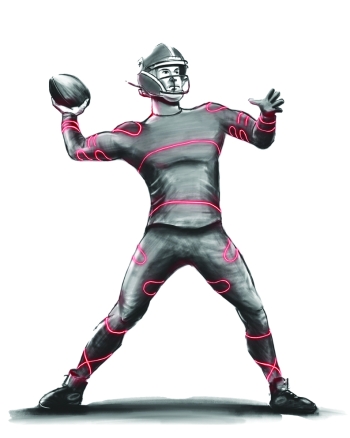
The first-place winner, wearable biosensor company Organic Robotics Corporation, will beta-test its Light Lace sensors with the Sun Devil football and triathlon programs to enhance the safety and performance of athletes. Using photonics instead of electronics, these soft, stretchable sensors track motion, muscle fatigue and respiratory levels to prevent injuries and boost physical performance.
“Light Lace sensors create an artificial skin that allows us to create digital twins of our tactile biometric information,” says Ilayda Samilgil, Organic Robotics co-founder and CEO.
Each sensor is equipped with a light that warns the user of high fatigue levels. Sensors are easy to use and can survive high-speed motions and intense exercise.
Learn more at organicroboticscorp.com.
More Science and technology

It’s complicated: New research reveals more about the social networks of baboons and African monkeys
Like people, nonhuman primates live in groups that vary in their size and shape depending on the species. Some primate groups are small and simple, others are large and more layered.Over the decades…

2 ASU professors elected to prestigious National Academy of Sciences
Two professors from Arizona State University have been elected to the prestigious National Academy of Sciences, one of the highest honors awarded to scientists in the United States.The academy…

12 million images later, Mars starts to make sense
Mars has been photographed to death. Orbiters have mapped it in high resolution, low resolution and even infrared. Scientists are drowning in data, and the problem isn’t seeing Mars anymore. It’s…