

Renowned scholar Angela Davis to speak at ASU virtual event

Angela Davis
Join Arizona State University’s Black African Coalition and Undergraduate Student Government leaders for an incredible evening of conversation with Angela Davis on Thursday, Feb. 18. Students and community members are invited to tune in to the event, called “Remaining Resilient & Rejoicing in Freedom with Dr. Angela Davis.” The virtual event is free to attend and will be available to watch online. Live broadcast begins at 6 p.m. MST.
Through her activism and scholarship over the last decades, Angela Davis has been deeply involved in our nation’s quest for social justice. Her work as an educator – both at the university level and in the larger public sphere – has always emphasized the importance of building communities of struggle for economic, racial and gender justice.
“For Black History Month, the Black African Coalition aimed to reflect on the lives of those that have contributed to the liberty and movement towards social equality and alleviation of racism through rejoicing and celebration within the Black community,” said Aniyah Braveboy, president of the Black African Coalition. “To achieve our goals, the BAC wished for Dr. Angela Davis to be our keynote speaker as she has been on the forefront of her advocacy and the epitome of a strong Black woman and Black power beginning in her teenage years.”
Davis’ teaching career has taken her to San Francisco State University, Mills College and UC Berkeley. She also has taught at UCLA, Vassar, the Claremont Colleges and Stanford University. She spent the last 15 years at the University of California, Santa Cruz, where she is now Distinguished Professor Emerita of History of Consciousness, an interdisciplinary PhD program, and of feminist studies.
Angela Davis is the author of nine books and has lectured throughout the United States as well as in Europe, Africa, Asia, Australia and South America. In recent years a persistent theme of her work has been the range of social problems associated with incarceration and the generalized criminalization of those communities that are most affected by poverty and racial discrimination. She draws upon her own experiences in the early '70s as a person who spent 18 months in jail and on trial after being placed on the FBI’s “Ten Most Wanted List.” Davis has also conducted extensive research on numerous issues related to race, gender and imprisonment. Her most recent book is "Freedom is a Constant Struggle: Ferguson, Palestine, and the Foundations of a Movement."
Davis is a founding member Critical Resistance, a national organization dedicated to the dismantling of the prison industrial complex. Internationally, she is affiliated with Sisters Inside, an abolitionist organization based in Queensland, Australia, that works in solidarity with women in prison.
Like many other educators, Davis is especially concerned with the general tendency to devote more resources and attention to the prison system than to educational institutions. Having helped to popularize the notion of a “prison industrial complex,” she now urges her audiences to think seriously about the future possibility of a world without prisons and to help forge a 21st-century abolitionist movement.
“Students from all races and ages should feel empowered and enticed to continue the change and revolution to promote diversity and inclusivity,” said Braveboy.
The ASU community and the public can tune in to watch the live event online.
More Arts, humanities and education
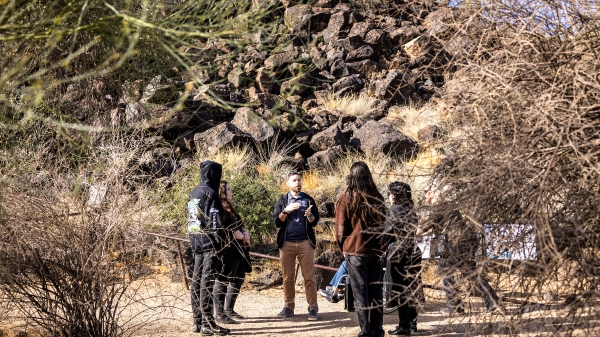
Petroglyph preserve celebrates 30th anniversary with ancient, modern tales
The Deer Valley Petroglyph Preserve provides a beautiful walk through a pristine desert where chuckwalla lizards are as plentiful…
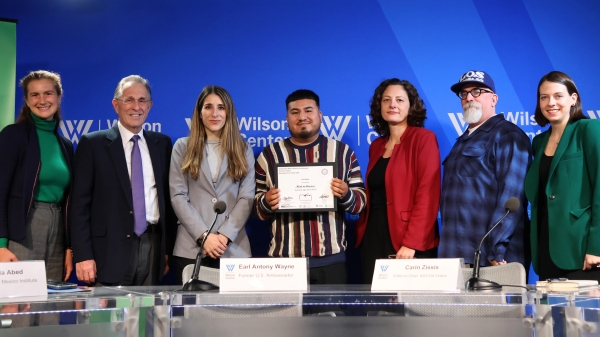
Kaleidoscope short film contest inspires powerful binational filmmaking in its second year
“We come to this country not to steal anybody’s jobs but to take advantage of the opportunities that the rest ignore. We’ve been…
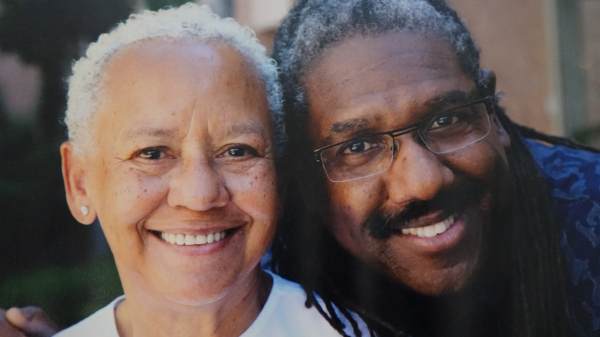
ASU's Neal Lester reflects on life, death of poet Nikki Giovanni
When Neal Lester heard on Monday that poet and activist Nikki Giovanni had died, the news hit hard.Lester, the founding director…