International graduate ready to return to India to do business
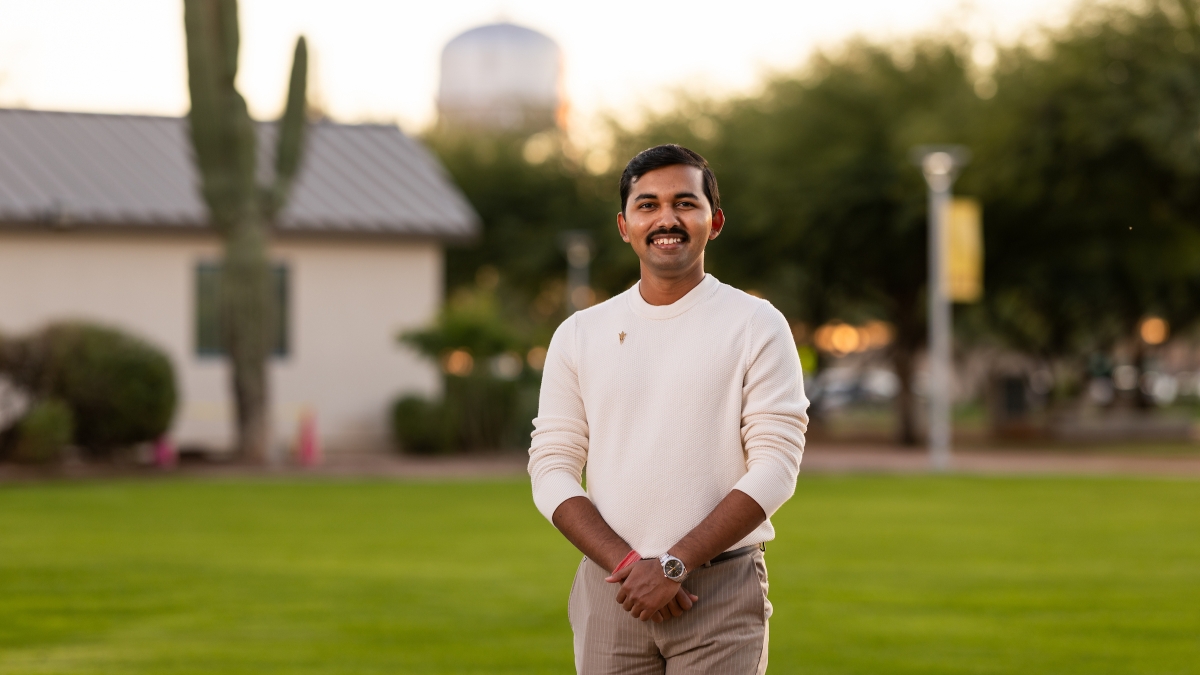
Mudit Lal, who is graduating with degrees in robotics and technological entrepreneurship and management, is ready to return to his native India and launch his business career. He was based at the Polytechnic campus, where he is photographed above. Photo by Samantha Chow/Arizona State University
Editor’s note: This story is part of a series of profiles of notable fall 2025 graduates.
Mudit Lal admits that Arizona State University was not his first choice for studying in America.
“I had everything I thought I needed to get into an Ivy League school, but it just didn’t work out for me. And honestly, I truly fell in love with ASU after I came here,” said Lal, who is graduating this December with bachelor’s degrees in robotics and technological entrepreneurship and management.
Lal, who is from India, has packed a lot into his time at ASU, creating a new student organization — the India Policy and Economy Research Club — working at the International Students and Scholars Center and founding a company.
He credits the ASU charter with changing his mind about higher education.
“I had thought that the elite of the elite, the best of the best, get the best education in the world. But if we really want to have humanity progress, we need to have high-quality education for every deserving student,” he said.
Lal shares some more information about his time at ASU.
Question: Why did you choose to study robotics?
Answer: I was into robotics since I was 13 or 14 years old. I knew robotics was going to be very useful for humanity. And I also consumed a lot of Iron Man content because it made me realize how much power and progress technology truly brings to the world.
Q: Why did you launch the India Policy and Economy Research Club?
A: After taking the (Science, Technology and Public Affairs) class with ASU President Michael Crow, I realized that policy can dictate the direction of humanity. In my long-term vision, I don't want to be just associated with robotics. I want to go into industries and fundamentally change how they function. And policy is going to be very crucial in that, because a lot of times, industries have not been able to progress simply because policy restricts them. Even if we create one policy leader, I believe we'll fundamentally change thousands of lives.
Q: What were some of the other activities you were involved in at ASU?
A: Being a residential peer mentor was very fun and fulfilling because I worked with a lot of students who had a similar story to me, of not knowing how to navigate college and being in a new country.
I’ve been working with Brent Sebold (director of Entrepreneurship and Innovation at the Ira A. Fulton Schools of Engineering) on an entrepreneurship search engine. He always supported the crazy ideas that we wanted to execute. ASU has a massive amount of content, especially for entrepreneurship, like podcasts and lectures. The search engine indexes the library. So if say, ‘I'm starting a space technology startup and I need a co-founder,’ it will look through the library and say, “This founder in the space tech industry talks about how to find a co-founder in this video.”
Q: Did you have other influential professors at ASU?
A: I took my physics class with Professor Pavan Pillalamarri and I have never seen someone teach with so much dedication and preparation. He made physics fun to learn and supported each student.
Q: How did you come to be an entrepreneur at ASU?
A: I was freelancing before, but I launched a proper agency once I came to ASU. My company, Devalok, helps companies with everything from naming the company to coming up with the logo, the packaging, the website, every little thing you can think of that has a design in it. ASU has been a massive factor for my success. I attend the monthly meetings of the ASU Chandler Innovation Center and that is where I got a lot of my clients. I've been to every Demo Day since I've been here because companies that have just been funded definitely need help.
Q: What’s something that changed your perspective at ASU?
A: When I took my class with President Crow, my biggest takeaway was a new way of looking at the world, about thinking 10 steps ahead or 10 years ahead and the ability to connect seemingly irrelevant pieces of information to realize how they're going to impact something else. And that will be extremely valuable for the rest of my life.
Q: What’s next for you?
A: We'll be building an office in India in my hometown of Lucknow. We are a 12-person team now, so we’ll be bringing everyone into one place and taking it to the next level. There are two more businesses that I'm working on. In India, we are seeing a quick-commerce boom. We are building Oshm, a technology infrastructure for mom-and-pop stores to put in their inventory, to get payment and to tell the delivery person where to go. The second is building my own robotics automation company. We are going to purchase robots and lease them out to manufacturing plants so they don't have to pay for the capital upfront.
As part of my TEM degree, we are supposed to come up with business plans, so I took these ideas as the project for that class. I was getting graded to work on my own business. So that was a big benefit.
More Business and entrepreneurship

ASU’s W. P. Carey School of Business recognized globally for excellence in research
Arizona State University's W. P. Carey School of Business continues to have a meaningful impact on academia, society and industry through its commitment to excellence and innovation in business…

Forecasting the future: How shifting policies are reshaping growth in the US and Arizona
This year, the nation has faced the effects of a government shutdown, widespread inflation and rapidly changing trade and immigration policies. Economists addressed these uncertainties and their…

ASU center provides a bridge between university, Arizona’s real estate future
After a period of uncertainty, confidence is returning to Phoenix’s commercial real estate market.According to Arizona State University’s W. P. Carey Center for Real Estate and Finance’s latest…