Adaptability key for future of public administration
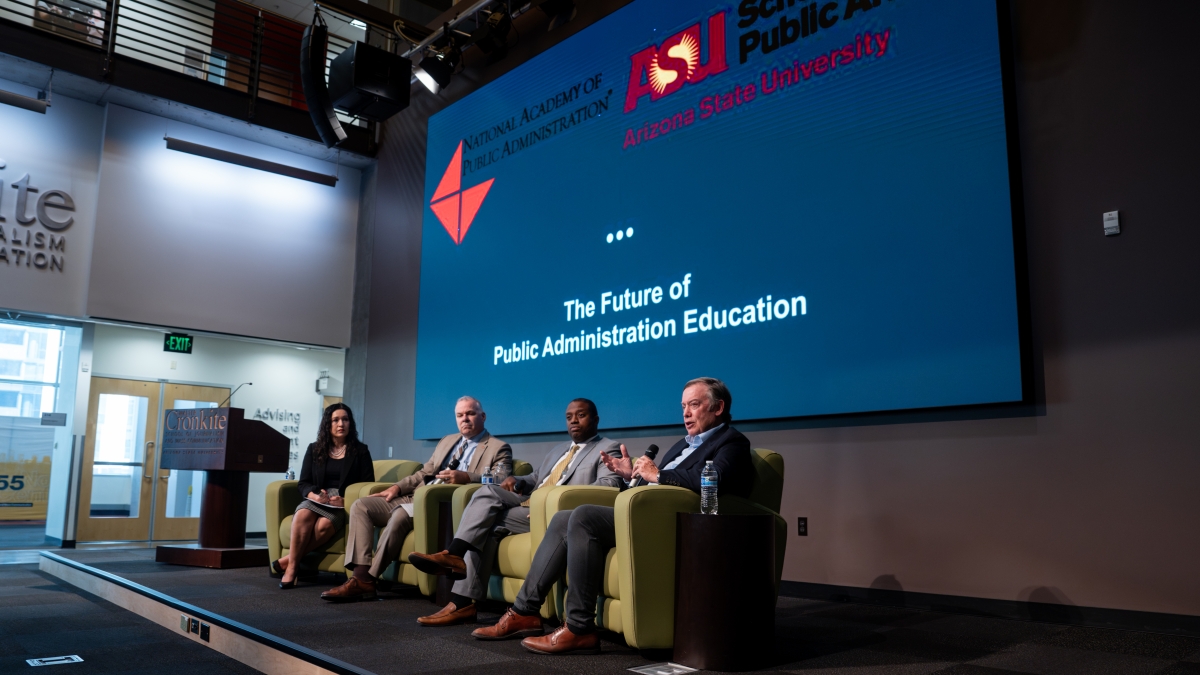
From left: Shannon Portillo, director of ASU's School of Public Affairs; Phoenix City Manager Ed Zuercher; James-Christian Blockwood, president and CEO of the National Academy of Public Administration; and ASU President Michael Crow discuss the future of public administration during a panel event titled “The Future of Public Administration Education” at the Walter Cronkite School of Journalism and Mass Communication in Phoenix on Oct. 7. Photo by Samantha Chow/Arizona State University
Curiosity. Agility. Grit.
These are just a few of the essential characteristics that future public servants will need to manage the challenges and chaos in the field of public administration, said a panel of experts who spoke about the discipline’s future at Arizona State University's Downtown Phoenix campus on Tuesday.
“We are not as innovative as we need to be in government,” ASU President Michael Crow said. “We need to do a better job of training, educating, empowering, labeling, everything. It's time for the modernization of everything. All the chaos going on right now? I'm fine with it. It's going to give us every opportunity to really look at things in new ways and move things forward in new directions.”
Crow was joined by moderator Shannon Portillo, director of ASU's School of Public Affairs; James-Christian Blockwood, president and CEO of the National Academy of Public Administration; and Ed Zuercher, executive director of the Maricopa Association of Governments. The discussion underscored the need for public servants to be adaptable and committed to helping others even with the evolving landscape of political disruptions and technological changes.
Blockwood echoed that disruption isn’t necessarily negative, but it requires future public servants to be able to engage in healthy dialogue. He has witnessed that people are too quickly losing the ability to productively disagree. How to maintain respectful discourse needs to be addressed in classes, as well as in society, he said.
Crow briefly touched on the federal government shutdown, pointing out that service interruptions, such as flight delays due to shortages of air traffic controllers, illustrate the necessity of government programs and those who deliver them, even though those programs are often taken for granted.
We need a public service that is “full-throated” in defense of the value it adds, Crow said.
That lack of acknowledgement for the value of public services is “The Walking Dead” theory of government, Zuercher said. In one scene of the postapocalyptic hit TV show, the protagonists are killing zombies, and in the next scene their clothes are freshly laundered and pressed and their teeth are clean. Yet viewers seemed to not question or care where the characters got clean water after the collapse of modern civilization and the services it provides.
“It's an example of the success of how we do government in the United States that people do take those sort of life-giving things for granted. We're very fortunate,” Zuercher said. “But we've got to tell the story better because that's the story of administrative capacity and the power of administration in the United States.”
Administrative capacity continues to grow, thanks in part to technological advances and AI.
“If you think about artificial intelligence and technology, there is ultimate access to information. There's nothing that's not at your fingertips almost immediately, and generally to everyone,” Blockwood said.
AI should be interpreted as augmented rather than artificial intelligence, the panel agreed, noting it is a system created by humans and used by humans to enhance decision-making abilities.
Crow, an advocate for the use of AI, sees it as a tool for managing complexity and increasing productivity. Zuercher said at some point, the data provided by AI has to be transformed into policies through judgment and compromise by people working together. People, not machines, will implement the policies.
Portillo added that the School of Public Affairs is offering an undergraduate- and graduate-level course in the spring semester called “AI and the Future of Government.”
Yet, despite changes at the federal level and new tools such as AI, the core principles of public service haven't changed. The motivation to pursue a career in public administration still begins with service.
“For a public servant, you want to serve others before yourself — that has to be the main driver. There's many things that people care about, specific issues, but it first starts with service. The motivation has to be service,” Blockwood said.
The event took place in advance of the 2025 Network of Schools of Public Policy, Affairs, and Administration Global Conference. This year’s conference, “Making a Difference Globally Through Quality Public Service Education,” is co-hosted by ASU, Northern Arizona University and University of Arizona Oct. 8–10 in Flagstaff, Arizona.
More Local, national and global affairs

ASU, Taiwan strengthen partnership ties
As both Arizona State University and Taiwan have become major players in Arizona’s burgeoning semiconductor industry, the university has worked to nurture its ties to the island.This fall, ASU…

ASU to host inaugural journalism and AI accelerator
Artificial intelligence is reshaping how people create, share and trust information, and Arizona State University is positioning itself at the forefront of that transformation.The ASU Knight…

Lost rituals, lasting grief: Study looks at pandemic's toll on Latino families in Arizona
Día de los Muertos, or Day of the Dead, is a meaningful time celebrated Nov. 1–2 when family and friends gather to honor and remember loved ones who have died. But during the COVID-19 pandemic,…