

ASU Carbon Summit displays sustainability leadership, collaboration and ... electric motorcycles

Jon Unangst (left), director of global government and business development for electric vehicle company Ryvid, speaks with aerospace engineering student Adam Drew (right) and psychology student Preston Mackey (center). Ryvid displayed electric motorcycles outside of the Student Pavilion for the Carbon Summit event Oct. 24–25. Photo by Katelyn Reinhart
This month, a student-led initiative brought government officials, entrepreneurs and nongovernmental organizations under one roof to discuss sustainable carbon solutions.
The annual Carbon Summit — the second of its kind at Arizona State University — took place from Oct. 24–25 at the Student Pavilion.
Speakers at the event presented on a variety of carbon-related themes: food transitions, energy transitions, circular economies, climate adaptation and sustainability.
Jason Marmon, a graduate student who served as the event director of the Carbon Summit, said this year’s event was a demonstration of the collaboration needed to tackle some of the most pressing challenges of our time.
“We're finding common ground for common good,” said Marmon, who is pursuing concurrent master's degrees in entrepreneurship and innovation through the W. P. Carey School of Business and in sustainability solutions through the College of Global Futures. “We need to have consensus on priorities for society and for communities. … We need to put our differences aside and focus on what we can agree on.”
The event was led by the Carbon Council, a student organization. Partners included AZ CleanTech, Undergraduate Student Government, Graduate Student Government, Changemaker Central and University Sustainability Practices. The two-day carbon solution showcase included speeches, presentations and pitches from a wide range of leaders both in and outside of ASU.
One ASU-focused presentation featured insights from Marc Campbell, assistant vice president of sustainability at ASU, on the university’s goal of being fully sustainable.
One challenge of being a “fully sustainable university,” Campbell said, is first defining what that means. Repeatedly ranked No. 1 for its sustainability impact and home to the world’s first School of Sustainability, ASU’s commitment to sustainability is well documented. But there is much to be done, he said, and the work should encompass the entirety of the ASU experience.
“I can sit in my office and come up with a definition of a ‘fully sustainable university.’ I can come up with revised goals,” he said. “But this isn't about me, and this isn't about my office. This is about all of us. This is about our institution and what we want to see it become.”
Campbell’s presentation highlighted a recurring theme of the Carbon Summit presentations: Decarbonization across all sectors will take years of determined, focused and mindful efforts. However, the individuals dedicated to the work being presented — including ASU students who worked to organize the summit — did not seem discouraged by the scale of the task.
-
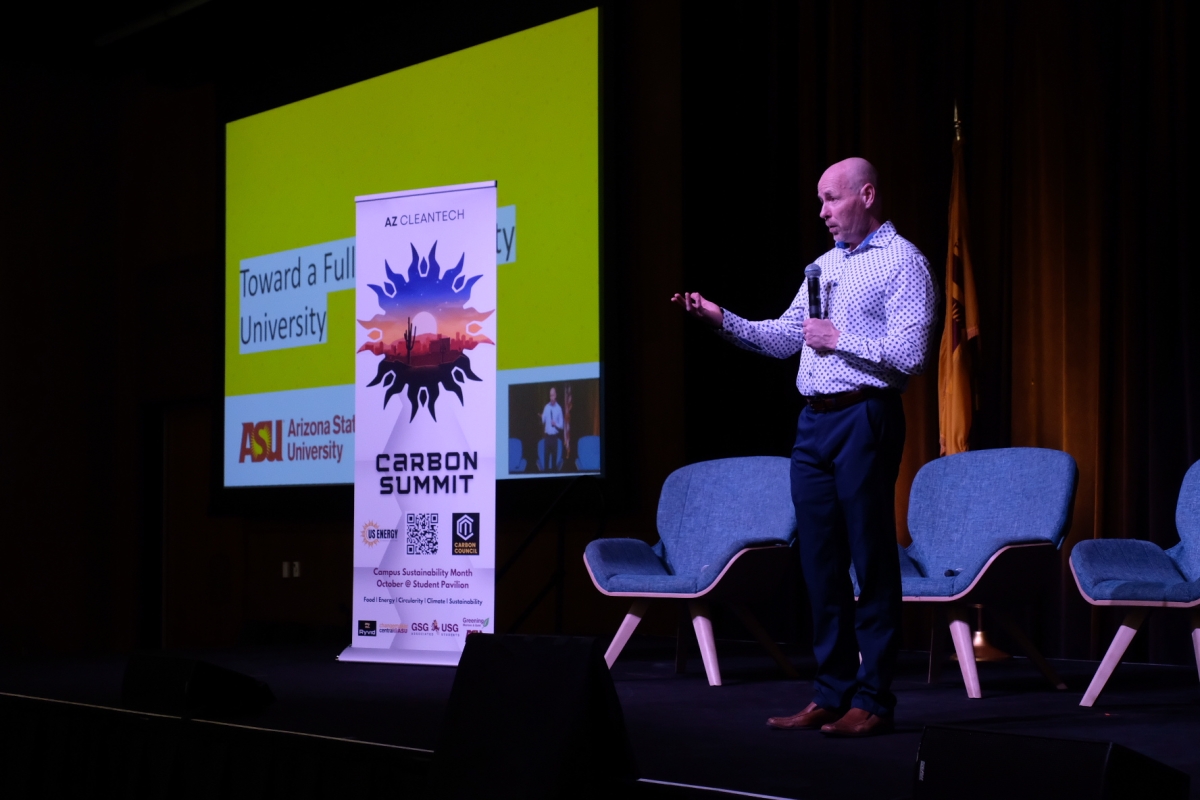
Marc Campbell, assistant vice president of sustainability at ASU, presents at the Carbon Summit on Oct. 25. During his presentation, he shared university sustainability updates and took audience feedback from students, particularly relating to student engagement.
Photo by Katelyn Reinhart
-
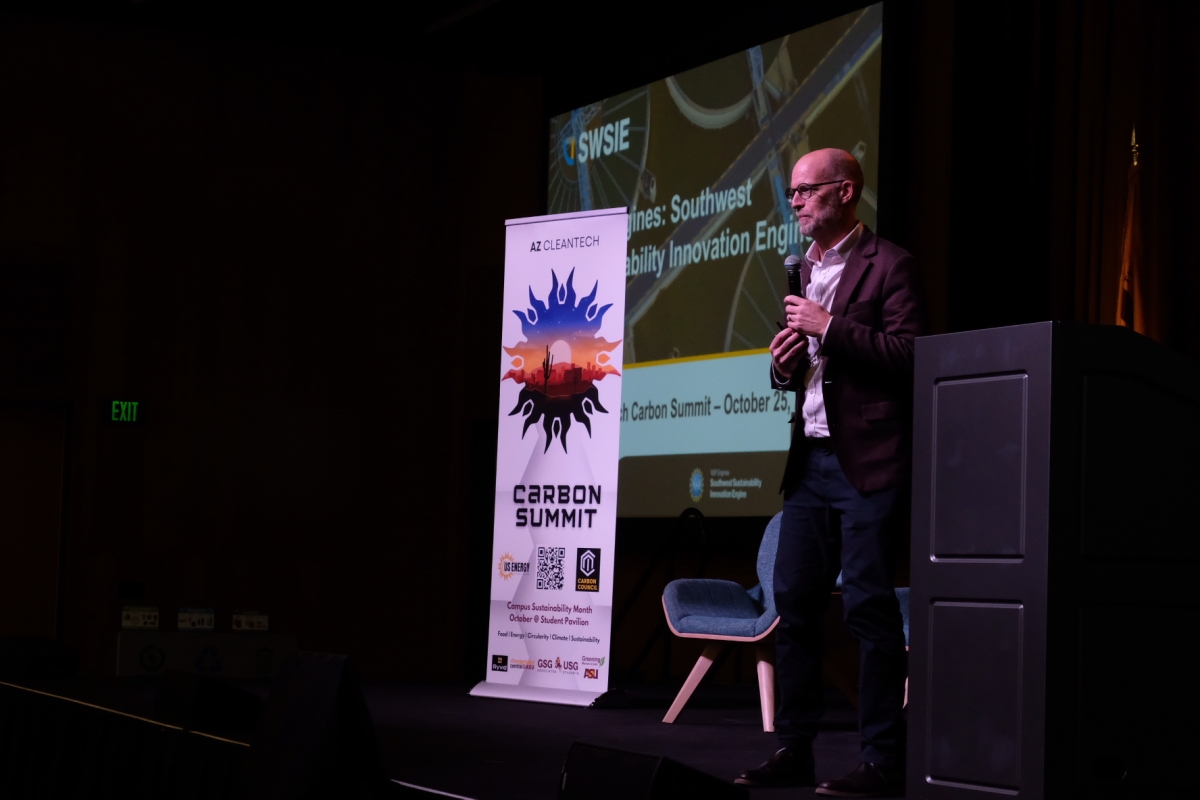
Brian Sherman, CEO of the ASU-led Southwest Sustainability Innovation Engine (SWSIE) initiative, presents on SWSIE efforts and the opportunities and challenges facing the Southwestern region. He spoke at the Carbon Summit on Oct. 25.
Photo by Katelyn Reinhart
-

A panel on actionable sustainability featured (from left) Shyaam Ramkumar of Plug and Play; Mark Hartman, city of Phoenix; Adam Shipley, city of Avondale; Brian Sherman, ASU/SWSIE; and ASU student and event director Jason Marmon.
Photo by Katelyn Reinhart
-
Marc Campbell, assistant vice president of sustainability at ASU, presents at the Carbon Summit on Oct. 25. During his presentation, he shared university sustainability updates and took audience feedback from students, particularly relating to student engagement.
Photo by Katelyn Reinhart
-
Brian Sherman, CEO of the ASU-led Southwest Sustainability Innovation Engine (SWSIE) initiative, presents on SWSIE efforts and the opportunities and challenges facing the Southwestern region. He spoke at the Carbon Summit on Oct. 25.
Photo by Katelyn Reinhart
-
A panel on actionable sustainability featured (from left) Shyaam Ramkumar of Plug and Play; Mark Hartman, city of Phoenix; Adam Shipley, city of Avondale; Brian Sherman, ASU/SWSIE; and ASU student and event director Jason Marmon.
Photo by Katelyn Reinhart
-
Marc Campbell, assistant vice president of sustainability at ASU, presents at the Carbon Summit on Oct. 25. During his presentation, he shared university sustainability updates and took audience feedback from students, particularly relating to student engagement.
Photo by Katelyn Reinhart
-
Brian Sherman, CEO of the ASU-led Southwest Sustainability Innovation Engine (SWSIE) initiative, presents on SWSIE efforts and the opportunities and challenges facing the Southwestern region. He spoke at the Carbon Summit on Oct. 25.
Photo by Katelyn Reinhart
-
A panel on actionable sustainability featured (from left) Shyaam Ramkumar of Plug and Play; Mark Hartman, city of Phoenix; Adam Shipley, city of Avondale; Brian Sherman, ASU/SWSIE; and ASU student and event director Jason Marmon.
Photo by Katelyn Reinhart
Sandra Perez, a junior studying material science and engineering in the Ira A. Fulton Schools of Engineering, is the co-founder and current president of the Carbon Council. The Carbon Council is a student organization dedicated to accelerating climate change solutions. The student group’s primary events, the Carbon Summit and an Earth Day concert, aim to encourage student and professional engagement in the sustainability space.
“There are so many students across all these different ASU schools who have the same passion for sustainability,” Perez said. “In sustainability, we need to be multidisciplinary and have interdisciplinary collaboration. The purpose of the Carbon Council is to unite every student, regardless of their major or education level.”
Perez worked closely with Marmon and other event organizers leading up to the Carbon Summit. She said that, as a student, it was inspiring to work directly with university entities and sustainability leaders.
“There are a lot of students out there who have very big visions for the future, but they feel like they have to wait to work toward them until it’s the ‘right time’ or until they’re ‘fully qualified’ to do so,” Perez said. “That’s simply not true. There are people out there who want you to get involved and want to help you. You just need to start.”
Miss this year's Carbon Summit? Watch it online.
The Carbon Summit was recorded and can be viewed online. The first video in the series can be found here.
More Environment and sustainability

Saving the environment to save ourselves
Saving the environment.At Arizona State University, that's not just a trendy slogan. From water insecurity to wildfire awareness to cleaning pollutants in urban fishing waterways, ASU is…

A sea change regarding our ocean
The ocean matters more than most of us may realize.Our seas offer soothing scenes for millions of vacationers. They provide seafood for our tables. They are a conduit for global logistics — from the…

'Earth Day Amplified' promotes power of collective action
Everybody loves the concept of sustainability. They want to do their part, and the chance to say they’ve contributed to the well-being our of planet.But what does that actually mean?Arizona State…