

The Sidney Poitier New American Film School launches faculty-curated screening series

Clinical Assistant Professor Brian McAuley addresses the audience following a screening of "Talk to Me." Photo by Taylor Blackmore
Everyone knows movies are better on the big screen. The Sidney Poitier New American Film School is proving it with a new faculty-curated screening series, launched in October, that brings classics new and old to the state-of-the-art theater at ASU’s Media and Immersive Experience (MIX) Center in downtown Mesa.
"Cinema isn't just an art form, it's a communal experience,” said Brian McAuley, clinical assistant professor in The Poitier Film School. “It's increasingly invaluable to experience films the way they were intended: on a big screen with booming speakers and a lively audience.”
The screenwriter and horror novelist, whose new Christmas-themed horror book “Candy Cain Kills Again: The Second Slaying” comes out Nov. 12, kicked off the screening series with "Possession at the MIX," presenting a pair of thematically linked horror films about possession: the iconic 1973 film “The Exorcist,” and the 2022 Australian horror film “Talk to Me,” about a group of young friends who play a party game with an embalmed hand that unleashes a terrifying supernatural force.
The Poitier Film School screening series continues in November with John Carpenter’s classic 1982 chiller “The Thing” on Monday, Nov. 4; and Jordan Peele’s 2022 sci-fi/horror epic “Nope” on Nov. 19. All screenings are free and open to the public.
“With this screening series, we're intentionally pairing a classic genre film with a modern masterpiece, connected by a common theme,” McAuley said. “We're also holding space after the films for conversations about the artistry and humanity that make these stories endure across generations. For example, we explored how the religious horror of ‘The Exorcist’ resonates today compared to the TikTok terrors of ‘Talk to Me.’"
Many of the MIX Center theater’s 261 seats at the Oct. 22 screening of “Talk to Me” were occupied by Poitier Film School students studying the art and craft of film, who stayed seated after the screening to engage in a post-film discussion led by McAuley.
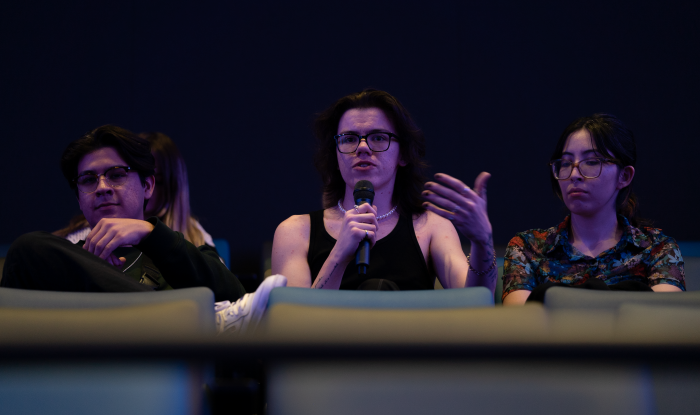
McAuley, who teaches screenwriting, emphasized the importance of well-drawn characters to secure the audience’s emotional investment.
“What makes the story work is that it’s really rooted in characters,” he said of “Talk to Me” in the post-screening discussion, calling it a “character-driven drama that happens to have horror mixed in.”
“When a horror movie can make you feel so many emotions other than fear, it makes the whole story so much better,” responded one film student.
Rodrigo Meirelles, a sonic artist and Poitier Film School professor of sound, was also in attendance for the screening and contributed his expertise to the discussion, calling attention to how the mood and emotional tone of the film was enhanced by the score and sound design.
“The variation of volume and intensity is astounding,” Meirelles said.
The film’s expert sound design was especially evident in the MIX Center’s theater, which is Dolby Atmos certified, a rare distinction.
“Movies were made to be enjoyed on the big screen, and we’ve got one of the best big screens in Arizona at the MIX Center,” said Poitier Film School Founding Director Cheryl Boone Isaacs. “Our expert film faculty are curating a thrilling series, screenings classics and new releases that both inform and entertain. Our students will learn not just film history, but how films remain in conversation with one another across the decades.”
One audience member at the screening of “Talk to Me” expanded her cinematic horizons in a big way.
“This is my first horror film that I’ve ever seen, because I don’t like horror,” said Jennifer Hankerson, a film and media production major. “It was a good first horror film, I would say.”
“Was it scary?” McAuley asked.
“Oh yeah,” she confirmed.
More Arts, humanities and education

Local traffic boxes get a colorful makeover
A team of Arizona State University students recently helped transform bland, beige traffic boxes in Chandler into colorful works of public art. “It’s amazing,” said ASU student Sarai…

2 ASU professors, alumnus named 2025 Guggenheim Fellows
Two Arizona State University professors and a university alumnus have been named 2025 Guggenheim Fellows.Regents Professor Sir Jonathan Bate, English Professor of Practice Larissa Fasthorse and…

No argument: ASU-led project improves high school students' writing skills
Students in the freshman English class at Phoenix Trevor G. Browne High School often pop the question to teacher Rocio Rivas.No, not that one.This one:“How is this going to help me?”When Rivas…