

Student group wins $50,000 in first-of-its-kind pitch fest at College of Health Solutions
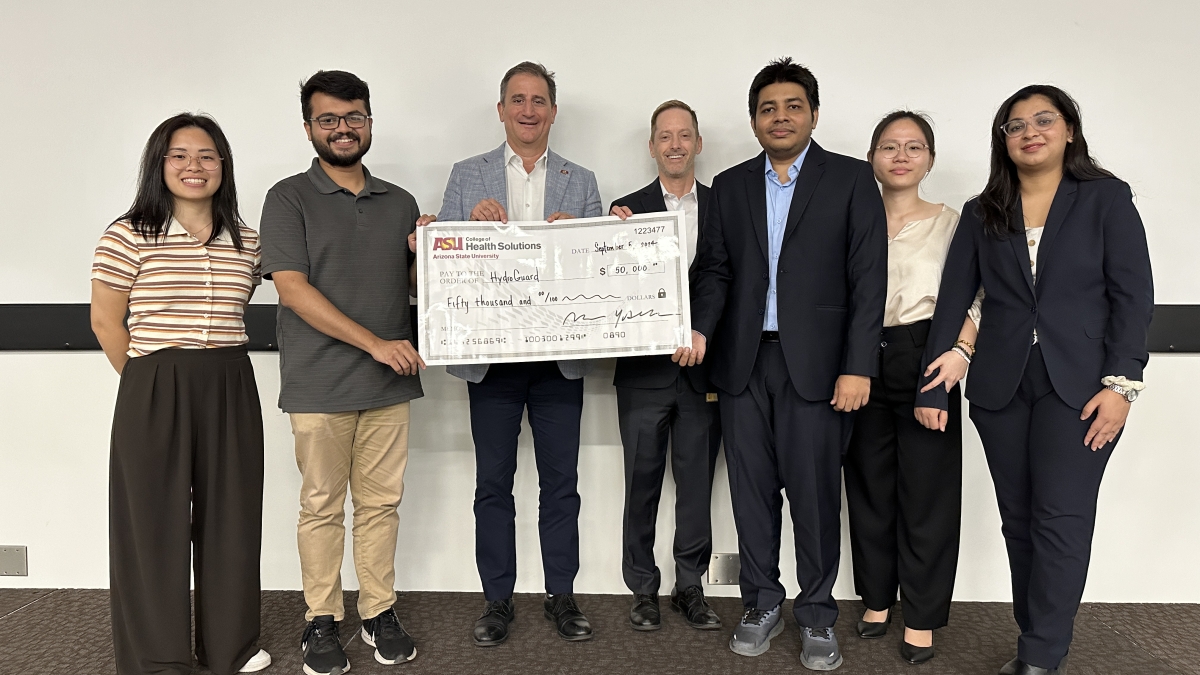
From left: Jiaqian (Amber) Lee, Asiful Arefeen, Michael Yudell, Matthew Scotch, Shovito Barua Soumma, Chau (Reina) Nguyen and Saanya Aroura. Photo courtesy of Keri Hensley/College of Health Solutions
By Kimberly Linn
On the heels of another heat record-setting summer, the College of Health Solutions at Arizona State University recently hosted its first-ever Student Research Challenge Pitch Fest with the university’s charge to serve the community at front of mind. The focus of the competition? To reduce the impact of heat on vulnerable and high-risk populations in Phoenix.
With $50,000 in seed money on the line, it came down to two final teams: HydroGuard, which proposed an app that tracks an individual's physical activity, heart rate, skin temperature and fluid intake to provide real-time feedback on hydration status, and SmartHeat, which proposed an app that allows users to create a health profile to receive recommendations on physical activities, along with heat-related illness risk factors based on the individual's fitness levels.
“This event is more than a competition; it’s a platform for students to develop real-world solutions to a pressing public health issue,” said Michael Briggs, executive director of research success at the College of Health Solutions. “It emphasizes innovation, feasibility and teamwork while providing resources and mentorship to help students bring their ideas to life.”
In the end, HyrdroGuard won out, with plans to use the $50,000 in funding to further develop their project concept.
“The inspiration behind our project came from recognizing the significant health risks associated with dehydration, particularly during physical activity or in heat-prone areas like Arizona,” said Hassan Ghasemzadeh, a faculty mentor for HydroGuard. “We observed a gap in the market for a comprehensive, easy-to-use solution that could monitor hydration in real time and provide personalized guidance.”
The HydroGuard team includes College of Health Solutions students Shovito Barua Soumma, a PhD student in biomedical informatics; Jiaqian (Amber) Lee and Chau (Reina) Nguyen, both master’s students in biomedical informatics and data science; Asiful Arefeen, a PhD student in biomedical informatics and a master’s student in computer science from the School of Computing and Augmented Intelligence; and Saanya Aroura, a master’s student in biomedical engineering from the School of Biological and Health Systems Engineering.
But the runner-up team did not walk away empty-handed, with SmartHeat being awarded $10,000.
SmartHeat is a four-person multidisciplinary team that includes College of Health Solutions students Binoli Herath, a PhD student in population health, and Raul Freire, a PhD student in exercise and nutritional sciences, as well as Ira A. Fulton Schools of Engineering students Rashmi Neelawathura, a PhD student in engineering education systems and design, and Tanmai Mukku, a master's student in computer science.
At the onset of the competition, each team was provided with $5,000 to develop their ideas in preparation for the final pitch event. They had regular meetings with their faculty mentors and the Research Success Hub to receive support and guidance. Training on the research expenditure process and project compliance matters, including Institutional Review Board requirements, was also provided, according to Briggs.
The final two teams competed by delivering investor-style pitches to a panel of faculty judges: Alicia Montalvo, clinical associate professor; Adela Grando, director and associate professor; and Edward Ofori, assistant professor.
The judges evaluated the pitches, focusing on idea clarity, originality, execution plan, team cohesion, budget projections, community impact in Maricopa County and overall presentation.
“We focused on several key criteria, including innovation, feasibility, impact and presentation quality,” Ofori said. “There was a discussion about how well the teams aligned their research goals with societal needs, as well as their ability to articulate both the scientific basis and potential outcomes of their projects.”
With their winnings, the HydroGuard team plans to begin larger-scale user testing to gather more data and further train machine learning algorithms for their app. They will also be working on establishing partnerships with hardware manufacturers to move toward a more scalable, market-ready product.
More Health and medicine

Reducing waste in medical settings
Health care saves lives, but at what cost? Current health care practices might be creating a large carbon footprint, according to ASU Online student Dr. Michele Domico, who says a healthier…

ASU offers bilingual counseling to Spanish speakers
Arizona is one of the five states in the nation with the highest percentage of Hispanic residents, according to the U.S. Department of Health and Human Services Office of Minority Health, and …

College of Health Solutions launches first-of-its-kind diagnostics industry partnership to train the workforce of tomorrow
From 2007 to 2022, cytotechnology certification examinees diminished from 246 to 109 per year. With only 19 programs in the United States, the cytology workforce that stands at the front line of…