

The tiny bone that led to a very big discovery
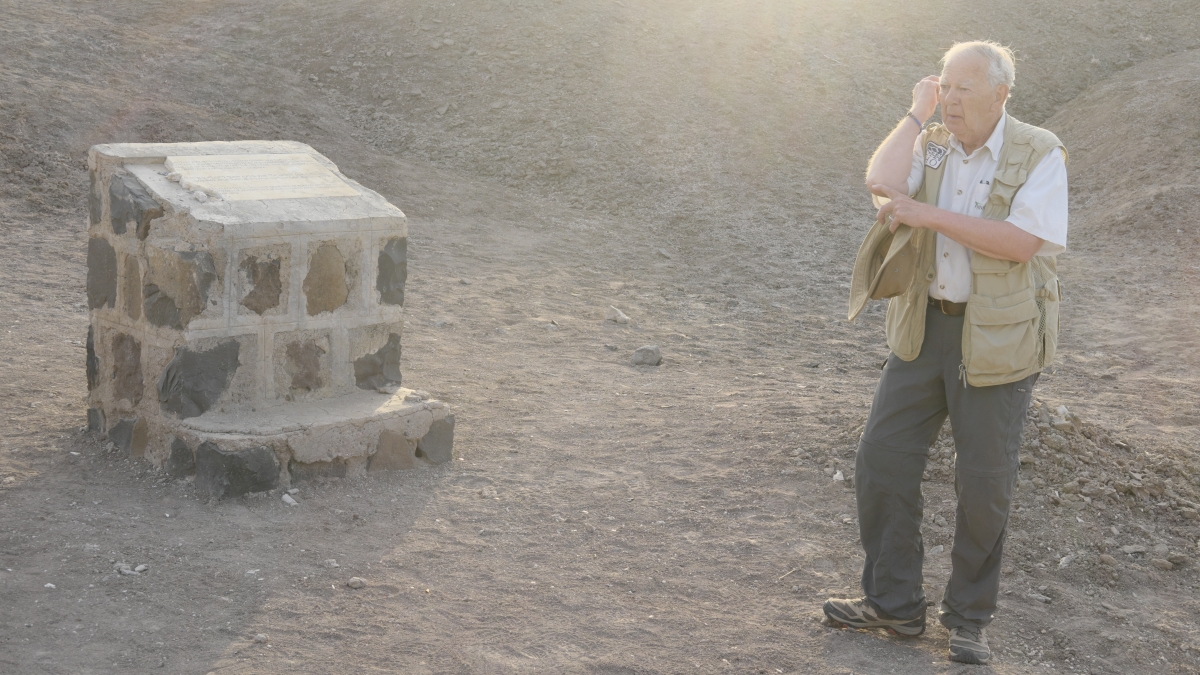
This summer, Donald Johanson, the Virginia M. Ullman Chair in Human Origins in the School of Human Evolution and Social Change and the founding director of the Institute of Human Origins at Arizona State University, visited the location where he first discovered the Lucy fossil skeleton in Hadar, Ethiopia, in 1974. He explained that the “first bone” he found from Lucy was part of the upper arm. Photo by Steve Filmer/ASU
Nov. 24 will mark 50 years since Arizona State University’s Donald Johanson discovered the Lucy fossil skeleton. It’s a find that shook the world of paleoanthropology and that still spawns new research.
The saying goes that “big things come from small beginnings,” so we asked Johanson — the founding director of ASU’s Institute of Human Origins — to show us the first tiny bone of Lucy that he spotted, and how it led to his discovery of Lucy’s skeleton in Hadar, Ethiopia.
The 3.2-million-year-old fossilized skeleton of a creature called Australopithecus afarensis, considered a direct human ancestor, preserved enough of her spine, pelvis and lower legs to show that Lucy and her kind were walking upright — like we do. The find is important because it suggests that our ancestors started walking upright before their brains (and skulls) began growing larger.
ASU is celebrating Lucy with a year of special events, including a gala, a symposium and a monthly lecture series. Learn more on the Institute of Human Origins website.
Spotlighting details of the discovery
This video is the first in a monthly series on ASU News leading up the November anniversary.
Up next in September: What might Lucy have looked like when she was alive? There's no time machine to take us back 3.2 million years, but a very special artist shows us how he has fused human anatomy with prehistoric finds to make a lifelike re-creation of Lucy.
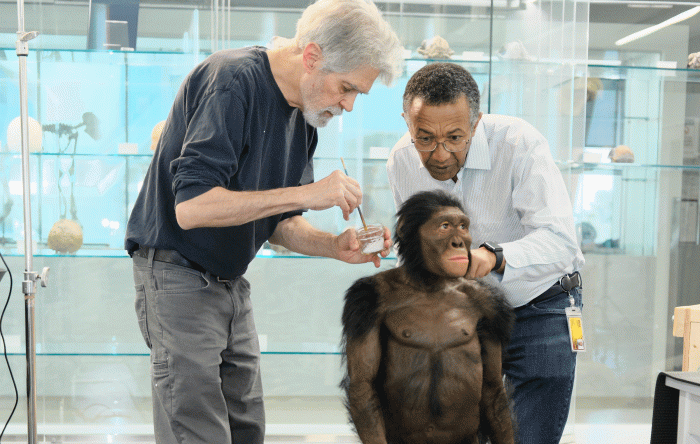
October: The crown jewel: Finding a complete skull for Lucy.
November: Donald Johanson on the momentous discovery and the future of related research.
Explore more: Find more coverage of the anniversary celebration at news.asu.edu/spotlight/lucy-at-50.
More Science and technology

ASU-led space telescope is ready to fly
The Star Planet Activity Research CubeSat, or SPARCS, a small space telescope that will monitor the flares and sunspot activity of low-mass stars, has now passed its pre-shipment review by NASA.…

ASU at the heart of the state's revitalized microelectronics industry
A stronger local economy, more reliable technology, and a future where our computers and devices do the impossible: that’s the transformation ASU is driving through its microelectronics research…

Breakthrough copper alloy achieves unprecedented high-temperature performance
A team of researchers from Arizona State University, the U.S. Army Research Laboratory, Lehigh University and Louisiana State University has developed a groundbreaking high-temperature copper alloy…