Virtual reality lab puts ASU meteorology students into the eye of a hurricane
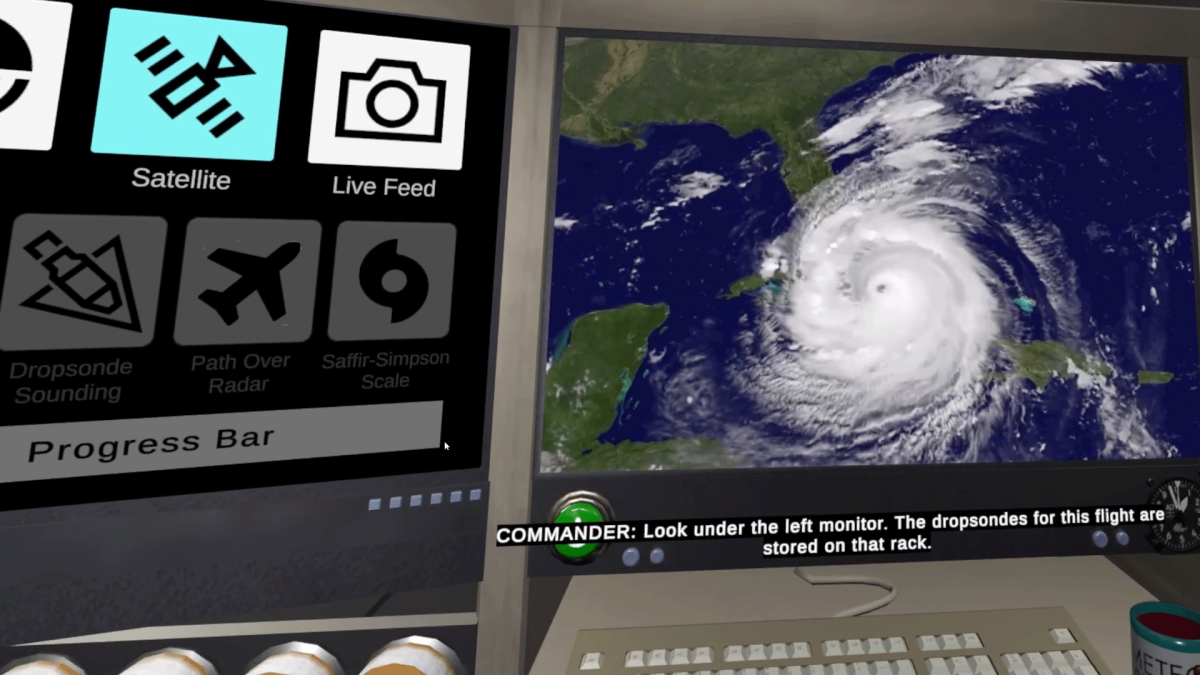
The "Hurricane Heroes" virtual reality lab experience uses real-life hurricane data. Image courtesy of the Meteor Studio
Students at Arizona State University have developed a virtual reality experience for a meteorology course that uses real-world sound and data to put users into the middle of a hurricane.
Rachael Kaye, a doctoral student in the School of Arts, Media and Engineering, who also taught the Introduction to Meteorology course this summer, created the “Hurricane Heroes” experience with her fellow student workers in Meteor Studio.
“A big part of my motivation was giving students a sense of urgency and putting them in a position to think about, ‘What would I do if I found myself in this situation?’ And then having them visualize it in a more hands-on way,” Kaye said.
The ASU Online class, open to students in any major, has a lab that includes the immersive module, called “Hurricane Heroes.” Students can choose to use a headset, which is mailed to them, for a three-dimensional experience, or watch a two-dimensional version on their computer screens.
The VR experience is presented in three acts as a story with interactive questions throughout, Kaye said.
“Each act focuses on a different career related to meteorology, and each act is also a different time frame, either before or after a hurricane makes landfall in Florida,” she said.
“In each act, they're in a different role. So two days before the storm hits, they’re a broadcast meteorologist. Then the day before the storm hits, they're on a hurricane hunter flight into the eye of the storm.
“The third act is the day after it hits, and they're part of emergency rescue support, surveying damage and helping to rescue a family.”
The experience is based on Hurricane Irma, which struck Florida in 2017 and caused widespread damage. The course uses real data from satellite radar and real sound from hurricane hunter flights during that storm.
Combining data with an engaging story is the challenge in creating an immersive experience, Kaye said.
“I’m the content expert and none of us were creative writers, so that took months of back and forth,” she said.
Then the artists and developers created the environment to match the story.
“And then I’d review it and would point out, ‘Well, this part needs to more accurately reflect the career or the environment,’" said Kaye, who worked as a TV and radio meteorologist for several years.
Her doctoral research is on how to develop computer and VR games for educational purposes.
“How do you bring all of the right pieces together to make something like this happen?” she said.
While she’s not teaching the Introduction to Meteorology course, GPH 212, this semester, “Hurricane Heroes” will still be used for the course’s lab, GPH 214.
Dion Pimentel, who graduated from ASU with a master’s degree in computer science and is now a freelance game developer, said that working on the experience while he was part of Meteor Studio was a big career boost.
“It was super representative of a team scenario in the gaming industry,” he said.
“Working at Meteor Studio came with the expectations of stakeholders and various nuances like deadlines and funding. It felt like I was working in that world.”
Kaye said that the career aspect of the course is important.
“Each act is a different career related to meteorology,” she said.
“Everyone loves to make fun of meteorologists, but there’s a lot that goes on and I wanted the class to have a better understanding of the scientific thought process that goes into it.”
More Science and technology
ASU graduate student researching interplay between family dynamics, ADHD
The symptoms of attention deficit hyperactivity disorder (ADHD) — which include daydreaming, making careless mistakes or taking risks, having a hard time resisting temptation, difficulty getting…

Will this antibiotic work? ASU scientists develop rapid bacterial tests
Bacteria multiply at an astonishing rate, sometimes doubling in number in under four minutes. Imagine a doctor faced with a patient showing severe signs of infection. As they sift through test…

ASU researcher part of team discovering ways to fight drug-resistant bacteria
A new study published in the Science Advances journal featuring Arizona State University researchers has found vulnerabilities in certain strains of bacteria that are antibiotic resistant, just…