

ASU faculty member elected to American Academy of Arts and Sciences
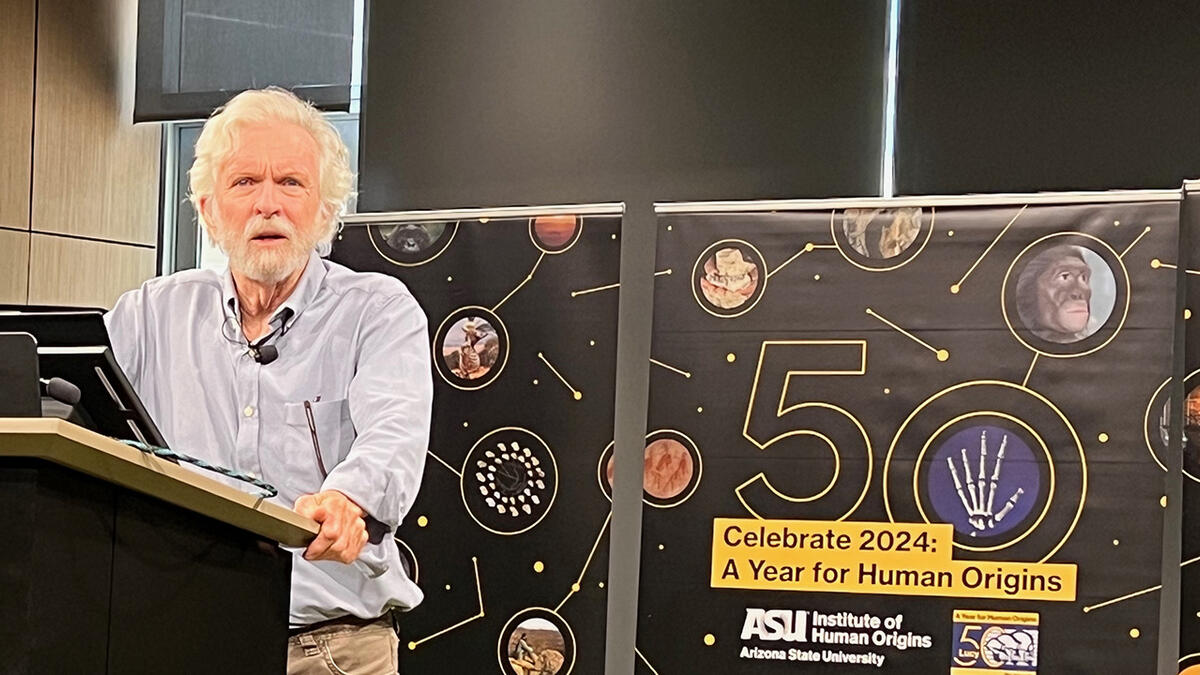
Robert Boyd speaks at a recent lecture. Photo by Julie Russ/ASU
Arizona State University Professor Robert Boyd is among those newly elected to the American Academy of Arts and Sciences, one of the oldest learned societies in the United States.
Boyd is one of 250 individuals elected to the academy in 2024 for their excellence and invited to uphold the academy’s mission of engaging across disciplines and divides. Others elected this year include actor George Clooney, Apple CEO Tim Cook and University of Arizona evolutionary biologist Judith Bronstein.
“We honor these artists, scholars, scientists and leaders in the public, nonprofit and private sectors for their accomplishments and for the curiosity, creativity and courage required to reach new heights,” said David Oxtoby, president of the academy. “We invite these exceptional individuals to join in the academy’s work to address serious challenges and advance the common good.”
Boyd, a professor in the School of Human Evolution and Social Change and a research scientist with the Institute of Human Origins, is considered a forerunner in the field of cultural evolution. Specifically, his research focuses on the evolutionary psychology of the mechanisms that give rise to — and influence — human culture, and how these mechanisms interact with population dynamic processes to shape human cultural variation. Boyd is also an affiliated professor with the ASU-Santa Fe Institute Center for Biosocial Complex Systems and the ASU Center for Social Dynamics and Complexity.
His work is summarized in three books, two coauthored with P. J. Richerson — "Culture and the Evolutionary Process," and "Not by Genes Alone: How Culture Transformed Human Evolution" — and by Boyd individually, "A Different Kind of Animal." Boyd, along with his wife, ASU primatologist Joan Silk, co-authored "How Humans Evolved," considered the gold-standard textbook for introduction to biological anthropology courses.
“Robert Boyd is one of the most highly cited scholars at ASU whose work has enlightened our understanding of human cooperation, agency and sustainability in the cultural evolution of humanity. His colleagues in the school are thrilled to witness his election to the AAAS, an honor that is richly deserved for this stellar scholar,” said Patrick Ryan Williams, director of the School of Human Evolution and Social Change.
Yohannes Haile-Selassie, director of the Institute of Human Origins, said, "Rob is a forerunner in the field of human cultural evolution. His election as a member of the American Academy of Arts and Sciences is truly a great recognition of his excellence in research of public value. The Institute of Human Origins is very proud to have a number of globally recognized research scientists like Rob."
The American Academy of Arts and Sciences was founded in 1780 by John Adams, John Hancock and other leaders of the time to honor excellence and convene leaders to examine new ideas, to address issues of importance to the nation and the world and to advance the public good. Since then, the organization has grown to include more than 13,500 members, recognizing several faculty and leaders from ASU, including President Michael M. Crow and School of Human Evolution and Social Change professors Jane Buikstra, Magdalena Hurtado and Joan Silk.
“I am really pleased to be elected to the AAAS. It’s a real honor,” said Boyd.
Induction ceremonies for new members will take place in Cambridge, Massachusetts, in September.
For a complete list of new American Academy of Arts and Sciences members, visit the organization’s website.
More University news

3 ASU students earn Goldwater Scholarships for STEM research excellence
Three Arizona State University students have been named Goldwater Scholars for 2025, placing them among the nation’s most promising undergraduates pursuing research careers in science, engineering…

Provost Teaching Awardees, Charter Professors empower local communities, students
The ASU Charter embodies the university’s commitment to student success and research of public value and responsibility to the community. In recognition of its importance, each year, Executive…

New online Bachelor of Social Work program exceeding enrollment expectations
Social workers are in big demand.Citing U.S. Bureau of Labor Statistics figures, the National Association of Social Workers projected the profession will grow 7% by 2033, faster than the average for…