

Associate professor shares her journey from NASA to ASU
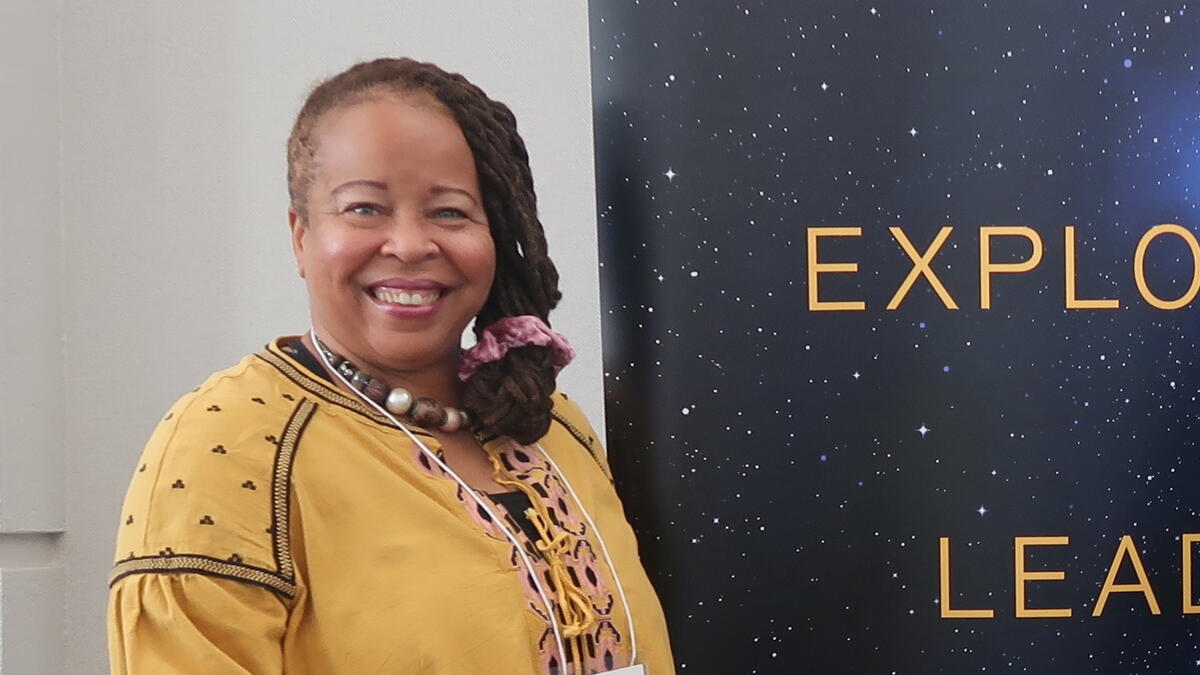
For more than 20 years, Tracee Jamison-Hooks, associate professor in Arizona State University's School of Earth and Space Exploration, worked as an electrical engineer for NASA. Her experience has allowed her to design a course for ASU engineers that completely revolutionizes the learning and teaching of digital signal processing. Courtesy photo
From leading space missions to designing and building spaceflight hardware and training students in space science and engineering, Arizona State University is proving that space is more than a distant place outside our reach.
And as we embark deeper into the final frontier, we need more space pioneers to help lead the way.
In honor of National Space Day on May 3, we're highlighting the work of one such pioneer: Tracee Jamison-Hooks, associate professor in ASU's School of Earth and Space Exploration, who is shooting for the stars in more ways than one.
But she claims her lifelong role as an electrical engineer — particularly for NASA — was unexpected.
“I would say that the electrical engineering path was more of a calling than something that I actually diligently pursued.”
For more than 20 years, Jamison-Hooks worked as an electrical engineer for NASA's Goddard Space Flight Center in Maryland.
Now, she helps to mold the next generation of space engineers at ASU. But she says this role, too, came as a surprise.
“I've never been so busy and scheduled in my life,” Jamison-Hooks said. “But at the same time, no one could have ever convinced me that I would have this kind of fulfillment.
“I didn't know that I would have this much respect for higher education. But I do.”
As an educator, Jamison-Hooks is determined to teach in a way that rectifies the mistakes of her own past educators.
“My approach to developing engineers is to develop them as if they're a whole person,” she said passionately. “They have thoughts, feelings, they have families, they have issues going on outside of the classroom. And sometimes they can't just ignore them and stay present.
“Connection is important,” Jamison-Hooks said. “Having people that you can connect to or look to is important as a young Black female who is getting her PhD in a STEM field.”
As far as managing current projects, Jamison-Hooks has developed a course for ASU engineers that completely revolutionizes the learning and teaching of digital signal processing.
“By revamping and recreating traditional courses, to give students the experience of building a (digital processing) system, they can map the principles that they have toward implementation while interacting with a board and its moving signals that they created. That's a big deal for students to have that experience walking out of the door.
“We exercise those first principles in hardware,” she said. “Not as a separate lab, but rather something very integrated into the teaching of the course.”
Ultimately, said Jamison-Hooks, “I really believe in experiential learning.”
She credits her beginnings as a digital signal processing product design lead for NASA for her expertise in teaching and implementing these principles.
“Digital signal processing is a form of electrical engineering; it's mostly math, and it directly applies to physics. In order for you to get information from an instrument, you must do digital signal processing on that data.”
As she reflects on the journey that got her here, she is also looking toward future endeavors.
On top of her many responsibilities, Jamison-Hooks is also highly involved in recruitment through her relationship with SCALE, a workforce development program for the Department of Defense, led by Purdue University.
“I receive funds from Purdue, and I have a relationship with them. They're sending me to the National Society of Black Engineers conference, to recruit for SCALE,” she shared enthusiastically. “Right now, the thing I'm focusing on is utilizing this current relationship.”
All of these different pursuits ultimately follow her purpose of educating the next generation of engineers.
“The main thing that I want to do is contribute to course development and creation and experiential learning and training.”
More Science and technology

Turning up the light: Plants, semiconductors and fuel production
What can plants and semiconductors teach us about fuel production?ASU's Gary Moore hopes to find out.With the aim of learning how to create viable alternatives to fossil-based fuels, Moore — an…

ASU technical innovation enables more reliable and less expensive electricity
Growing demand for electricity is pushing the energy sector to innovate faster and deploy more resources to keep the lights on and costs low. Clean energy is being pursued with greater fervor,…

What do a spacecraft, a skeleton and an asteroid have in common? This ASU professor
NASA’s Lucy spacecraft will probe an asteroid as it flys by it on Sunday — one with a connection to the mission name.The asteroid is named Donaldjohanson, after Donald Johanson, who founded Arizona…