

ASU Biodesign Institute scientist Hao Yan receives prestigious Humboldt Research Award

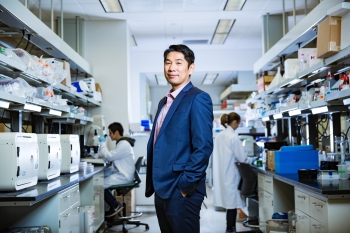
ASU Biodesign Institute Professor Hao Yan is honored with the prestigious Humboldt Award for his pathbreaking contributions to the field of DNA nanotechnology. Graphic by Jason Drees
Hao Yan, director of the Biodesign Center for Molecular Design and Biomimetics at Arizona State University and the Milton D. Glick Distinguished Professor within ASU’s School of Molecular Sciences, has been honored with the Humboldt Research Award by the Alexander von Humboldt-Stiftung Foundation.
This prestigious $65,000 award acknowledges Yan's extensive achievements in research and education.
"The institute is thrilled that the Humboldt Society is honoring Hao for his pathbreaking research and outstanding contributions as a mentor to young scientists,” says Joshua LaBaer, executive director of the Biodesign Institute.
"Hao has been one of the most prolific global leaders in the field of DNA nanotechnology, a rapidly expanding discipline, transforming everything from disease diagnosis and treatment to microelectronics, computation and data storage."
Each year, the Alexander von Humboldt Foundation recognizes up to 100 international researchers of outstanding repute in their respective fields, honoring their comprehensive academic contributions. Recipients are invited to undertake a research initiative in Germany, collaborating with expert peers. The award enables a stay of between six months and a full year, which can be split into multiple stays.
In 2024, the Alexander von Humboldt Foundation symposium will take place in Bamberg, Germany, March 21–24. The 2024 annual meeting is scheduled for June 26–28 in Berlin.
Yan will be hosted by Professor Laura Na Liu, who heads the 2nd Physics Institute at University of Stuttgart. The award presents Yan with the opportunity to foster collaborative endeavors with other notable German scientific institutions.
A trailblazer in DNA nanotechnology and bio-inspired molecular design, Yan's innovative work involves manipulating DNA on a nanoscale (or billionths of a meter). His leadership in crafting designer nanostructures and nanorobots for applications such as cancer detection, imaging, computing and electronics has significantly influenced the DNA nanotechnology research sector worldwide. The tools developed in his lab are crucial to the rapid progression of molecular engineering.
Yan's research has culminated in more than 230 publications, with over 40 in esteemed journals like Science, Nature and Cell, including cover features.
Acknowledged for his dedication to mentoring, Yan has guided more than 30 mentees to faculty positions at institutions worldwide, including Yale, Emory, Rutgers, University of Florida, Tsinghua University, Nanjing University, Chinese Academy of Sciences and the Indian Institute of Technology. His former students have also achieved leadership roles in the chemical and biotech industries.
Yan is an elected fellow of the U.S. National Academy of Inventors (2022), American Institute for Medical and Biological Engineering (2023) and the American Association for Advancement of Science (2019). He is the recipient of the Foresight Institute Feynman Prize in Nanotechnology (2020) and the Rozenberg Tulip Award in DNA Computing (2013).
Other honors include Fast Company’s 100 Most Creative People (2019); Alfred P. Sloan Research Fellowship (2008); National Science Foundation CAREER Award (2006–2011); and Air Force Office of Scientific Research Young Investigator Award (2007–2010). He currently serves as an associate editor for ACS Applied Bio Materials and as an academic associate editor for Science Advances, and has previously served as the president of the International Society for Nanoscale Science, Computation and Engineering (ISNSCE).
More Science and technology

ASU research is helping solve crimes
On TV, detectives solve crimes in 43 minutes (plus commercial breaks). In real life, it takes much more time — and many more minds, including researchers discovering new ways to analyze evidence and…

Compact X-ray laser lab aims to reveal deep secrets of life, matter and energy
X-rays allow us to view inside the human body to diagnose broken bones and other hidden problems. More recent X-ray advances are making it possible to see events at the scale of atoms and molecules,…

Apollo lunar samples enable ASU researcher to pinpoint moon’s crystallization timeline
A team of researchers, including Arizona State University geochemist Melanie Barboni, in collaboration with scientists from The University of Chicago, have made a new discovery about the history of…