

Judith Karshmer doesn’t mince words when it comes to the nursing shortage in Arizona and the rest of the country.
“This is a dire nursing need,” said Karshmer, dean of Arizona State University’s Edson College of Nursing and Health Innovation.
The average national vacancy rate for registered nurses in hospitals in 2022 was approximately 10%, and a study from the U.S. Department of Health and Human Services projected that the demand for registered nurses nationwide will be more than 3.6 million by 2030.
That’s why a $5.5 million grant ASU recently received from the Arizona Department of Health Services is significant.
The funds will result in a new cohort of 104 nurses starting this summer and graduating in summer 2024.
ASU’s grant has three specific and important criteria:
- As required, 80% of the money will be used for scholarships that will pay tuition and fees for the 104 students.
- Twenty percent of the money will be used to hire two new full-time faculty members and part-time faculty. Faculty help is needed because according to an American Association of Colleges of Nursing report on 2021–22 Enrollment and Graduations in Baccalaureate and Graduate Programs in Nursing, U.S. nursing schools turned away 91,938 qualified applications in 2020 due to an insufficient number of faculty, clinical sites and classroom space, as well as budget constraints.
- Finally, the grant stipulates that students awarded the scholarship must commit to staying and practicing in Arizona for four years, thus having a direct impact on Arizona families.
“Our goal is to have the students getting experience there to stay there,” Karshmer said. “Hopefully, it will give them a chance to think about moving to or working in, say, Wickenburg or one of those other small towns.”
Karshmer said diversity will be important in selecting the 104 students.
A National Institute of Health Studies report showed residents of underserved and rural areas are more likely to identify with and seek health care from individuals who are representative of their own communities.
“It’s quite a robust finding, whether it’s language, culture or just proximity,” Karshmer said. “We are trying to be really thoughtful about this. Our goal as a college is to have our graduates and our faculty look like the state of Arizona, and we need to do more work in that area.”
The scholarship money will go a long way toward satisfying the diversity component, Karshmer said.
Edson College has the infrastructure to handle the additional 104 students. In addition to its presence on the Downtown Phoenix campus, it has a location in Lake Havasu that opened two years ago, it expanded to the West campus last fall and it will have a presence at the Polytechnic campus this fall.
“We have the mechanism to secure these additional placements,” Karshmer said.
Although the grant will expire after the cohort graduates in 2024, it’s Karshmer’s hope that the impact of the grant will last for years to come.
“If it is successful and these graduates stay in Arizona, maybe the collective will in the state is that we really need to put this kind of support into the preparation of nurses,” she said. “Who knows? It might happen.
“I’ll tell you what, though. It will help Arizona State University. It will help establish further infrastructure for students. Even though we won’t have this scholarship money for them, we will have access to and for them. That’s good for ASU and good for the state.”
For more information or to learn about eligibility, email or call AcceleratedBSN@asu.edu or 602-496-0937.
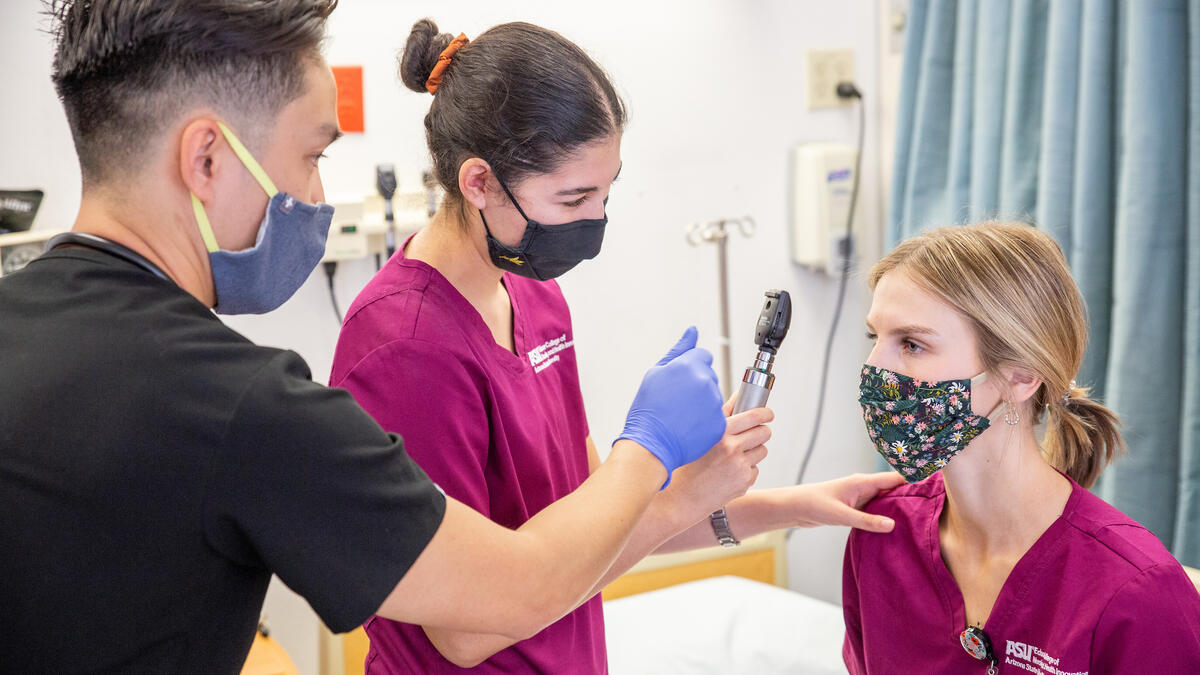
Top photo: Faculty Associate Joseph Tran helps train Edson College prelicensure students. Photo by Mitchell Tay/ASU
More Health and medicine

College of Health Solutions launches first-of-its-kind diagnostics industry partnership to train the workforce of tomorrow
From 2007 to 2022, cytotechnology certification examinees diminished from 246 to 109 per year. With only 19 programs in the United States, the cytology workforce that stands at the front line of…

ASU's Roybal Center aims to give older adults experiencing cognitive decline more independence
For older people living alone and suffering from cognitive decline, life can be an unsettling and sometimes scary experience.Arizona State University is out to improve that experience.Two projects…

Dynamic data duo advances health research
The latest health research promises futuristic treatments, from cancer vaccines to bioengineered organs for transplants to medical nanobots. While these technologies may one day be…