

Editor’s note: This story is featured in the 2022 year in review.
Since childhood, Payton Major has worked diligently to realize her dream career.
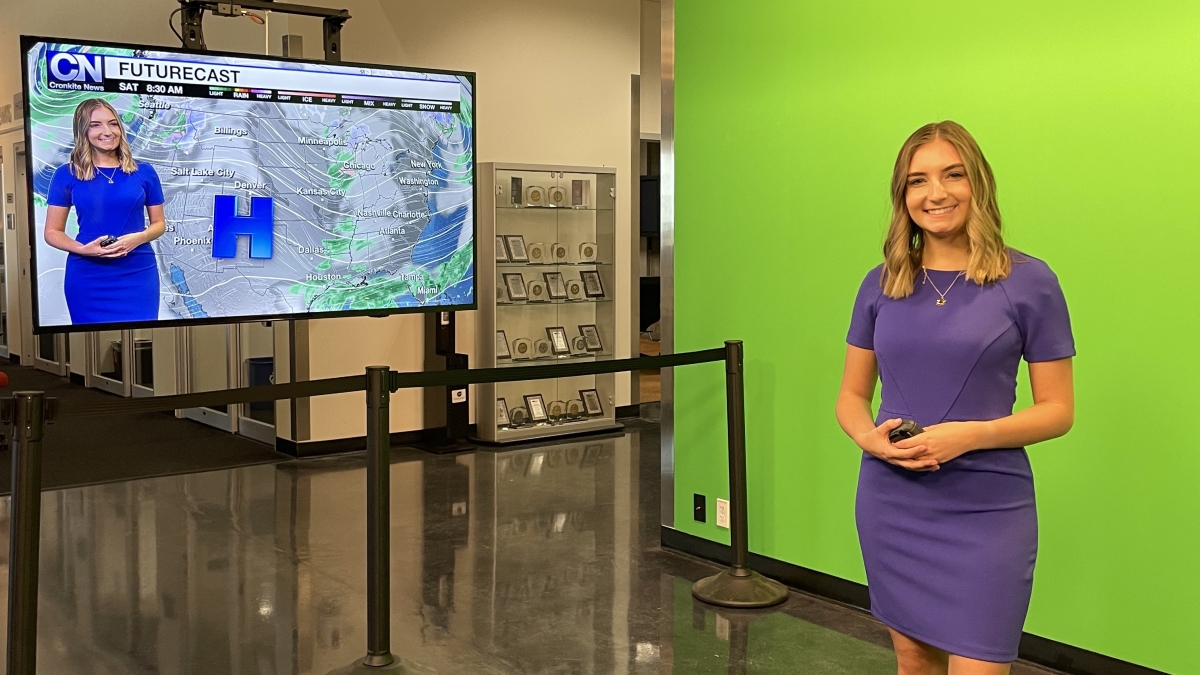
When she was 12, Major waited outside a Portland, Oregon, news station for hours to get her first glimpse of what a TV newsroom looked like. In high school, she convinced her principal to let her turn an empty room with a greenscreen into her video testing ground. And in her first few years at Arizona State University, Major both helped establish ASU’s weather club and anchored Cronkite News’ weekly weather broadcast.
Now, Major, a senior who is double majoring in geography (meteorology) and journalism and mass communication, will be traveling this week to CNN’s world headquarters in Atlanta, where she will be serving as the network's 2022 Summer Weather and Climate Intern – and one step closer to becoming a broadcast meteorologist.
“CNN is something I have watched as a little girl, so this is so surreal,” Major said, who bested a competitive nationwide pool of applicants for the sole position that will run from early June until mid-August. “I never ever thought I would be here ... I'm so excited.”
In her role, Major will support the weather and science needs for all CNN on-air and digital platforms. She’ll assist the production of on-air weather content, research stories and help create digital weather and science coverage for CNN’s millions of viewers around the world. Major also will learn to use advanced weather graphics software and build elements for on-air use.
“I'm really excited to use the technology that CNN has,” said Major, who is also earning a certificate in atmospheric sciences from ASU. “CNN has state-of-the-art technology when it comes to camera movement and augmented reality to make sure that the audience is obtaining what we're saying.”
Major is a part of ASU's dual degree program, where students can enroll to receive dual degrees in both meteorology and journalism in less time by streamlining the admissions process and course requirements.
The program offered through the School of Geographical Sciences and Urban Planning and the Walter Cronkite School of Journalism and Mass Communication teaches students advanced skills in reporting, videography and multimedia journalism, in addition to the skills needed to run computer-based weather models, analyze remote sensing data and interpret the complexities of climate science.
“My goal is to make weather and climate understandable to the public,” Major said. “There’s something fascinating about the power of weather. Extreme weather events can change someone's life in seconds. I always knew weather is something that will always be important.”
For Major, this accomplishment represents yet another step in her commitment to her goal, the hard work that is required and her continued dedication to face the challenges ahead.
“It hasn't been an easy journey whatsoever,” said Major, who, on top of balancing a rigorous academic course load, works four jobs. “It took a lot to get to where I am, and I'm sure it'll take a lot more to get further.
“But with passion, it doesn't matter what circumstances you're faced with if you have something that drives you. I'm just really excited. I am one step closer. Anything I can do to get closer to that dream.”
Top photo courtesy Payton Major
More Law, journalism and politics

Can elections results be counted quickly yet reliably?
Election results that are released as quickly as the public demands but are reliable enough to earn wide acceptance may not always be possible.At least that's what a bipartisan panel of elections…

Spring break trip to Hawaiʻi provides insight into Indigenous law
A group of Arizona State University law students spent a week in Hawaiʻi for spring break. And while they did take in some of the sites, sounds and tastes of the tropical destination, the trip…

LA journalists and officials gather to connect and salute fire coverage
Recognition of Los Angeles-area media coverage of the region’s January wildfires was the primary message as hundreds gathered at ASU California Center Broadway for an annual convening of journalists…