2 graduating doctoral students offered assistant professorships

Leslie Del Carpio
Two graduating doctoral students from Arizona State University's School of International Letters and Cultures (SILC) who began their studies together four years ago have both accepted job offers to begin their careers as assistant professors at U.S. universities this fall.
Leslie Del Carpio and Valeria Ochoa, both part of the PhD program in Spanish linguistics, are excited to move immediately into the next phase of their professional lives after graduating this year.
Del Carpio accepted a position as an assistant professor of Spanish heritage language and linguistics at Indiana University, while Ochoa will be an assistant professor of Hispanic/Latino/a studies at the University of Puget Sound.
Their success on the academic job market is a testament to the work the school's faculty and staff put into preparing the school's students for their future careers, whether within academia or in other related fields, such as international relations, public policy, sustainability, education and translation.
“The job market is an arduous process that can take up a lot of time and energy,” Del Carpio said. “Once I learned that I had been offered the position at Indiana, I felt as if all my hard work had been validated and became excited about the next step in my career.”
She will begin by teaching courses on Spanish writing for heritage speakers and introductory Hispanic linguistics at Indiana University. This will build off of her work with Spanish heritage speakers — those who grew up with Spanish being spoken at home or in their community — at ASU, as well as her roles as a graduate teaching associate and mentor to incoming graduate students.
Del Carpio learned from her own experiences overcoming adversity how to support students during times of success and struggle. She moved to the United States from Lima, Peru, at the age of 11, without knowing English. A first-generation student, she earned bachelor’s and master’s degrees from the University of Illinois Urbana-Champaign before coming to ASU for her PhD studies.
“I decided to continue my studies at SILC due to the amazing quality of the professors in the program. I liked that the professors in the Spanish linguistics department had interests that were similar to mine,” Del Carpio said.
Once at ASU, she was faced with the challenge of completing her degree program while in the middle of a pandemic. During that time, her dad passed away, adding to the weight on her shoulders and leaving her without a part of her support system.
“Sometimes I think that I downplay the journey that has gotten me to where I am now,” Del Carpio said. “While life has gotten harder, it is important to find reasons to keep going. I understand that it is not always easy to find your way in the world of academia. It can sometimes be hard to ask for help or figure out what questions to ask. There are also pressures that one faces because they know they have to succeed.”
For her, two of those reasons to keep working toward her goals have been her students, whom she said she is always learning from, and her own mentors.
“I have been lucky to always encounter at least one good mentor who I saw as an example and who I saw myself in, which highlights the importance of representation. They believed in me and pushed me to do my best, which always encouraged me to go for my goals. I hope that as a mentor I have been able to do the same,” she said.
One such mentor is Sara Beaudrie, associate professor of Spanish linguistics, who oversees both the Spanish language program and the Spanish heritage language program.
“Leslie has made remarkable progress in her four years at ASU,” Beaudrie said. “Leslie has had the opportunity to obtain research publication experience with both professors and fellow students, and that helped her be ready to take on the challenges of being an assistant professor at a top research university. This PhD also prepared her to conduct research with LatinxLatinx is a gender neutral term some prefer to use for a person from, or whose ancestors were from, a Spanish-speaking land or culture, or from Latin America. populations in the United States."
Beaudrie was a co-chair of Del Carpio’s dissertation, which “analyzes the use of the Spanish past tense in three-generation Spanish-English bilinguals,” Del Carpio said.
Her goals for her research include empowering U.S. Spanish speakers to utilize their voices and bringing awareness of this specific minoritized linguistic variety to Spanish speakers inside and outside the Spanish language classroom.
Del Carpio’s dissertation “presents groundbreaking research that seeks to contribute to the burgeoning field of Spanish in the U.S. and heritage language education. Her research makes an innovative contribution by analyzing corpus data with actual speech samples from these speakers,” Beaudrie said.
She explained that the Spanish linguistics PhD program that Del Carpio and Ochoa are a part of is designed to graduate future leaders in the field of heritage language pedagogy and research. The two students were even able to publish an article they co-wrote together along with Assistant Professor of Spanish Marta Tecedor in the Journal of Pragmatics, and they have another article forthcoming, as well.
There are currently only a few jobs available in this competitive area of expertise, Beaudrie said, so both students’ accomplishments are “truly outstanding.”
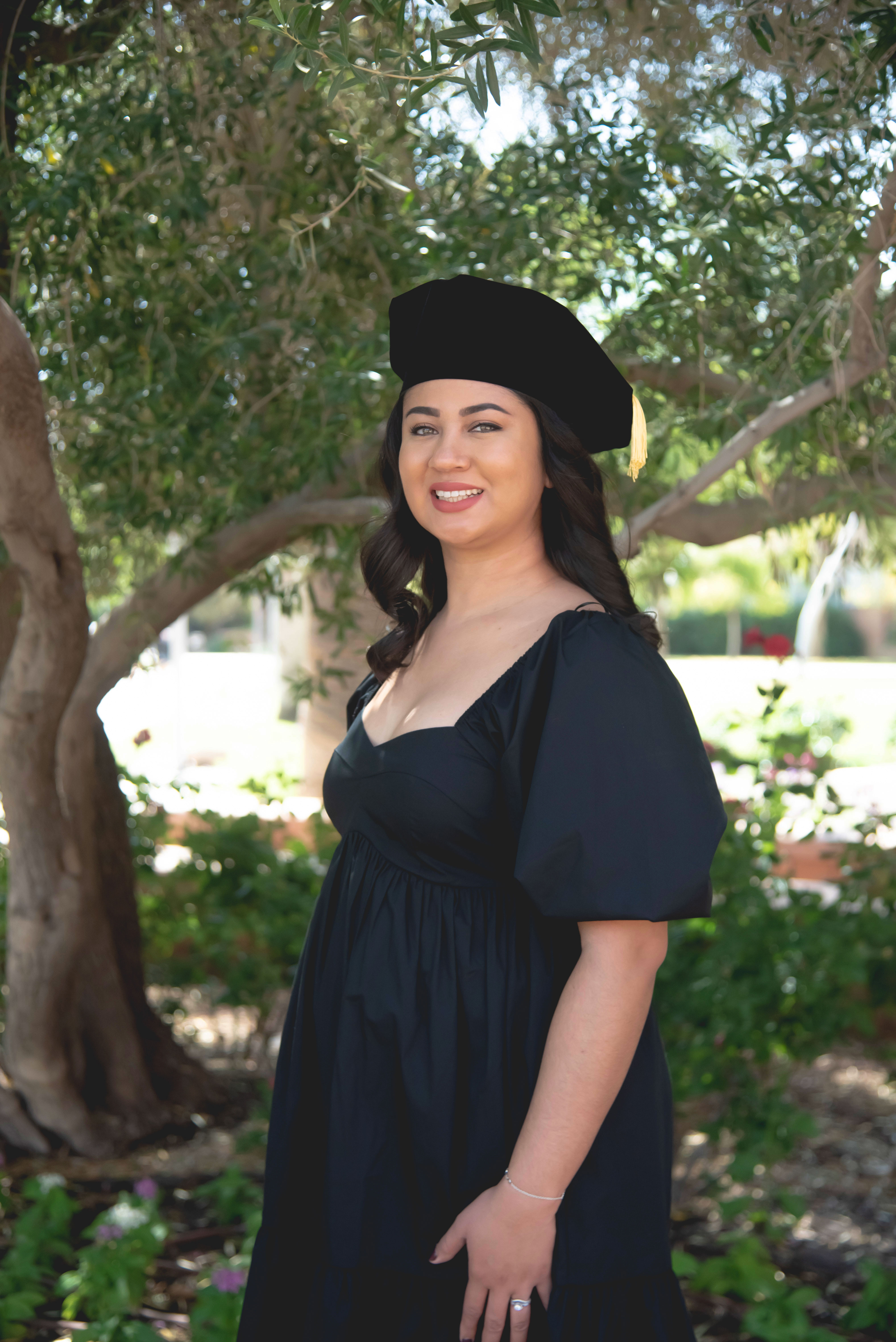
Valeria Ochoa
Ochoa said the school's unique approach to the subject of Spanish as a heritage language is what drew her to attend ASU after earning a bachelor’s degree at the University of Nevada, Las Vegas, and a master’s degree at the University of Oregon. During her master’s studies and while completing an internship at the Center for Applied Second Language Studies, Ochoa discovered she wanted to pursue these subjects further.
“I realized during my master’s that I wanted to continue on to do a PhD in order to be able to be one of the few researchers in the field of Spanish as a heritage language that also identifies as a heritage speaker of Spanish herself,” said Ochoa, who describes herself as a first-generation Mexican American and daughter to two Mexican immigrants from Guadalajara and Tepic.
“I chose (the School of International Letters and Cultures) given that it houses one of the only programs in the whole world with a track specifically designed to research Spanish as a heritage language and teach in a Spanish heritage language program.”
Ochoa served as a graduate teaching associate at ASU and will cover similar ground in her job at the University of Puget Sound, where she expects to teach courses on Spanish linguistics, U.S. Spanish and Latino/a studies.
She was with Beaudrie, her adviser, when she received the university's email that they wanted to hire her.
“I was completely shocked when I found out I was being offered the position,” Ochoa said. “Anyone who has spent time looking for a job in academia is aware of how grueling and often disheartening the process is given that sometimes it can just be a matter of luck. I spent many hours drafting documents, doing mock job talks and going over resources online that provided advice from numerous professors and professionals.”
Her years of hard work — dating back to her undergraduate education — paid off. Now, Ochoa will get to continue the research, teaching and mentorship she is passionate about, and continue to learn on the job from other scholars in her field. This includes hopefully building off her dissertation research, which examined the perspectives of Indigenous instructors and students within Spanish heritage language education.
“I want nothing more than to support other Latinx students, especially considering how few Latinas in the U.S. hold PhDs,” Ochoa said. “My goal is not to focus solely on their academic or linguistic development, but also their development as a fully confident and critically aware Latinx person in the U.S.”
Assistant Professor of Spanish Michael Gradoville, who was a member of Ochoa’s dissertation committee, said this dedication to her peers and her community is what distinguishes her research.
“While the heritage language field itself exists as an instrument of inclusion of speakers of minority home languages, Valeria's research helps advance this inclusive mission of heritage language studies by broadening perspectives on what it is to be a speaker of Spanish as a heritage language in the United States,” Gradoville said.
He explained that Indigenous Spanish-speaking immigrants are often marginalized in their countries of origin, a process that continues in the United States when they are grouped together with people of other Hispanic identities at the expense of their Indigenous heritage and cultures.
Ochoa’s research centers these individuals and ultimately reveals that this category of Spanish speakers is far more diverse than many have portrayed it to be. That diversity should be celebrated, she said, and Spanish speakers of all backgrounds deserve to be supported in the fields of language learning and higher education.
“Everything I have ever done is for my community, my people, my family. Nothing makes me happier than having the opportunity to make a difference for someone who never in their wildest dreams thought they would be able to achieve their goals,” Ochoa said.
More Arts, humanities and education

Barbie partners with ASU FIDM on summer fashion camps
Barbie, the iconic fashion doll by Mattel Inc., and Edikted, an LA-based style-led contemporary fashion brand, are teaming with…

From Scottsdale to LA: ASU FIDM takes the runway
The ninth annual ASU FIDM Fashion Show expanded beyond Arizona for the first time this year with a debut show in Los Angeles.…

ASU filmmaker highlights lifesaving work during a Phoenix heat crisis
A new documentary by an Arizona State University filmmaker captures the frantic moment when medics bring a man back from the…