

ASU to have total of 7 Academy of Social Work and Social Welfare Fellows in 2022
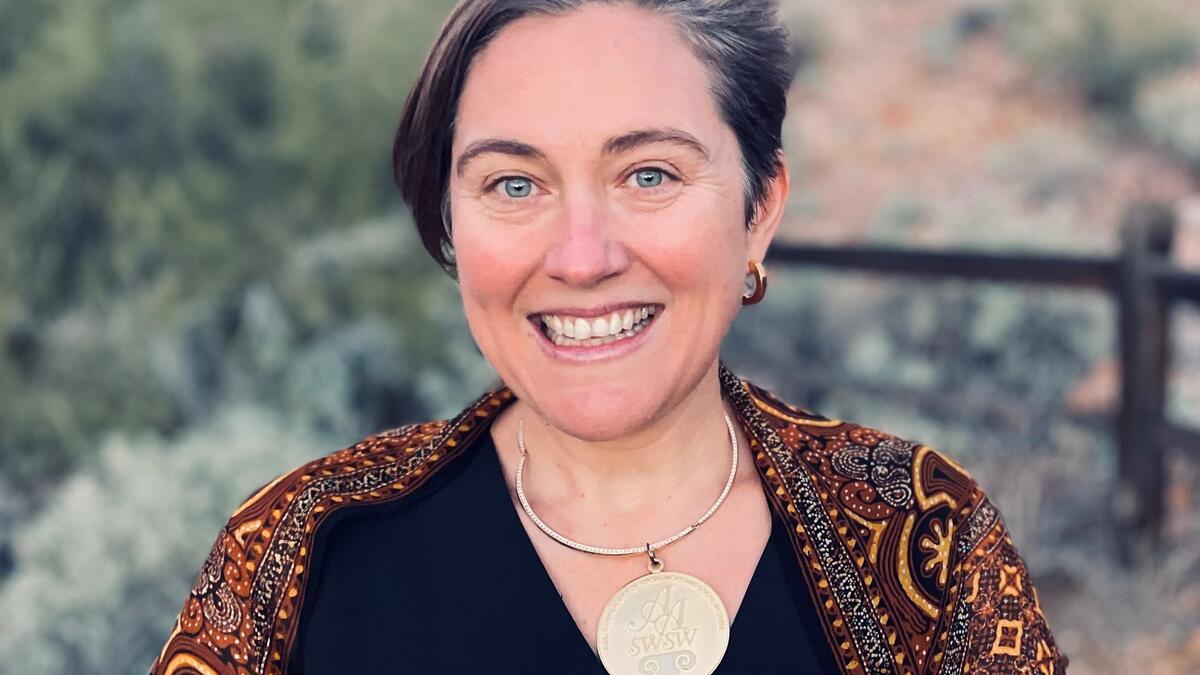
Professor Jill Messing of the ASU School of Social Work wears a medal designating her induction as a fellow of the American Academy of Social Work and Social Welfare. Photo courtesy Jill Messing
The American Academy of Social Work and Social Welfare‘s selection of a professor as one of its fellows represents a major distinction for that professor’s institution.
This year, Arizona State University will have seven, all active members of the School of Social Work faculty.
The sixth, Professor Jill Messing, will be inducted at a Jan. 19 virtual ceremony. Renee Cunningham-Williams will be ASU’s seventh AASWSW Fellow when she joins the School of Social Work faculty in August from another university, where she was serving when she became a fellow in 2021.
Cunningham-Williams was inducted into the academy in 2021 while a faculty member at Washington University in St. Louis. The ASU School of Social Work’s other AASWSW Fellows are: Professor David Hodge, Communitas Professor Craig Lecroy, School of Social Work Director and Foundation Professor Elizabeth Lightfoot, Regents Professor Flavio Marsiglia and Arizona Centennial Professor of Social Welfare James Herbert Williams.
Being named a fellow is not something one applies for, but must be nominated for by a current academy member, Lightfoot said.
An extensive vetting process follows, and nominees are never told they were considered unless they are inducted, added Lightfoot, who was inducted in 2020 while teaching at the University of Minnesota. She became ASU’s School of Social Work director in July 2021.
Since 2009, the academy has inducted more than 140 fellows, described as “prominent scholars, top researchers and practitioners, with unparalleled insight and professional experience. Academy research makes exceptional contributions in our field and beyond.”
Messing, who is director of ASU’s Office of Gender-Based Violence, has been a member of the School Social Work faculty since 2008. She earned a PhD in social welfare and a master's degree in social work from the University of California, Berkeley.
Messing said she’s honored to join many accomplished scholars from across the discipline of social work.
“Social work is an exciting field with tremendous potential to change the world. Being inducted into the academy shows that the work that I’m doing is making a difference,” she said.
Lightfoot praised Messing’s induction as testimony to her impressive body of work and its impact on the social work field.
“Professor Messing is most deserving of this rare and special distinction,” Lightfoot said. “Induction in the AASWSW clearly demonstrates how her vital research regarding gender-based violence continues to bring honor to both her own highly accomplished career and to our school and university. I know our colleagues join me in extending to her heartiest congratulations.”
Messing said her selection tells her that, with the help of many others, she is accomplishing something in domestic violence research.
“Being recognized by my colleagues in this way is an honor. It affirms that I am making a difference in the social work profession and contributing to change in our society,” Messing said. “I haven’t done this work alone. I had great mentors, colleagues and students; I am deeply grateful to them and to the women who have shared their stories of trauma and strength to contribute to my research. They have each helped move the field forward and contribute to domestic violence prevention and intervention.”
More Arts, humanities and education

ASU+GSV Summit brings experts together to discuss advancements in education
Arizona State University President Michael Crow kicked off the ASU+GSV education technology summit in San Diego on Monday with a…

ASU professor's project helps students learn complex topics
One of Arizona State University’s top professors is using her signature research project to improve how college students learn…

Award-winning playwright shares her scriptwriting process with ASU students
Actions speak louder than words. That’s why award-winning playwright Y York is workshopping her latest play, "Becoming…