
It’s the year 1500. A buyer and a seller are haggling in the massive Aztec marketplace of Tlatelolco, over chiles, cacao beans or copal incense perhaps. It’s getting heated.
“Swallow-mouthed!” (Such a chatterer!)
“Have you become a wild bee?” (So puffed up.)
“Where is the sorcerer?” (Are you trying to stiff me?)
“Is it your real nose?” (Honestly?)
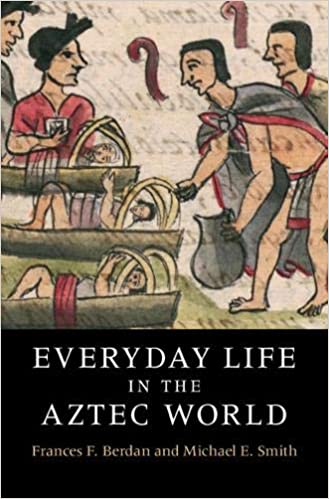
Welcome to "Everyday Life in the Aztec World," a new book co-authored by archaeologist Michael Smith, a professor in Arizona State University’s School of Human Evolution and Social Change.
Incredibly vivid and detailed, the book takes readers on a tour of one of Mesoamerica’s greatest civilizations through the daily lives of six people – the emperor, a priest, a featherworker, a merchant, a farmer and a slave – and four events – the birth of a child, a market day, a day in court and a battle.
The book is like a trip back through time with two expert guides. Interspersed throughout the chapters are fictional vignettes like the haggling at the market, a frantic novice priest who finds himself short of human sacrifices on the eve of an important ceremony, a slave who has been slacking off weaving and learns her owners are considering selling her to the priests, and an ambitious farmer who may have bitten off more than he can chew.
But it’s not exactly fiction. Every single detail and fact is real.
“We’re not novelists,” said Smith of his collaboration with Frances Berdan, professor emeritus of anthropology at California State University, San Bernadino. “We’re scholars.”
Smith has worked in Mexico for decades and directs ASU’s Teotihuacan Research Laboratory in Mexico. Berdan speaks Nahuatl, the Aztec language, and is an expert on Spanish colonial documents like the Florentine Codex, a 16th-century ethnography written by the Spanish Franciscan friar Bernardino de Sahagún.
“We both sort of had fun with these little fictional vignettes,” Smith said. “That kind of thing is fun to do, but if you do too much of it … We're trying to write history; we're trying to write archeology. We're not trying to write fiction about the Aztecs, but adding those (vignettes) sort of lends a certain level of immediacy to it. And it was a lot of fun. I really enjoyed it and the ones that I wrote tie in … to specific sites I've worked at and things I've done.”
Even if you’re somewhat familiar with the period and culture, surprising facts leap out:
- Priests were regarded as somewhat creepy. “There was probably a basic wariness around someone who controlled mysterious and powerful forces,” Smith said. Not helping may have been the fact that priests never washed their hair, which was matted with dried human blood from sacrifices. (Aztecs were clean people who bathed regularly.)
- If things weren’t working out for you, you could simply pick up and leave. It wasn’t medieval Europe, where that wasn’t an option. You went to another village and pled your case before the local council, who would place you with a family who needed help with farming or pottery making or the like.
- If things really weren’t working out for you, you could sell yourself into slavery. You could also buy your way out of it (although it wasn’t easy).
- One category of society were “bathed” slaves, destined for a one-way trip to the top of a temple, and there was no way out of that.
Along the way, the book provides glimpses of Aztec culture that remain today in Mexico. For instance, Aztec markets were almost exactly like big Mexican markets today, like the Libertad in Guadalajara, where everything has its own place: the saddle aisle, the live bird aisle, and so on. The Tlatelolco marketplace was surrounded by arcades, as in many Mexican cities today, where goods cost a bit more than those sold out on the plaza. And the basic setup for a seller — goods spread out on a tarp on the ground, with an awning overhead to shield the sun – has not changed at all in five centuries.
“I think a lot of what still exists in Mexico today in Mexican culture are not the big things like the empire and the big pyramids and the sacrifices, the offerings — it's the everyday kinds of things,” Smith said. “It's the way people build their houses and the way things are laid out on the ground, the marketplaces, that kind of thing.”
As the introduction notes, “We are fortunate to glimpse this colorful, vibrant world.”
Top image: Aztec stone cuauhxicalli of Moctezuma. Aztec Gallery of the National Museum of Anthropology, Mexico City. Photo courtesy of Wikimedia
More Arts, humanities and education

Building resilience in the foster care system, from advocates to children
In Arizona alone, nearly 76,000 children are in the foster care system, with only 3,000 registered foster families. That averages out to five children per foster family. In the T.…

First convocation in Los Angeles marks graduation milestone for ASU
While audiences in the Beaudry Theater are usually encouraged to keep quiet, friends and family burst into cheers to celebrate graduating Sun Devils at Arizona State University’s first-ever…

ASU’s Deer Valley Petroglyph Preserve hosts first anthropology camp for high school students
It’s a bright, Saturday morning in north Phoenix as four high school students make their way into ASU’s Deer Valley Petroglyph Preserve. But they weren’t there to walk the trail, visit the museum or…