Forecasting Arizona’s economy: The case for a V-shaped rebound
Editor's note: This story originally appeared in the summer 2020 issue of ASU Thrive magazine.
Even though the Grand Canyon State experienced record-shattering job losses and economic contraction during the pandemic, there’s hope the pain will be short-lived. Strong underlying fundamentals, an influx of stimulus money and ASU’s support for innovation could help stave off an extended recession.
Prior to COVID-19, Arizona had one of the strongest economies in the country in terms of population growth and job creation, says Lee McPheters, director of the JPMorgan Chase Economic Outlook Center at ASU. In 2019, the state added a record 80,000 new jobs while wages increased 4.4% compared to the nationwide average of 3%.
“We went from one of the most thriving economies in the country to double-digit unemployment. It’s probably the worst we’ve seen since the Great Depression, but we’re following the national cycle,” McPheters said.
In the seven weeks ending May 4, more than 514,000 Arizonans applied for unemployment benefits, according to the state Department of Economic Security. The number translates to a 15% unemployment rate, with some of the biggest job losses in tourism, hospitality and restaurants.
Of surprise are the declines in health care, an industry that is often recession-proof. The postponement of elective surgeries (a large source of profit for many hospitals) has taken a toll on health facilities in Arizona and nationwide. Health systems and hospitals across the U.S. are on track to lose more than $202 billion between March 1 and June 30, according to a report by the American Hospital Association.
Yet, there are some glimmers of hope, especially in knowledge-based industries, biotech and high-tech manufacturing, McPheters said. Some manufacturers have been able to help the response and capitalize on new opportunities by converting facilities to the production of personal protective equipment. For example, one Honeywell facility in Phoenix shifted operations to producing N95 masks, using 150 employees working three shifts, six days per week. Combined with another Honeywell facility in Rhode Island, the company will make 20 million masks per month.
A strong startup economy
Entrepreneurship and innovation could also help drive the state recovery, said Ji Mi Choi, associate vice president of Entrepreneurship and Innovation, ASU Knowledge Enterprise. Between December 2019 and May 2020, the number of startups the office works with rose from 467 to 548.
“The adage that necessity is the mother of invention rings true. There is generally an uptick and increase in new business formation that happens after a disturbance,” Choi said.
Some of the potential market opportunities include new solutions to support e-commerce and food delivery, sanitation products and services, and remote health applications. As it has for years, ASU will play a strong role in developing and nurturing the innovation economy.
“Universities have a significant talent pool and a way to work with a built-in audience who are already eager, motivated and hungry to make an impact in the world,” McPheters said.
Replacing lost jobs
As a basis for his forecast, McPheters follows the Blue Chip Economic Indicators, an organization that has polled top economists each month since 1976. The consensus calls for an extremely weak second quarter with as much as a 35% drop in GDP, followed by a slow recovery in Q3 and Q4 that will recoup roughly half of the job losses.
“It doesn’t get us back to where we were, but we’ll start replacing lost jobs, and then, we’re expecting that in 2021, we’ll recover another 100,000 jobs with job growth in the 4% to 5% range,” McPheters said.
One benefit that has only started to flow into the economy is the unprecedented stimulus money under the Coronavirus Aid, Relief, and Economic Security (CARES) Act, McPheters said. As of early May, Arizona businesses had been awarded 19,280 Paycheck Protection Program loans for a total of $4.8 billion.
With solid underlying fundamentals and incoming stimulus funds, there’s a strong case for a V-shaped recovery that will return Arizona as one of the top-performing economies in the U.S. when the public health issues are mitigated, McPheters said.
Yet economists’ forecasts are based on a “huge assumption” that a COVID-19 vaccine will be created in the next 12 months, McPheters said. Some health experts have already cautioned about a second wave of infections that could be worse than the first and could lead to more lockdowns and more economic damage.
“There’s national optimism, but no one knows; we’re in unprecedented times,” McPheters said. “There’s tremendous uncertainty, and we just don’t have any basis for a forecast or a model that tells us what to expect.”
Get business resources, including partnership options, at wpcarey.asu.edu/corporate-relations.
ASU has numerous resources, including free mentoring at entrepreneurship.asu.edu.
Written by Craig Guillot.
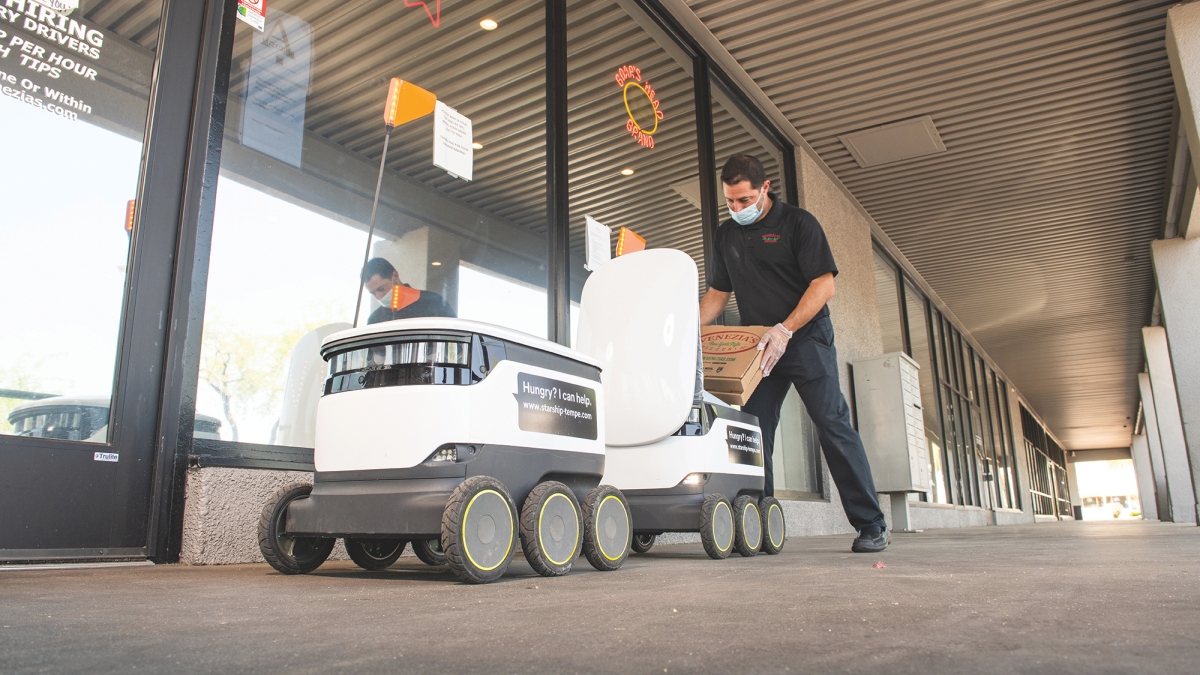
Top photo: During the pandemic, Venezia’s New York Style Pizzeria in Tempe, owned by Domenick Montanile, ’98 BS in purchasing/logistics management (pictured), began offering curbside pickup as well as robot deliveries. The business is recognized as a Sun Devil 100. Photo by Jarod Opperman/ASU
More Business and entrepreneurship

New rankings show impact of ASU W. P. Carey School of Business
Good rankings for Arizona State University's W. P. Carey School of Business reinforces the school's commitments to access, excellence and innovation.This week, the Financial Times Business Education…

Arizona Business and Health Summit asks attendees to innovate for value
Arizona State University's W. P. Carey School of Business hosted the third annual Arizona Business and Health Summit, sponsored by the Arizona Biomedical Research Centre, on Thursday, Nov. 14, in…

An economic forecast with lots of variables
The prospect of a new presidential administration is prompting some discussions among top economists.Tariffs, immigration, possible deportation, tax cuts and reduced renewable energy credits are top…