

ASU researcher's cancer paper makes top 100
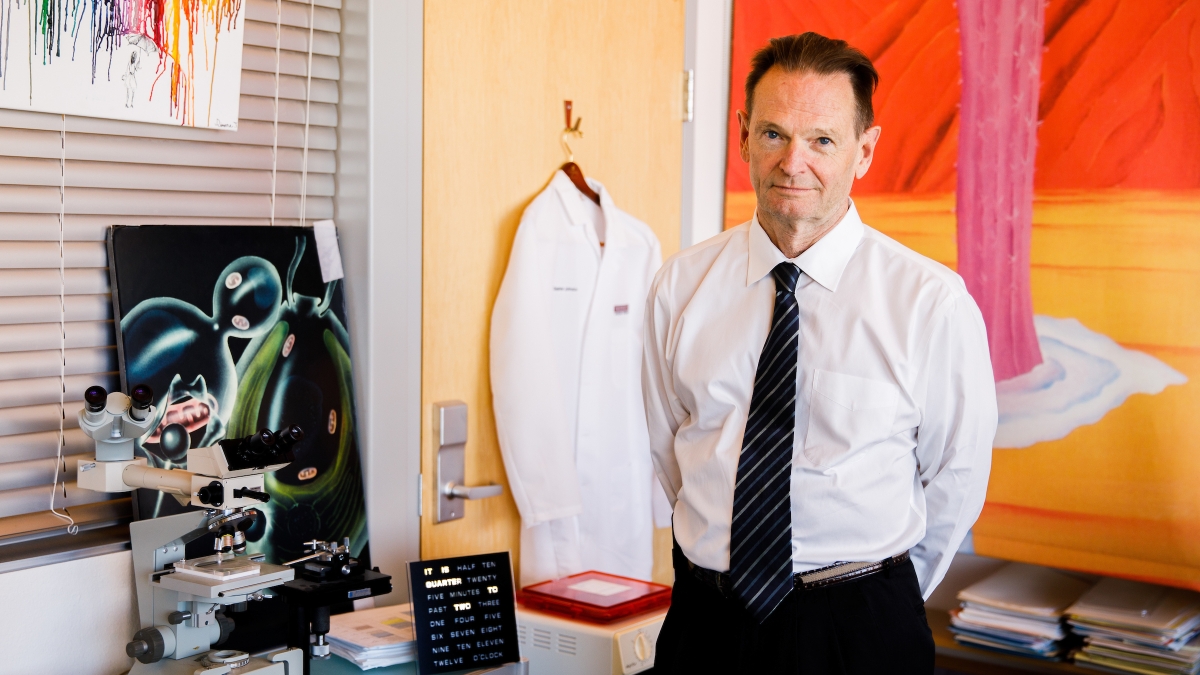
Stephen Albert Johnston directs the Biodesign Center for Innovations in Medicine and is a professor in the School of Life Sciences at ASU. Photo by Andy DeLisle/ASU
News that Stephen Albert Johnston’s published approach to cancer prevention is one of 2019’s most downloaded papers in cancer research is testament to scientific interest in breakaway approaches to cancer. Today, Johnston’s paper is 14th most popular among more than 1,000 papers submitted to Nature Scientific Reports from across the world.
“The work we reported represents the foundational research for the vaccines and diagnostics we have been working on for 15 years,” said Stephen Albert Johnston, director of the Biodesign Center for Innovations in Medicine at Arizona State University’s Biodesign Institute. Johnston is also a professor in the School of Life Sciences.
“We are now translating it to clinical applications that we hope could end deaths from cancer,” he said.
Johnston’s startup, Calviri, was established to “provide affordable products worldwide that will end deaths from cancer by combining a unique, highly immunogenic source of neoantigens with a peptide array platform.”
"RNA Transcription and Splicing Errors as a Source of Cancer Frameshift Neoantigens for Vaccines” is the result of the work of Johnston and his team, including first author Luhui Shen and coauthors Jian Zhang, HoJoon Lee and Milene Tavares Batista. Phillip Stafford, Tsukasa Oyama and Bao-Xi Qu performed the early foundational research and statistical analyses for the work.
Johnston’s team is approaching the concept of cancer in a radically new way — by attacking it like an infectious disease. They hypothesized that by using neoantigens resulting from tumor mutations to design vaccines, they could induce the immune system to target cancer with a high degree of specificity. Neoantigens are molecules occurring on the surfaces of cancerous cells that may be recognized by the body’s defensive T cells and attacked.
The new approach offers a triple-defense therapeutic vaccine, which broadly protects, and is specific to both the cancer-type and its unique mutations. This “designer vaccine” is made possible by using chip technology that allows researchers to screen a patient’s blood sample for an antibody response against a library of 200,000 neoantigens.
The work has moved steadily from concept to discovery, to mice studies, to the largest-ever dog cancer vaccine trial, funded by the Open Philanthropy Project. If that is successful, Johnston is eager to move to the first human clinical trials. Johnston said they have the technology to make the human vaccine right now, but even optimistically, it would be five to 10 years before human use.
“This is probably the only approach to a broadly preventative cancer vaccine, so we feel we have to try it,” Johnston said. “The implications of success would be quite large — for dogs and people.”
The research work is the culmination of years of support, including early, high-risk grants from the Department of Defense and the W. M. Keck Foundation.
Find the complete Top 100 in Cancer list here.
Written by Dianne Price
More Science and technology

ASU professor breeds new tomato variety, the 'Desert Dew'
In an era defined by climate volatility and resource scarcity, researchers are developing crops that can survive — and thrive —…

Science meets play: ASU researcher makes developmental science hands-on for families
On a Friday morning at the Edna Vihel Arts Center in Tempe, toddlers dip paint brushes into bright colors, decorating paper…

ASU water polo player defends the goal — and our data
Marie Rudasics is the last line of defense.Six players advance across the pool with a single objective in mind: making sure that…