

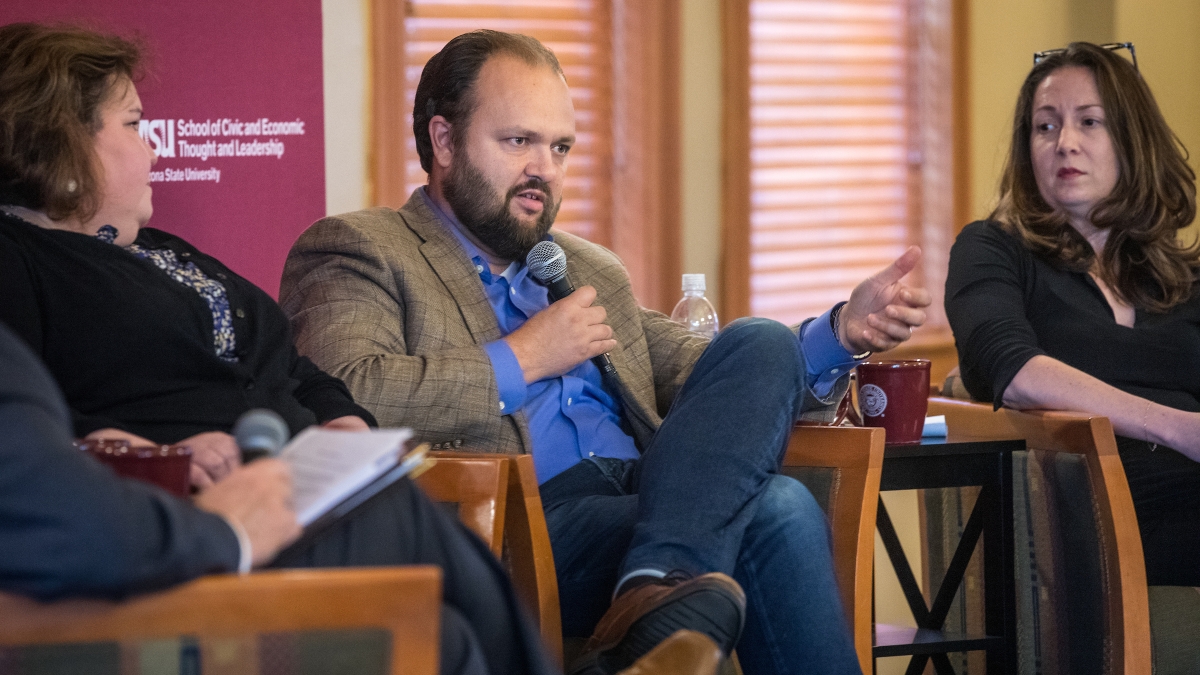
Center for the Study of Religion and Conflict interim director John Carlson warned audience members at an event Tuesday evening on Arizona State University's Tempe campus that they’d better be having a late dinner.
“Many of us grew up being told not to talk about religion and politics at dinner, so I’m going to assume we’re all eating late tonight, because that’s exactly what we’re going to do now,” he said. “Tonight, we’ll be exploring the role religion plays in public life — the good, the bad and the ugly — with a focus on the civic sphere.”
Sponsored by the School for Civic and Economic Thought and Leadership as part of its “Polarization and Civil Disagreement” lecture series, “Religion in the Civic Sphere” featured New York Times op-ed columnist Ross Douthat; editor-at-large for the National Review Kathryn Jean Lopez; and Chicago-based journalist Amy Sullivan, who has covered religion and politics for TIME, Yahoo and the Washington Monthly. Carlson served as moderator, and the Center for the Study of Religion and Conflict as a co-sponsor, along with the University of Mary.
The panel discussion was the second of three public talks related to a project spearheaded by the Center for the Study of Religion and Conflict and the Walter Cronkite School of Journalism and Mass Communication. “Religion, Journalism and Democracy” brings together journalists and religious scholars to exchange insights and expertise in a series of workshops, public talks and private luncheons throughout the fall semester.
“What makes this panel — and the center’s yearlong project — so exciting is the opportunity to advance public understanding about the role of religion in public life," Carlson said. "Religion has always been part of democratic life. The question we need to explore are the ways in which it informs or distorts our visions of what it means to be citizens in a republic.”
The third public talk, “A Conversation on Religion, Journalism and Democracy with Daniel Burke,” takes place Monday, Oct. 29, from 7 to 8 p.m. at the Cronkite First Amendment Forum on ASU’s Downtown Phoenix campus.
The conversation at Tuesday evening’s event was lively, ranging from religious female voting patterns to abortion to civil religion in the Donald Trump White House.
Much of what was discussed was framed by how it might affect the upcoming midterm elections in November. And the “perennial question,” Sullivan said, “is whether Trump is losing evangelical women or not.”
Panelists were uncertain, but Douthat said it’s likely that many evangelical women who voted for Trump did so while “holding their nose,” and that perhaps some of them regret it — something that will be revealed on Nov. 6.
Regarding concerns about freshly appointed Supreme Court Justice Brett Kavanaugh’s stance on abortion rights, Douthat pointed out that while pledging her support for him, U.S. Sen. Susan Collins attempted to reassure the public that Kavanaugh would not overturn Roe v. Wade.
Douthat was skeptical: “Somebody is getting taken for a ride here, and we’ll find out who in the next five years.”
When conversation turned to the state of civil religion in the Trump administration, Sullivan shared an anecdote about her 4-year-old son, who made a comment about the president being mean. She felt it demonstrated how even young children are picking up on public sentiment that the current president is lacking in moral character.
Carlson explained civil religion as the guiding principles of the country that include such notions as freedom and human dignity for all.
“This president is not a real strong voice of civil religion,” Carlson argued, citing Trump’s reluctance to halt a billion-dollar arms deal with Saudi Arabia despite the country’s apparent sanctioning of the alleged murder of Saudi journalist and Washington Post columnist Jamal Khashoggi.
What Carlson wanted to know from the panelists was whether we, as a nation, can recover from what he called a seeming moral descent.
“I do think we can recover,” Lopez said. “But it depends on who’s willing to fight for principles and party leadership.”
The discussion concluded with questions from audience members, one of whom posited a question in the same vein, about how a nation so divided can possibly come together again in light of major differences of opinion on political, religious and general life issues.
Lopez’s response was simple but poignant: “We all have something in common.”
Top photo: New York Times columnist Ross Douthat speaks during "Religion in the Civic Sphere: A Panel Discussion," on Tuesday in Old Main. From left, panelists Kathryn Jean Lopez, a senior fellow at the National Review Institute; Douthat; and Chicago-based journalist Amy Sullivan held a lively political discussion moderated by John Carlson, interim director of ASU's Center for the Study of Religion and Conflict. Photo by Charlie Leight/ASU Now
Ross Douthat was also a featured speaker at the lecture, "One Country, Three Faiths: America's Real Religious Divide," hosted by the School of Civic and Economic Thought and Leadership on Wednesday, Oct. 17.
Video by Jamie Ell/ASU Now
More Law, journalism and politics

Can elections results be counted quickly yet reliably?
Election results that are released as quickly as the public demands but are reliable enough to earn wide acceptance may not always be possible.At least that's what a bipartisan panel of elections…

Spring break trip to Hawaiʻi provides insight into Indigenous law
A group of Arizona State University law students spent a week in Hawaiʻi for spring break. And while they did take in some of the sites, sounds and tastes of the tropical destination, the trip…

LA journalists and officials gather to connect and salute fire coverage
Recognition of Los Angeles-area media coverage of the region’s January wildfires was the primary message as hundreds gathered at ASU California Center Broadway for an annual convening of journalists…