

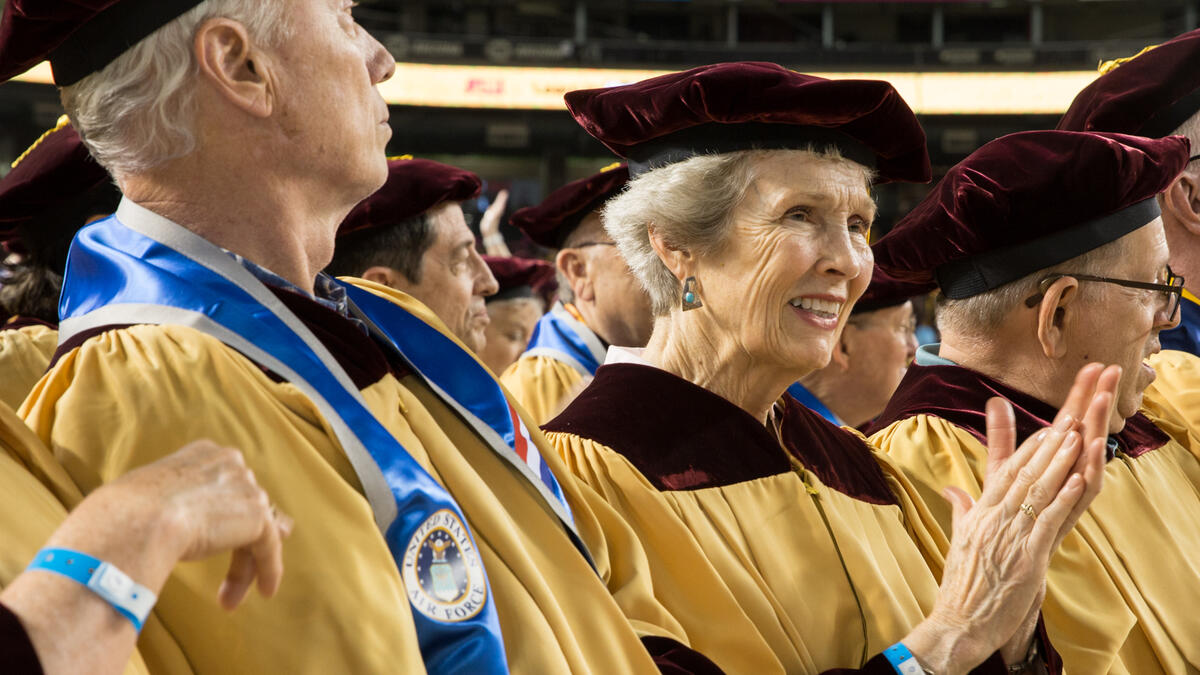
Every year in May, the ASU Alumni Association gears up for its largest event of the year: to honor graduates from 50 years back. Though 1968 may seem like a long time ago, for a number of returning grads it feels like yesterday.
The Golden Graduates have the opportunity to reconnect over a two-day special event that includes campus tours, receptions with VIPs, a dinner prior to the graduation ceremony, recognition by President Michael Crow during commencement, and the Golden Circle induction and candle-lighting ceremony in front of Old Main.
One of this year’s Golden Graduates, Antonia “Toni” Oliver earned her undergraduate engineering degree in 1968. Her daughter Wendy was 4 years old at the time.
Video by Ken Fagan/ASU Now
It was a difficult time for Oliver, but she didn’t dwell on her struggles. She was a single mom working on an engineering degree. Oliver took her math and science courses as well as the 40 hours of liberal studies that were required at the time by the university president.
She worked weekends while taking courses. At times, she brought Wendy to class where she would draw or play on a blanket in back of the classroom.
“I didn’t even consider asking permission to bring her to class. I just did it!” Oliver said.
When Oliver wasn’t able to watch her daughter, her sister, a dormitory resident assistant and ASU marching band member, would take over.
“My aunt would take me to band practice,” said the now-54-year-old Wendy. “Also, my mom would volunteer as an usher at Gammage Auditorium, so I got to see a lot of plays.”
Wendy would hang out with her mother in the computer center where her mother’s classmates would give her paper and pencils to draw pictures for them.
Oliver, who went on to have a career as a chemical engineer in Oregon and Illinois, decided that she wanted to make the trip to Tempe for the Golden Graduation.
“When I told Wendy, she said, ‘I want to go to, I went to school so I should go too!’”
More Science and technology

ASU-led space telescope is ready to fly
The Star Planet Activity Research CubeSat, or SPARCS, a small space telescope that will monitor the flares and sunspot activity of low-mass stars, has now passed its pre-shipment review by NASA.…

ASU at the heart of the state's revitalized microelectronics industry
A stronger local economy, more reliable technology, and a future where our computers and devices do the impossible: that’s the transformation ASU is driving through its microelectronics research…

Breakthrough copper alloy achieves unprecedented high-temperature performance
A team of researchers from Arizona State University, the U.S. Army Research Laboratory, Lehigh University and Louisiana State University has developed a groundbreaking high-temperature copper alloy…