

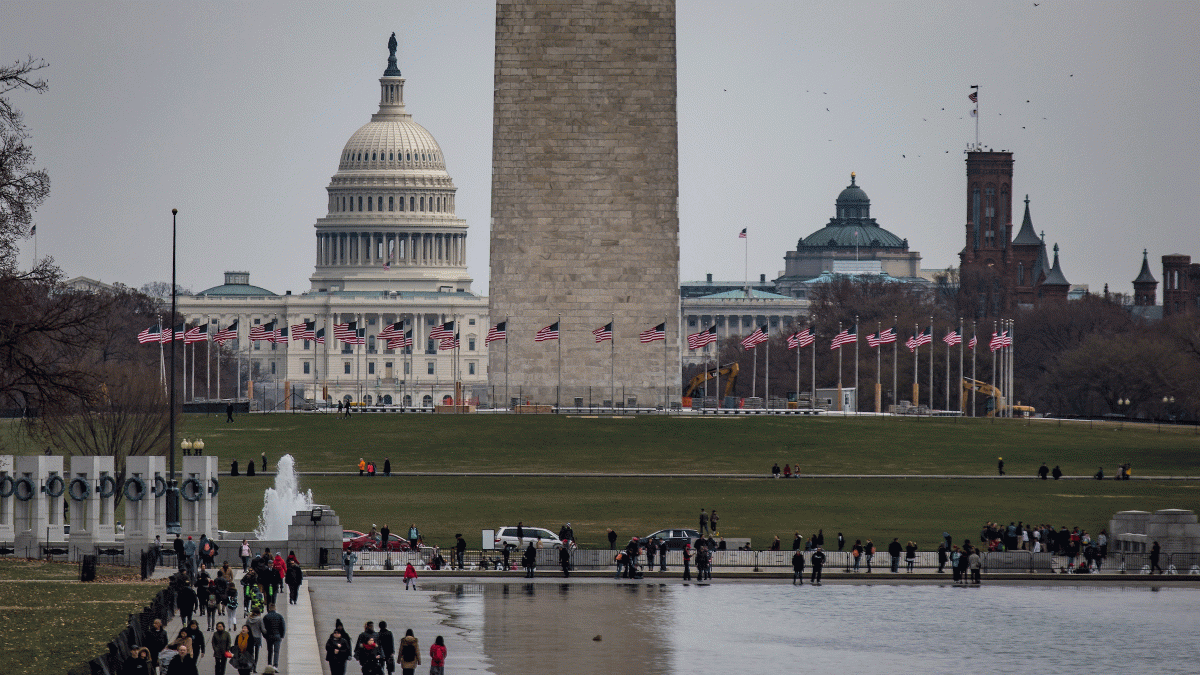
Editor's note: Opening week continued at the Ambassador Barbara Barrett & Justice Sandra Day O’Connor Washington Center at ASU. Find the current day's blog here, with links to the other day's highlights.
Panel: ‘Globalism in the Age of Nationalism’
9:30 p.m. Thursday, March 15
The U.S. and other countries around the world face an interesting balance: growing calls for nationalism — seen in such outcomes as Brexit — while we move with increasing acceleration toward globalism.
“With more technology, we have more globalization; with more globalization, we have more technology,” Allen Morrison, CEO and director general at the Thunderbird School of Global Management at ASU, told a group that included many Thunderbird alumni Thursday evening in Washington, D.C.
In the past, it took decades if not centuries for innovations to catch on. But today, as technology accelerates, our human knowledge doubles on average every 13 months, Morrison said.
Technology — particularly sensors, which drive the big-data industries from health devices to inventory management — is driving globalization in four ways, he said: economies of scale (which lower costs), rising costs of R&D and equipment (if it costs that much to develop, companies want to reach as many customers as possible and make the money back), declining costs of shipping and transportation (leading to global supply chains) and essentially free and immediate communications.
Keeping up with that level of technological change can overwhelm us, and in times of stress, “we turn to leaders, often failed or compromised leaders, and look to them in an almost unhealthy way as someone who can solve all our problems,” Morrison said. And the people who embrace these roles “may be enemies to the cause of good citizenship and ironically may be among the loudest voices for nationalism.”
“How do we handle nationalization in a world of globalization?” he asked.
Jeff Cunningham, Distinguished Professor of Practice at Thunderbird, took over and led a panel that tackled that question.
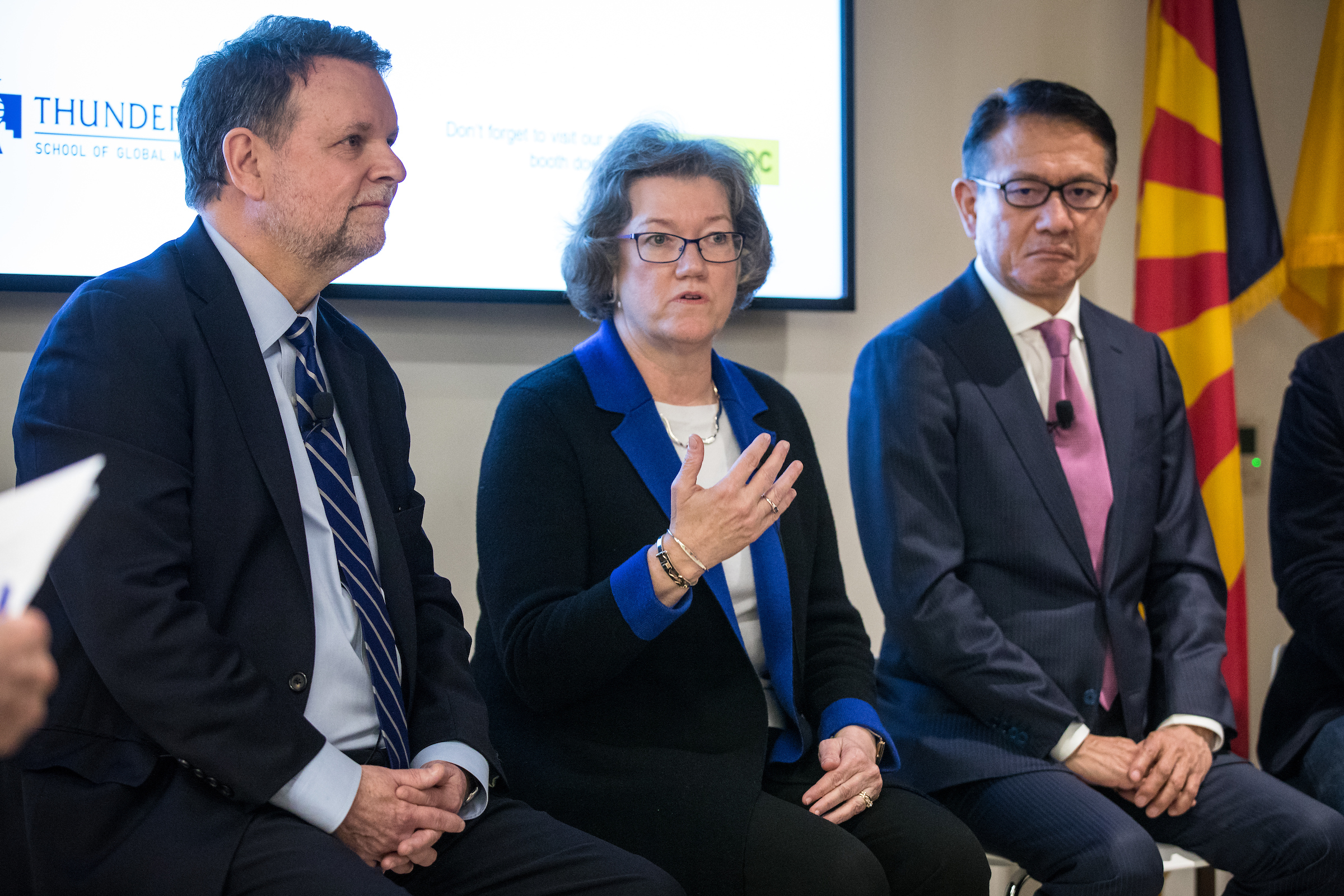
ASU's Anne Simmons-Benton speaks at the Thunderbird School of Global Management panel Thursday evening. Panelists included Kris Balderston (left) with FleishmanHillard and Hiroshi Hamada, Thunderbird alumnus and chairman/CEO of ARUHI Corp. in Tokyo. Photo by Charlie Leight/ASU Now
David Young, owner and chief consultant of marketing management consulting firm Young & Associates Ltd. and Class of ’91 Thunderbird alum, said many people were surprised when they woke up the day after the Brexit vote, but that there was no one reason people wanted to leave the European Union.
It was geographically focused — those outside the big cities wanted to leave the EU — but it was also that people were frustrated with immigration, frustrated with government or simply wanted to go against the status quo.
“The underlying thing is there was frustration, and we’re seeing that in the States and elsewhere in Europe,” he said.
Cunningham brought up protectionism in Japan in the 1970s and ’80s.
“Protectionism could work for a specific strategically targeted industry … in the short term,” said Hiroshi Hamada, chairman of the board and CEO of mortgage bank ARUHI Corp. in Tokyo and Class of ’91 Thunderbird alum.
But in the long term it hurts innovation, he said.
Politics certainly come into play, as well as attitudes toward immigration. Most of the panelists expressed the belief that perhaps the younger generation won’t have as strong a pull toward nationalism.
“Information is the key word here,” Young said. “What’s become clear … information isn’t playing a part of decision making. People are deciding on emotional grounds” and then picking and choosing the facts to match.
Is the problem really technology, or is it a trade issue with China, Cunningham asked. “Isn’t China the problem?”
“There’s a lot of fear of China, but many of the larger U.S. corporations are looking to that as a market,” said Anne Simmons-Benton, executive director of ASU International Development. “The ones that are most competitive are using that.”
Hamada echoed that.
“As a neighbor, we (Japan) are quite frankly scared, in terms of politics and military,” he said. “But the world is too much involved. … At the end of the day, market wins over politicians.”
Cunningham asked whether “localism” is just nationalization writ small — disenfranchising farmers 100 miles away.
“Do you feel fear when you say ‘localism’?” Simmons-Benton said. “Do you feel fear when you say ‘nationalism’?”
It may be that, like Brexit, the question is geographically tied.
“The government really has to be thinking differently about how they cushion the blow, particularly to the people in the middle of the country,” said Kris Balderston, president of global public affairs and strategic engagement for public relations firm FleishmanHillard.
He cited a Harvard study that showed the entire center of the country is hurting with opioid addiction and long-term unemployment — “we have to be doing things differently than we have been in the past and putting investment there.”
Cunningham said Thunderbird has authority in this discussion because it is so global.
“But the big defining factors — there are probably other institutions that say they think globally — is we are not a beltway organization, we’re not a coastal organization — we’re from the heartland, we’re from flyover country. …
“We really are in the heartland, and we know what the heartland thinks and breathes, and so I think we bring that part — not nationalism, but we bring that part of the conversation that has been missing, or as Roosevelt called it again, the forgotten.”
And now having the platform of the new building in Washington, D.C., Thunderbird can become a forum for both policy and business decision makers, he said.
“The future looks very T-Bird-ish.”
Watch the entire discussion on ASU’s Facebook page here.
FB Live: ‘Globalism in the Age of Nationalism’
6:30 p.m. Thursday, March 15
The panel “Globalism in the Age of Nationalism” will be livestreamed on ASU's Facebook page at 7:15 p.m. Eastern Daylight Time today.
Video: Learning from the current anti-immigrant backlash
3:10 p.m. Thursday, March 15
Clarissa Martinez de Castro, deputy vice president in the office of research, advocacy, and legislation for UnidosUS, explains the dichotomy of the United States, a nation that cherishes its immigrant roots as a foundational element of its character yet also goes through waves of harsh anti-immigrant sentiment. The hope is that this time we can learn from it.
Video by Jamie Ell/ASU Now
Presentation: 'Perspectives on the Current Immigration Debate: Communities in a Transborder World'
2:45 p.m. Thursday, March 15
Lisa Magaña, professor and interim director, School of Transborder Studies, Arizona State University
Magaña kicked off the event with an overview of the School of Transborder Studies, the first of its kind in the nation. The interdisciplinary school looks at the impact of borders, the politics of immigration, Latino politics and all aspects of the Latino immigrant experience — from health care to the arts to humanities.
The school offers a variety of resources to support Latino immigrant students, including CAMP — the College Assistance Migrant Program — which provides academic support to students from migrant and seasonal farmworker backgrounds during their first year in college. “So often, first generation students have no idea what it means to be at an American university. This program brings them to ASU, provides assistance, housing, counselling, referrals and whatever else is needed to assimilate into a university setting.”
Magaña spoke of the increasing role Latinos in Arizona are playing in the political process. “There was a 35 percent increase in Latino political participation in the last election. When we think about Latino politics, it’s being redefined. It’s no longer just the idea of voting. You have individuals that are incredibly politically involved but because of their status cannot vote, but have been very important political players.”
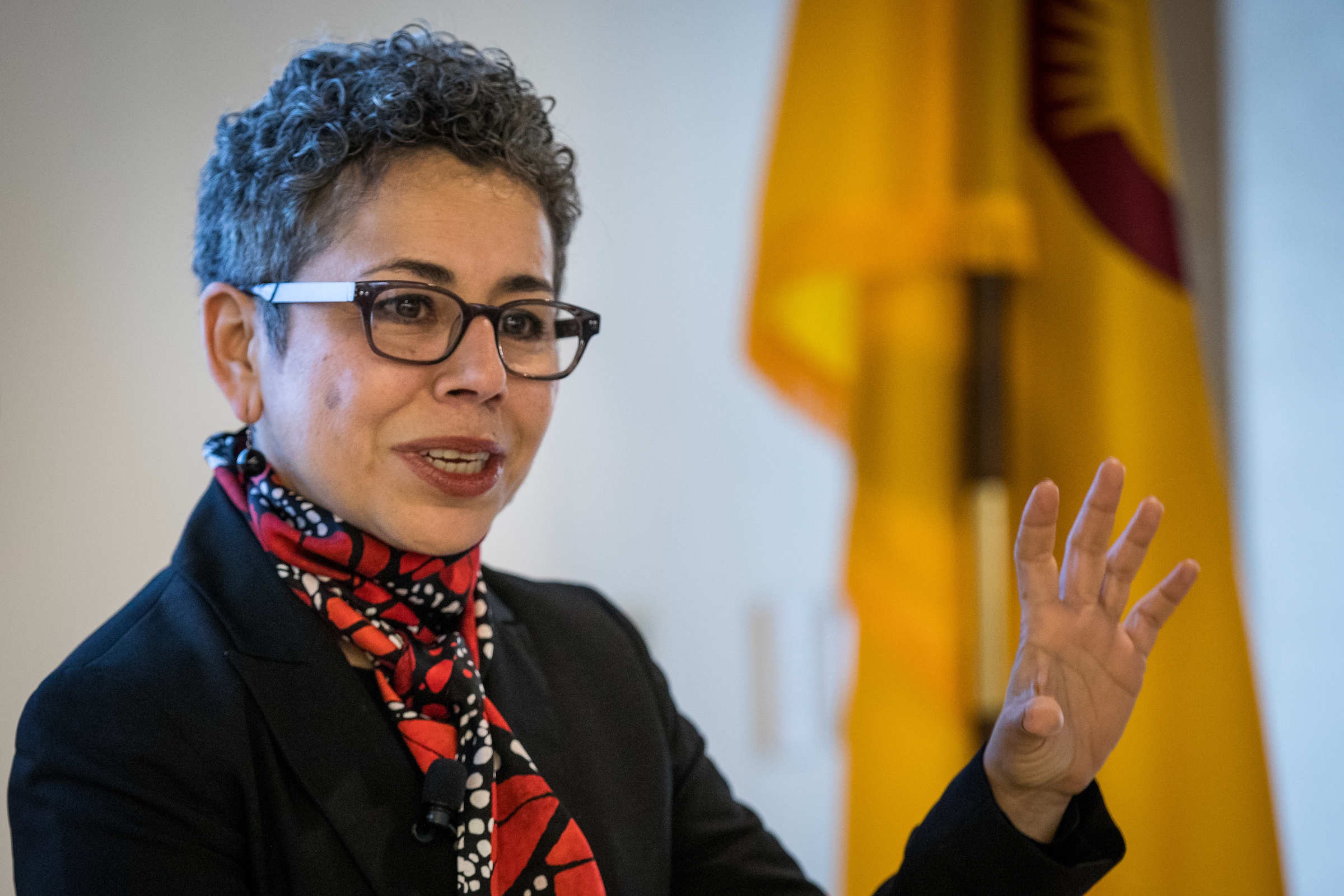
Clarissa Martinez de Castro speaks about Latino-related immigration issues at the School of Transborder Studies discussion in Washington, D.C., on Thursday, March 15. Photo by Charlie Leight/ASU Now
Clarissa Martinez de Castro, deputy vice president in the office of research, advocacy, and legislation, UnidosUS
Martinez de Castro offered a national perspective on the current immigration debate, noting that while the majority of Americans (80 percent) support relief for Dreamers and a resolution on DACA, Congress is many steps behind the public. “The debate has a lot of similarities with the other debate on gun violence. If you look at where the public is, there is broad consensus on the sensible steps we can take. What is standing in the way of those solutions is an aggressive campaign of misinformation to polarize people away from solutions.”
She noted that the anti-immigrant sentiment experienced by Latinos today is not unique; every wave of immigrants to the United States has experienced backlash. “If you visit Ellis Island, you can read the headlines and see how people spoke about immigrants in the past. Latinos are the current phase of the immigrant profile. One of many.”
The way forward, she suggested, lies in continued advocacy at the local, state and federal levels. “Lifting up the voice of the Latino community on the streets, in the voting booth and in the halls of Congress. En las casas, en las casillas, y en el Congreso.”
Both presenters emphasized that while political change is an important part of the solution, creating spaces in the community for people to come together and connect is critical to improving understanding of different cultures and backgrounds. Said Martinez de Castro, “We need to create spaces where Americans from all walks of life come together, break bread together, share experiences, and in doing so learn about each other’s aspirations and challenges. When we do that, we realize we have much more in common.”
“The debate is not only about immigration policy, it’s about who we are as a country and who we aspire to be as a country.”
And while she acknowledged the challenges are many, she maintains hope for a brighter future for all. “We are a country that sees diversity as one of our greatest national assets, where everyone has a place, regardless of ancestry or religion. That is the American mosaic. That is what diversity is. It’s all of us.”
Video: The perfect time for a School of Transborder Studies
2:20 p.m. Thursday, March 15
What does the idea of a border in a border state mean? Lisa Magaña, interim director and professor in ASU's School of Transborder Studies said there are a lot of implications for understanding transborder studies. Magaña was a panelist at the school's presentation on "Perspectives on the Current Immigration Debate: Communities in a Transborder World."
Video by Jamie Ell/ASU Now
10 things you might not know about CSPO
12:18 p.m. Thursday, March 15
One of the groups headquartered in the new Barrett & O'Connor Washington Center is the Consortium for Science, Policy and Outcomes (or CSPO, pronounced see-spoe).
The organizing question for CSPO is: How can science and technology most effectively contribute to an improved quality of life for the greatest number of people? The group cultivates public discourse and fosters policies to help decision makers and institutions grapple with the power and importance of science and emerging technology.
Here are more facts about CSPO:
- The consortium was originally created at Columbia University as a research center in Washington, D.C., by Michael Crow, who was then the executive vice provost for research at Columbia, and CSPO co-director Daniel Sarewitz.
- CSPO was instrumental in acquiring approximately $13 million for the Center for Nanotechnology in Society at Arizona State University (CNS-ASU) from the National Science Foundation. CNS was the world’s largest center for research, education, and outreach on the societal aspects of nanotechnology.
- The group publishes a book series called "The Rightful Place of Science," which now includes 10 volumes on a broad range of subjects.
- CSPO’s co-founder and co-director, Professor Daniel Sarewitz, was recently profiled in the online magazine Undark for a provocative essay he wrote for The New Atlantis called “Saving Science.”
- In partnership with the National Academies of Sciences, Engineering, and Medicine, and the University of Texas at Dallas, CSPO co-edits the influential Issues in Science and Technology magazine.
- CSPO played a catalyzing role in the development of the National Science Foundation’s Science of Science and Innovation Policy (SciSIP).
- The consortium has led citizen-focused technology forums throughout the United States. CSPO was the North American organizing partner of World Wide Views in 2009 and 2012; a partner in the National Citizens Technology Forum in 2008; an organizer of the Futurescape City Tours in 2013; the host of forums on NASA’s Asteroid Initiative; a NOAA partner on facilitating community resilience; and is now developing a forum program on autonomous vehicles and the governance of geoengineering research.
- Through activities going back more than two decades, CSPO has emerged as a global leader in focusing attention on climate adaptation and resilience as critical components of climate policy.
- For several years in row, CSPO has ranked among the world’s top 10 science and technology think tanks by the authoritative Think Tank and Civil Societies Program at the University of Pennsylvania.
- CSPO launched the School for the Future of Innovation in Society — originally a research center and graduate program housed in the College of Liberal Arts and Sciences — in 2015.
Video: What is the reality of a border?
10:20 a.m. Thursday, March 15
ASU’s School of Transborder Studies — the first of its kind in the nation — looks at how borders can define us, inspire us and bring us to new discoveries.
This is the video they’ll be sharing at today’s lunchtime panel.
What does the border mean to you?
FB Live: ‘Perspectives on the Current Immigration Debate: Communities in a Transborder World’
12:30 a.m. Thursday, March 15
The panel “Perspectives on the Current Immigration Debate: Communities in a Transborder World” will be livestreamed on ASU's Facebook page at 11:30 a.m. Eastern Daylight Time today.
Katherine Reedy and Penny Walker contributed to this blog. Top photo by Charlie Leight/ASU Now
More Law, journalism and politics

Can elections results be counted quickly yet reliably?
Election results that are released as quickly as the public demands but are reliable enough to earn wide acceptance may not always be possible.At least that's what a bipartisan panel of elections…

Spring break trip to Hawaiʻi provides insight into Indigenous law
A group of Arizona State University law students spent a week in Hawaiʻi for spring break. And while they did take in some of the sites, sounds and tastes of the tropical destination, the trip…

LA journalists and officials gather to connect and salute fire coverage
Recognition of Los Angeles-area media coverage of the region’s January wildfires was the primary message as hundreds gathered at ASU California Center Broadway for an annual convening of journalists…