

Political exits on the rise: ASU professor on why quitting is not a bad option

Bob Corker. Jeff Flake. Orrin Hatch. Darrell Issa. The list of political heavyweights who have decided to retire or opt out of bids for re-election is growing. Has flight superseded fight in today’s divisive political climate? And, if so, is quitting in the midst of difficult times a cop-out or simply the right thing to do for the individual involved?
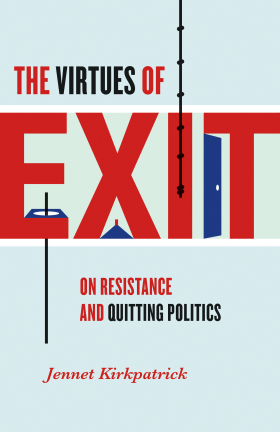
Jennet Kirkpatrick, an associate professor in the School of Politics and Global Studies at Arizona State University, believes in the power of exit. In her new book, "The Virtues of Exit: On Resistance and Quitting Politics," Kirkpatrick puts forward the notion that leaving political organizations can actually be a tool for change, and that political actors can actually benefit from quitting or refusing to be a part of something.
“One of the book’s major themes revolves around the idea that leaving political organizations is not always cowardly, weak or self-interested,” Kirkpatrick said. “It looks at political actors and activists who walk away in a defiant, strong way and who use their departures to create political change.”
But, as Kirkpatrick also notes, the downside of leaving — even for a good reason — is a loss of participation and voice. Principled resignation, she said, has a cost: “This is what makes it a significant political act. It involves sacrifice.”
Kirkpatrick shares more of her insight on the benefits and costs of exits in the current political climate in this conversation with ASU Now.

Jennet Kirkpatrick
Question: What do you think is behind the recent wave of congressional exits?
Answer: While there are many reasons for the wave of resignations and retirements, some Republicans have explained that they are leaving office because they oppose the current administration. In his speech announcing that he would not run for re-election, Arizona Senator Jeff Flake stated that, because of his deep political and moral disagreements with President Trump, he could no longer serve in good conscience. An important idea I learned from writing my book is that exits can be done in different ways. It’s not necessarily that you leave and it’s over. It is possible to walk away in defiance and draw attention to injustices and wrongs occurring within a political organization or country. While this is a serious move that should be carefully considered, this type of “resistant exit” is an option we should be aware of.
Q: Reaction to some of the more dramatic political exits in the midst of a very divided political landscape has been mixed. We have seen descriptions ranging from “honorable” to “cop out” in response to some individual announcements. Are these fair conclusions, or oversimplified judgments?
A: I understand the view that a resignation is a cop out. Democracy depends on civic participation. If good citizens are not willing to stay in office or vote, democracy loses its legitimacy.
At the same time, writing my book made me realize that exits are not always cowardly or selfish. Exits can be courageous acts of defiance and they have the potential to give voice to views that might otherwise be silenced.
In non-democratic contexts, resistant exits can be honorable, too. For individuals living in places where political freedoms are severely restricted, exit is sometimes one of the few safe ways to resist. Taking this course of action, political exiles have left their homelands and opposed those in power from abroad.
Q: What is the gamble and/or the payoff from quitting a coveted position of power?
A: Exits from powerful posts involve giving up the capacity to influence it from the inside. Someone else can take your spot. In Senator Flake’s case for instance, a number of individuals have declared they will run for his seat, including controversial former Arizona Sheriff Joe Arpaio. But a resistant exit may, in the long run, be worth the sacrifice. It can rally opposition in others, on the inside and the outside, and it can raise public awareness.
Q: Can you think of another time in U.S. political history when we have seen a mass exodus of so many legislators — particularly from one political party? What were the results of such an upheaval?
A: Before the American Civil War abolitionists opted out of American politics in a number of ways to express their opposition to slavery. Officials resigned from office, and citizens refused to vote. In his famous essay "Civil Disobedience," Henry David Thoreau argued that public officials who supported abolition should resign and that abolitionists should not pay their taxes. Thoreau even went as far as to write a letter of resignation from citizenship and sent it to the State of Massachusetts. These kinds of abolitionist actions raised awareness about the injustices of slavery and galvanized resistance to it.
More Law, journalism and politics

Can elections results be counted quickly yet reliably?
Election results that are released as quickly as the public demands but are reliable enough to earn wide acceptance may not always be possible.At least that's what a bipartisan panel of elections…

Spring break trip to Hawaiʻi provides insight into Indigenous law
A group of Arizona State University law students spent a week in Hawaiʻi for spring break. And while they did take in some of the sites, sounds and tastes of the tropical destination, the trip…

LA journalists and officials gather to connect and salute fire coverage
Recognition of Los Angeles-area media coverage of the region’s January wildfires was the primary message as hundreds gathered at ASU California Center Broadway for an annual convening of journalists…