


Update March 21: Governor praises geography bee contestants for dedication to STEM; find out who won.
----
Geography trivia: What building is at 33.4 degrees longitude north and 111.9 degrees latitude west?
If you’re a map lover, you might know that it’s the Memorial Union at Arizona State University — site of the Arizona Geography Bee on Friday.
On that day, 101 young students in grades four through eight will compete, answering questions about map locations, events, history, climate and culture until one is crowned the champion. Gov. Doug Ducey is scheduled to open the final round of competition with a geography quizExamples of geography bee questions: On a map, locate where the Tiananmen Square Massacre was. Which lake in Africa was created to provide power? (Answers: Beijing and Lake Volta in Ghana.). The bee is sponsored by the National Geographic Society, and the state winner will travel to Washington, D.C., in May for the national competition.
Geography is part of the state’s social studies curriculum in every grade, and classroom teachers get a lot of help from the Arizona Geographic Alliance, housed in the School of Geographical Sciences and Urban Planning at ASU. The alliance holds workshops, field trips and conferences for teachers.
The subject is much deeper than learning the names of rivers and mountain ranges, according to Gale Olp Ekiss, co-coordinator of the Arizona Geographic Alliance.
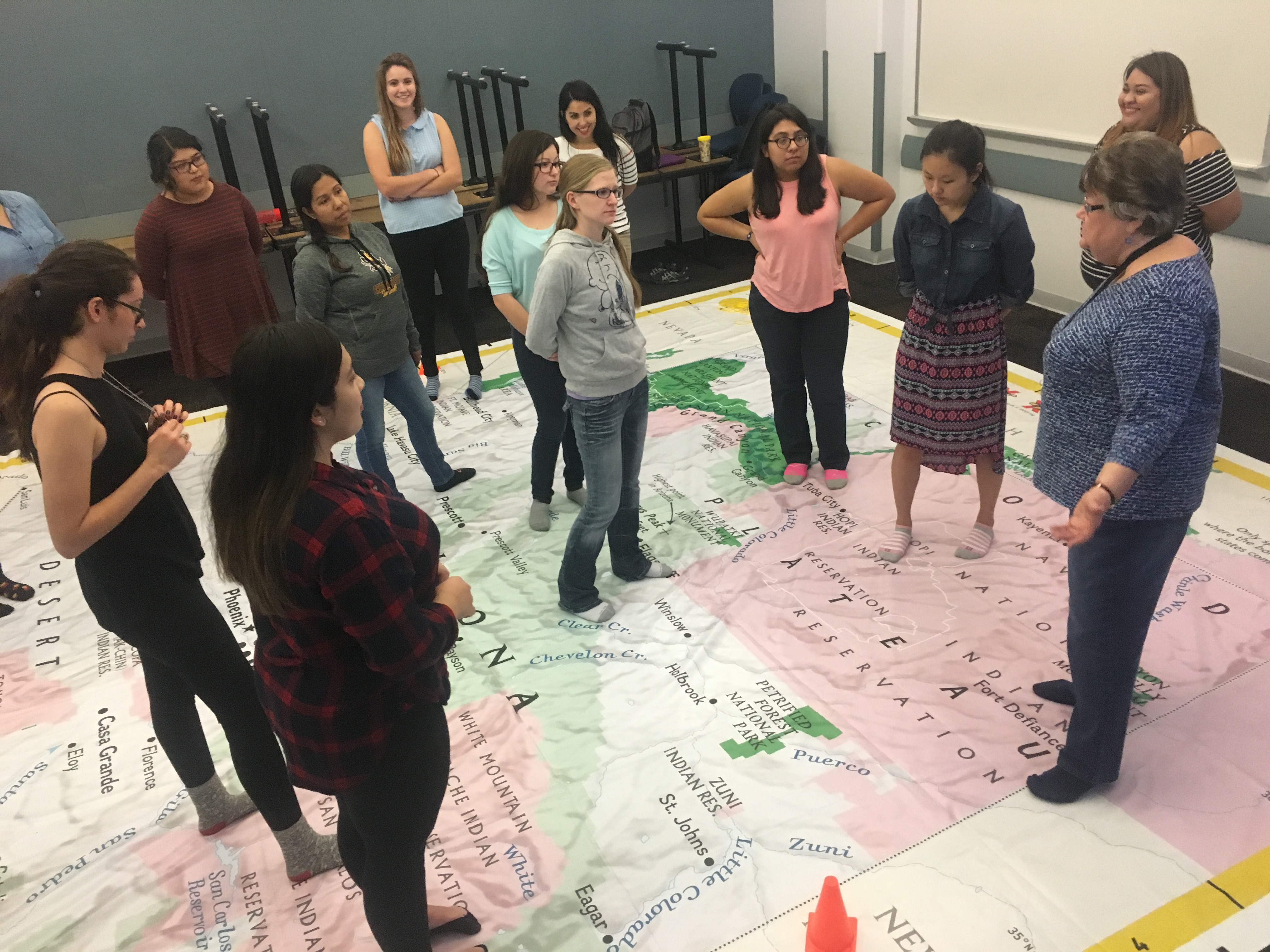
Gale Olp Ekiss, co-coordinator of the Arizona Geographic Alliance, shows teachers how to use the giant floor map that the alliance lends for free to schools.
“Geography is the place in the curriculum where diversity is taught. It’s where teachers spend time on culture, regions and learning about others and how we’re interconnected,” Ekiss said.
Last fall, the alliance’s “GeoConference” ran workshops on how to teach the impact of wildfires on the ecosystem, using sonar to map the ocean floor and how technology changed society when the Pacific Railroad was built.
Map skills are big, too. Giant, actually. The alliance has two new 21- by 17-foot floor maps made of heavy vinyl that it lends to teachers around the state at no cost. Elementary students play games on the maps, like relay races and scavenger hunts, to learn about legends, directions and longitude and latitude. The maps will be in the Memorial Union on Friday, and students who are eliminated in the early rounds of the bee can play with them.
The cost of the two giant maps was covered by the National Geographic Society, but the alliance held its own crowd-funding campaign last year to pay for a new map that will teach ecosystems and topography. Ekiss hopes that giant map will be ready to lend by the start of the 2017-18 school year.
The alliance, funded by the National Geographic Society, the state and ASU, was launched in the School of Geographical Sciences and Urban Planning in 1992. Back then, Ekiss was a classroom teacher at Powell Junior High School in Mesa, and she was one of the first teachers the alliance sent to Washington, D.C., for training with the National Geographic Society. She became a “teacher consultant” who taught other teachers before coming to ASU.
“We’ve touched 19,000 teachers and influenced more than 100,000 students,” Ekiss said of the alliance’s work.
Ekiss said that geography is a hot field for careers.
“Geospatial technology is one of the three biggest fields emerging for employment,” she said.
“If you’re going to be economically competitive, it’s good to have your workforce understand the world.”
The Arizona Geography Bee will start at 9:30 a.m. Friday in the Arizona Ballroom in the Memorial Union on ASU's Tempe campus. Gov. Doug Ducey is scheduled to arrive at 11:30 a.m. to meet the contestants and will kick off the final round of competition with a trivia game at noon. For details, click here.
More Arts, humanities and education

Upcoming exhibition brings experimental art and more to the West Valley campus
Ask Tra Bouscaren how he got into art and his answer is simple.“Art saved my life when I was 19,” he says. “I was in a dark place and art showed me the way out.”Bouscaren is an …

ASU professor, alum named Yamaha '40 Under 40' outstanding music educators
A music career conference that connects college students with such industry leaders as Timbaland. A K–12 program that incorporates technology into music so that students are using digital tools to…

ASU's Poitier Film School to host master classes, screening series with visionary filmmakers
Rodrigo Reyes, the acclaimed Mexican American filmmaker and Guggenheim Fellow whose 2022 documentary “Sansón and Me” won the Best Film Award at Sheffield DocFest, has built his career with films that…