

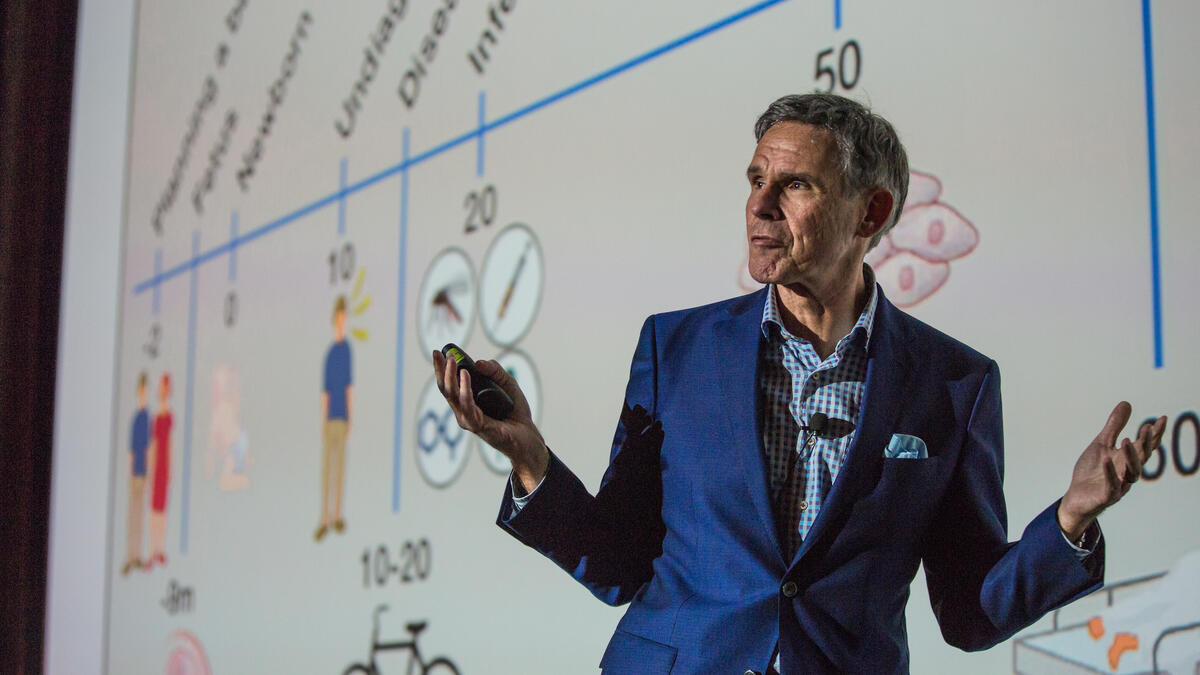
One of the nation’s leading proponents of digital medicineDigital medicine refers to the clinical implementation of wireless technologies in health and health care. shared his thoughts and predictions on the future of health care Wednesday night at Arizona State University's Marston Exploration Theater.
Eric Topol, internationally renowned cardiologist, geneticist, author and researcher, delivered the W. P. Carey School of Business' seventh annual McKenna Lecture to a crowd of more than 200 faculty, students and members of the public. With an almost casual air, he spoke of virtual doctor visits, bandages that measure vital signs and smartphone apps that diagnose diseases.
“For many years, it’s been talked about that medicine is going to be personalized,” Topol said. “We’re finally starting to get there.”
Part of getting there is understanding that each patient is a unique human being. The other part is adapting technology to that purpose.
Topol is the author of two books that delve even deeper into the subject, 2012’s “The Creative Destruction of Medicine: How the Digital Revolution Will Create Better Health Care” and 2016’s “The Patient Will See You Now: The Future of Medicine Is in Your Hands.”
"The smartphone will be the hub of the future of medicine."
— Eric Topol, professor of genomics at the Scripps Research Institute
Duke Reiter, special adviser to the ASU president, said the former served as a guide for him in the creation of the Health Futures Council at ASU, a group of ambassadors and advisers convened to direct and support the university’s health-related research, education and clinical programs.
“I found that what he was saying in that book is an uncanny parallel to what we’ve done at ASU in terms of deployment of technology and expanding our reach and being aware of how the customizing of health care works for you as a patient,” Reiter said.
Topol spoke at length on the topics of genomicsGenomics refers to the branch of molecular biology concerned with the structure, function, evolution and mapping of genomes. and the digital health world, two areas in which ASU has made significant strides. The university’s 100th spinout company, Gemneo Bioscience, uses gene-sequencing technology to allow physicians to better understand and tailor treatments around individual patients’ disease and immune responses. The university has also served as an incubator for startups like EpiFinder, which uses a smartphone application to diagnose epilepsy.
“Genomics is probably the biggest [health-related] breakthrough in the last 50 years,” Topol said, later adding that “the smartphone will be the hub of the future of medicine.”
And it’s not just what kind of care can be delivered that’s changing — it’s how that care is delivered.
In line with Topol’s comments on the need for more personalized, affordable health care is the Mayo Clinic and Arizona State University Alliance for Health Care. FormalizedThe alliance was formalized after 12 years of working together on programs that range from nursing to medical imaging to regenerative and rehabilitative medicine to wearable biosensors. in October 2016, the partnership aims to bring the nation’s most innovative university and the world leader in patient care together to create a curriculum for the science of health care delivery that spans all aspects of the field — including clinical, legal and administrative work — with a focus on how patients receive care to improve quality, outcomes and cost.
“Our strategy is to educate people differently,” director of ASU’s School for the Science of Health Care Delivery Victor Trastek said at the time. “To train the health care workforce for the future so that they think differently and can make the best decisions for the patient. And then, hopefully, you’ll get good care for a reasonable price.”
While all of these advancements have enormous potential for positive change in health care, Topol concedes that there are some challenges ahead.
For example, he said, although artificial intelligence may be able to diagnose diseases faster and more accurately than a human doctor, it requires the collection of personal data to do so. Questions like who owns that data and concerns about its security will need to be addressed.
Earlier Wednesday, Topol attended a luncheon sponsored by the Health Futures Council at ASU where he met with some of the university’s leading innovators in health care to share ideas and make meaningful connections.
“His thought leadership in democratizing health care through technology is a key factor in improving access and lowering costs toward building healthy communities, which resonates with ASU’s mission of finding sustainable health solutions,” said Sethuraman Panchanathan, executive vice president of Knowledge Enterprise Development and chief research and innovation officer at ASU.
Topol ended his talk Wednesday night with a hopeful message. Referring to technology that records health data, he said, “We have the basis now to have a massive planetary knowledge resource for health care.” And though we have some hurdles to get past first, “we have the ability to predict better treatments, prevention, better everything. … Someday, we’ll be able to predict a heart attack before it happens.”
Top photo: Eric Topol speaks about the future of health care and medicine in the United States on Wednesday in ASU's Marston Exploration Theater on the Tempe campus. Topol is the founding director of Scripps Translational Science Institute and a professor of genomics at the Scripps Research Institute. Photo by Anya Magnuson/ASU Now
More Health and medicine

Making medicine side-effect free
Many drugs that address medical conditions can come with serious side effects. In drug commercials, the litany of potential side effects is often longer than the benefits being touted. Carl…

Diagnostic research happening at ASU focused on detecting diseases earlier to save lives
It was one of America’s founding fathers, Benjamin Franklin, who may have foreshadowed today’s health care innovation when he quipped the adage: An ounce of prevention is worth a pound of cure.In…

Fighting the fungus among us
It starts with a spore.When inhaled, spores of the coccidioides fungus can cause coccidioidomycosis — better known as valley fever. The spores may be fungi, but they are no fun.Valley fever usually…