
Editor's note: This is part of a series of profiles for spring 2016 commencement. See the rest here.
Alexi Choueiri starts the twins’ story: “We left because of war.”
In 2005, Lebanon erupted into war after the assassination of former Prime Minister Rafic Hariri. The Choueiri family fled Beirut, and 12-year-old Robert and Alexi left behind everything they knew to begin middle school in Arizona.
It was tough. There was culture shock and dislocation. Although the boys spoke Arabic and French and went to an English-speaking school in Lebanon, Robert struggled with the language.
At Corona del Sol High School, the brothers began to flourish. Robert (above, left) was student body president, and Alexi was senior class president.
The two have not lived together during their time at ASU, but remained close.
“We’ve always been fairly independent as twins, but it has been a huge advantage going here as siblings because we’ve been able to feed off each other’s strengths,” Robert said.
Together as freshmen, they founded the ASU branch of Global Microfinance Brigades, a nonprofit that sends undergraduate students to developing countries to create community banking systems and teaches financial literacy. Both are Tillman Scholars, and Robert is a McCord Scholar as well as the Barrett Outstanding Graduate.
Now, with graduation approaching, the two will take separate paths after an extraordinary journey together.
“We don’t know what that’s going to be like, to be honest,” said Alexi, majoring in biochemistry and economics in the College of Liberal Arts and Sciences. “We were separated for the summer, but even then we made time to see each other.”
Last summer, Alexi was an Amgen Scholar at Harvard University and Robert worked as an investment analyst in the U.S. Foreign Service Internship Program in Washington, D.C., but they visited each other.
Robert — who is receiving his degree in economics from the W. P. Carey School of Business — said the change won’t be a problem.
“We’ve always been independent, but we came to each other when we needed it. We’ll find a way.”
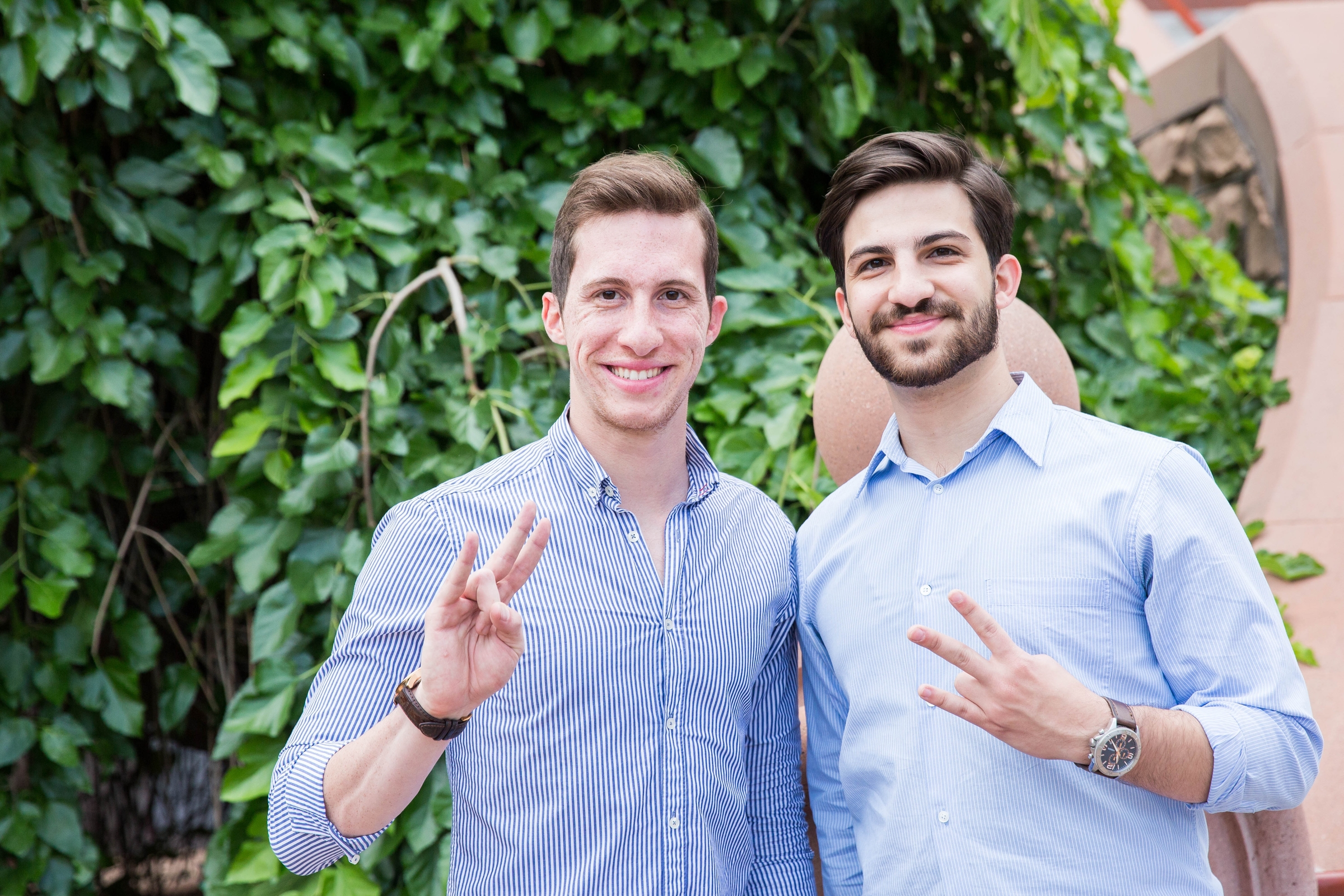
Twins Robert (left) and Alexi Choueiri flash the pitchfork at their favorite place on campus: Old Main. Photos by Deanna Dent/ASU Now
The two answered some questions about their time at ASU.
Question: What was your “aha” moment, when you realized you wanted to study the field you majored in?
Answer: Even in middle school, Alexi was interested in neuroscience. He has worked in the lab at Barrow Neurological Institute since high school.
“I had a deep interest in biology and what makes people tick. I joined a lab at Barrow doing brain-cancer research because my cousin had brain cancer. From that I transitioned to pure neuroscience,” he said.
The internship at Harvard last year convinced him to pursue a doctorate.
Robert was inspired by his family’s experience.
“The experience of evacuating and leaving everything I had known got me curious about international affairs and conflict. Before I got to ASU I was looking to do global studies, and then I realized that the root of a lot of issues stemmed from business and economic development.
Through the microfinance nonprofit, his job as a consultant at Arizona Microcredit Initiative and his work in Washington, D.C., he has seen how development works at an individual, regional and international level.
Q: What’s something you learned while at ASU — in the classroom or otherwise — that surprised you or changed your perspective?
A: The two were pleasantly surprised at the flexibility they found at ASU with hybrid online classes and other ways to fit in their many activities.
“It gave us a big competitive edge,” Alexi said. “My brother worked during the week at many internships, and I was a given a lot of time to do my research. We were both able to be heavily involved outside of our coursework.”
Q: Why did you choose ASU?
A: The twins’ siblings had gone to ASU. Robert was in the Leadership Scholar Program and Alexi won a Presidential Scholarship.
“It was an easy decision,” said Alexi, who had also considered the University of California at Berkeley.
Q: What’s the best piece of advice you’d give to those still in school?
A: “Take time to explore your interests,” Alexi said.
“I think too many people have a self-imposed idea of what they want to do, and by the time they hit senior year, it doesn’t feel right. I looked into being a doctor, a dentist, a consultant. Until you expose yourself, you won’t get that gut feeling of what you want to do.”
Robert said there are two sides of finding yourself.
“Become rooted in complete selflessness, and at the same time, take a step back and make time to be introspective and reflective,” he said. “Those are the two elements to really fight for that ‘why.’ ”
Q: What was your favorite spot on campus, whether for studying, meeting friends or just thinking about life?
A: Both brothers like Old Main.
“It feels like a little oasis,” Alexi said.
Robert said, “There are little secret spots over there.”
Q: What are your plans after graduation?
A: Alexi will move to Cambridge to begin PhD studies in neuroscience at the Massachusetts Institute of Technology, funded by a three-year National Science Foundation Graduate Research Fellowship.
Robert is weighing two career options — one in Singapore and one in Washington, D.C.
Q: If someone gave you $40 million to solve one problem on our planet, what would you tackle?
A: Alexi would invest the money in research: “I’m very interested in unlocking how the brain works and particularly psychiatric diseases. I would like to find a genetic and molecular basis for neurological disorders.”
Robert would start an innovation fund: “I would invest in low-income, underserved entrepreneurs who would encompass social entrepreneurship and sustainable development.”
More Health and medicine

A life of service: How ASU’s Cheryl Schmidt turned duty into a legacy
When Cheryl Schmidt was a little girl in rural Ohio, she would watch her mother dress for work —crisp white uniform, nursing cap perched perfectly in place. Her mother had been a nurse and…

New ASU program supports parents in high-stress careers
High-pressure jobs can come with chronic stress, long shifts and unpredictable schedules. These pressures, when not managed, can ripple into family life, affecting both parents’ and children’s…

Focusing on ADHD: Research, tips and misconceptions
Millions of children and adults across the U.S. live with attention-deficit/hyperactivity disorder, or ADHD, yet the condition and its treatments are still widely misunderstood.From time blindness…