

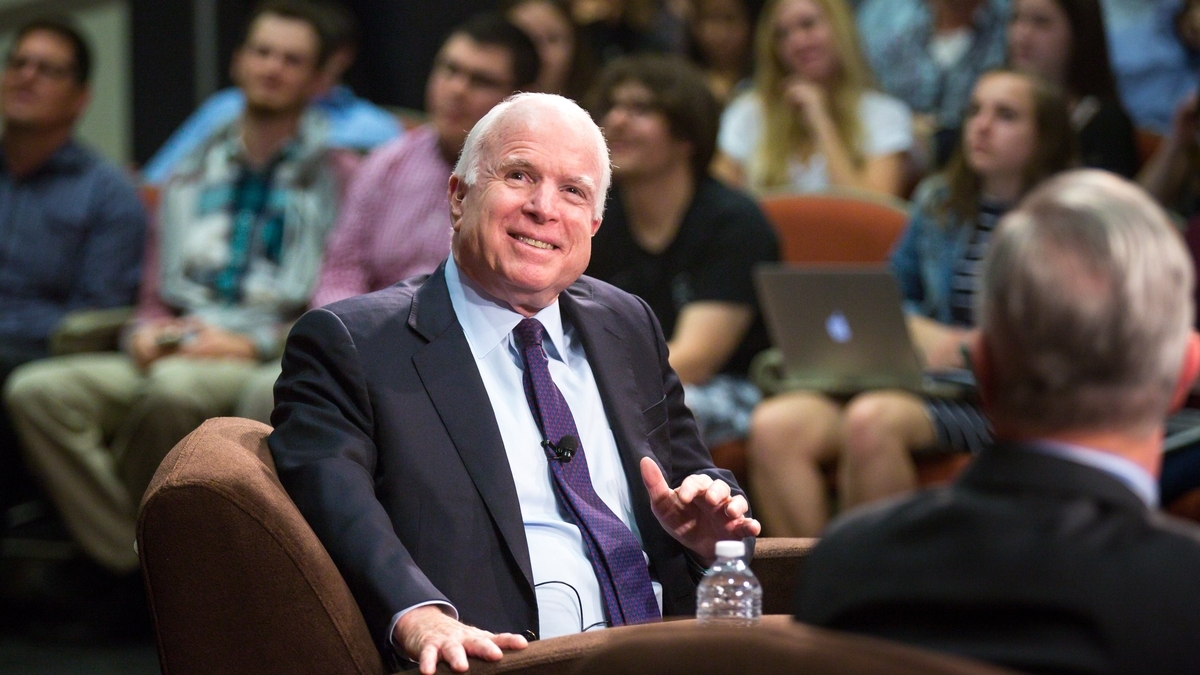
U.S. Sen. John McCain (R-Ariz.) is a man people come to for answers, but when it comes to the 2016 presidential election he’s as baffled as the next guy.
“We’re in the most unusual period in American political history in modern times,” said the Arizona Republican, who was the GOP’s nominee for president in 2008 and one of the most high-profile veterans of the Vietnam War.
“I’ve never seen anything like it and know of no political pundit who could have predicted it, and I don’t know what’s going to happen next.”
McCain visited the Walter Cronkite School of Journalism and Mass Communication on Arizona State University's Downtown Phoenix campus Friday to take part in “Iconic Voices,” a public interview series.
Moderated by Professor of Practice Jeff Cunningham, the discussion was attended by approximately 200 students, faculty and members of the public. It explored McCain’s views on the 2016 election, global security, refugees in Europe, the state of the Arizona economy and his political career.
The 79-year-old McCain was first elected to the U.S. House of Representatives in 1982 and four years later to the U.S. Senate, where he has remained for three decades. He currently serves as the chairman of the Senate Armed Forces Committee and sits on the Senate’s committees on Homeland Security and Governmental Affairs, and Indian Affairs.
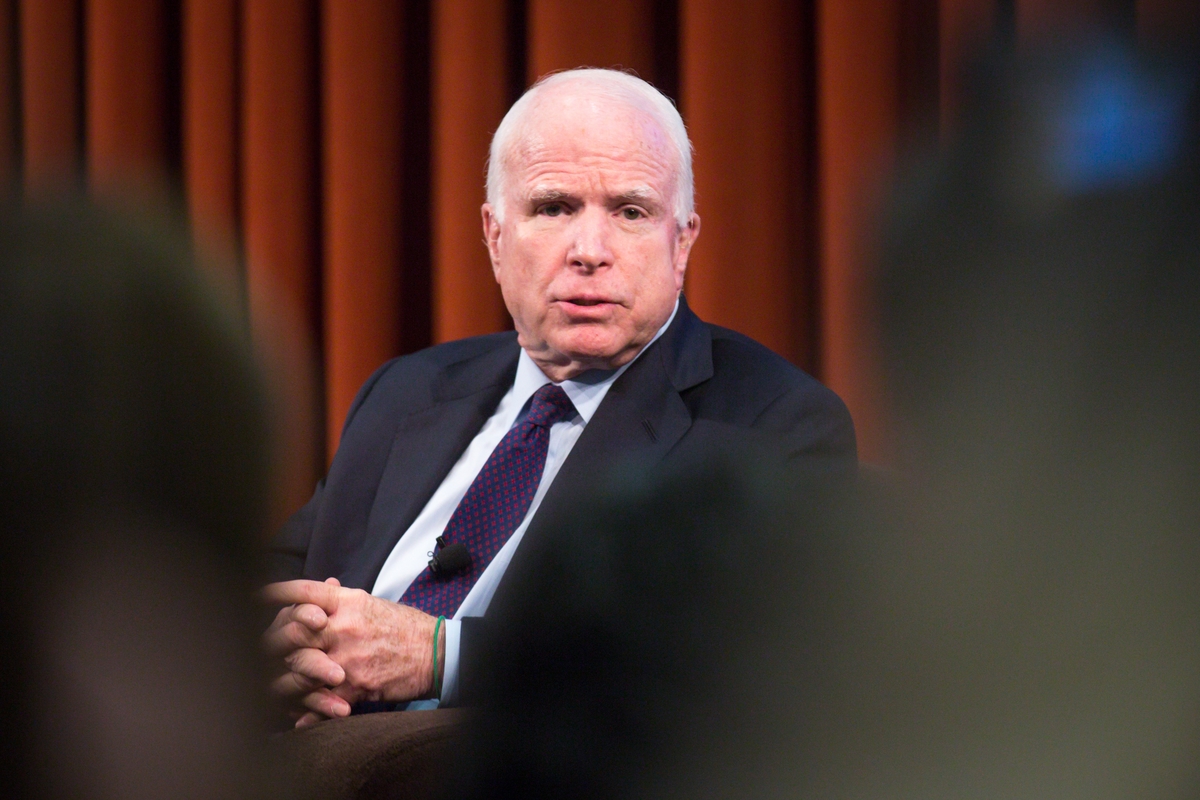
Sen. John McCain talks with Jeff Cunningham as part of his "Iconic Voices" series at the ASU Cronkite School of Journalism and Mass Communication on Feb. 19 in Phoenix. McCain touched on a variety of topics ranging from the presidential candidates to the Supreme Court to North Korea. Photos by Charlie Leight/ASU Now
McCain said the 2016 presidential election is being driven by anger, dissatisfaction and mistrust in elected officials, which is why Republican candidate Donald Trump and Bernie Sanders, a Democrat from Vermont, are emerging as front-runners for their respective parties.
“There are lots of Americans who are angry. Millions of Americans looking for work. Millions of Americans who have not seen any improvement in their lives since the economic crash of 2008,” McCain said. “There’s a lot of middle-aged Americans that yearn for a previous era in our history where we had a steadily improving economy, when we were the strongest nation in the world. There’s a great deal of unhappiness, and there’s a great deal of uncertainty.”
McCain said Trump’s campaign slogan, “Make America Great Again,” and the perception that he is not a part of the establishment are resonating with voters who are looking for something different.
“He (Trump) defies all historic precedence,” McCain said.
Sanders’ popularity among younger voters, McCain said, is his belief that that all education should be free in the United States and that Democratic candidate Hillary Clinton doesn’t engender public trust.
“So many young Americans carry this burden, particularly if you go into a profession like medicine and others, where they’re carrying hundreds of thousands of dollars of student loans, which will take them years to pay off,” McCain said. “Bernie Sanders says all education should be free and, yes, it’s a simplistic statement, but I also think that he’s popular because Hillary Clinton has an issue of trust. … If people don’t trust a candidate, then they’re not willing to examine their other values. Right now, Secretary Clinton’s trust numbers are in the 30s.”
A possible independent third party could emerge in the race, McCain said, in New York Mayor Michael Bloomberg, whose net worth is estimated at around $44 billion.
“He could spend a couple of billion and it wouldn’t bother him in the slightest,” McCain said. “I’m not saying it’s gonna happen, but I think two things could happen that have never happened in modern times — one is a third-party candidate who is very viable and the other scenario on the Republic side is a brokered conventionIn U.S. politics, a brokered convention is a situation in which no single candidate has secured a pre-existing majority of delegates (whether those selected by primary elections and caucuses, or superdelegates) prior to the first official vote for a political party's presidential candidate at its nominating convention. — Wikipedia, which happened with Gerald Ford and Ronald Reagan and was a disaster. It could lead to a Democratic or Independent victory.”
McCain said whatever happens in the 2016 election will not only be memorable but historic.
“These are the most telling times, my friends,” McCain said. “You’ll be telling your grandchildren about it.”
More Law, journalism and politics

Can elections results be counted quickly yet reliably?
Election results that are released as quickly as the public demands but are reliable enough to earn wide acceptance may not always be possible.At least that's what a bipartisan panel of elections…

Spring break trip to Hawaiʻi provides insight into Indigenous law
A group of Arizona State University law students spent a week in Hawaiʻi for spring break. And while they did take in some of the sites, sounds and tastes of the tropical destination, the trip…

LA journalists and officials gather to connect and salute fire coverage
Recognition of Los Angeles-area media coverage of the region’s January wildfires was the primary message as hundreds gathered at ASU California Center Broadway for an annual convening of journalists…