Computer science club propels master’s student toward fast-paced future
At ASU, Abhirup Vijay Gunakar turns Friday-night workshops into a launchpad for leadership and innovation

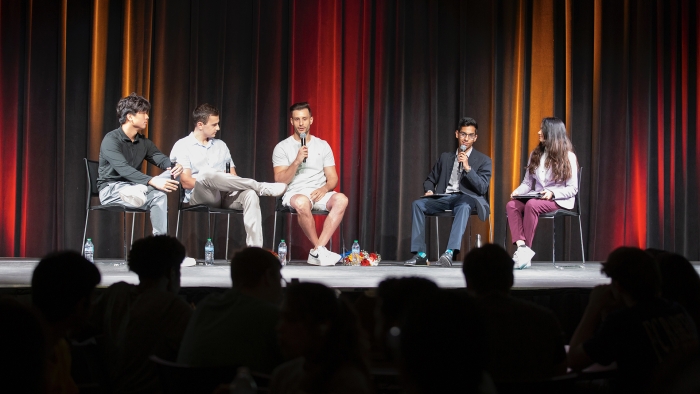
Abhirup Vijay Gunakar speaks onstage at an event hosted by the Arizona State University Google Developer Student Club, or GDSC. Abhirup, a computer science master’s student in the School of Computing and Augmented Intelligence, part of the Ira A. Fulton Schools of Engineering at ASU, currently serves as the group’s president. Photo courtesy of Pranav Teja Pemmasani
For computer science master’s student Abhirup Vijay Gunakar, the most transformative moments of his college experience didn’t happen in a classroom. They happened on Friday evenings.
While an undergraduate student in the School of Computing and Augmented Intelligence, part of the Ira A. Fulton Schools of Engineering at Arizona State University, he joined the Google Developer Student Club, or GDSC, and found his calling.
“I joined GDSC as a member in my first semester at ASU,” he says. “Those 5 p.m. Friday workshops, where we coded and learned something new, were always exciting and something I looked forward to all week.”
Those weekly sessions sparked a journey that would eventually lead him to become president of the club — known for hosting more than 50 technical workshops a year and sponsoring and judging large-scale hackathons and events featuring engineers from top technology companies.
But for Gunakar, the workshops offered something more foundational: a chance to build community and discover just how fast the world of technology moves.
That lesson hit in full force this spring when the club traveled together to NVIDIA’s GTC 2025 conference, a global AI event held in San Jose, California, in March — an experience Gunakar calls his favorite memory from his time with GDSC.
“We saw (NVIDIA President) Jensen Huang deliver the keynote and were among the first people to witness the release of the Grace Blackwell Superchip and new GPU architectures,” Gunakar says. “It was an eye-opening experience because things move fast in the modern tech world, especially in the AI era.”
Beyond seeing innovative hardware unveiled in real time, the trip gave the group an unexpected window into the startup ecosystem.
“We also got invited to a few invite-only startup gatherings in the Bay Area, where we built connections and learned directly from leaders in the field,” Gunakar says.

Leading through acceleration
Though GDSC is one of ASU’s most active technical organizations, its scale presents a unique leadership challenge. Gunakar, who previously served as senior vice president before becoming chapter lead and president, says the experience feels strikingly similar to running a young tech company.
“Running a club is basically like running a startup,” he says. “You have to handle everything from hosting Google engineers and special guests to leading technical workshops and managing funding.”
It’s a demanding role — one that requires not only the coordination of a large team but also the ability to stay on the edge of technological innovation.
That responsibility shaped Gunakar in unexpected ways. While he says his academic training grounded him in the fundamentals of computer science, the hands-on, fast-evolving nature of club leadership demanded skills that mirror the realities of the industry.
“You’re constantly problem-solving,” he says. “You’re thinking about how to keep students engaged, how to grow the club responsibly, how to make sure events run smoothly and how to help other students succeed.”

Making your own momentum
Gunakar’s personal leadership philosophy was shaped early in his ASU journey by advice from GDSC’s founder and Fulton Schools alumnus Ananay Arora, along with former leads Arnav Aghav and Pavel Ryabov.
“One important piece of advice they gave me was that opportunities are what you make of them,” he says. “Do not waste your time, and try as much as you can in college, even if you fail.”
It’s counsel he now passes along to the next generation of developers entering the ASU community.
“There are a lot of student clubs at ASU, and ASU Engineering puts a lot of effort into helping them succeed,” he says. “Try what you are genuinely interested in without ever worrying too much about the result. Things can go well or badly, but what truly matters is what you learn from those experiences. You get one life and one chance, so make the most of it.”
Building confidence through community
Today, Gunakar works as a systems security researcher alongside Adil Ahmad, assistant professor of computer science and engineering, and as a graduate teaching assistant in the Fulton Schools, continuing to build on the foundation he credits GDSC for helping establish.
“My time with GDSC has been one of the most enriching parts of my ASU journey,” he says. “I am deeply grateful for this opportunity, for every interaction and collaboration, for the whole ASU community, and for our incredibly supportive core team.”
Gunakar’s journey — from Friday workshops to leading one of ASU’s largest student organizations — reflects a central truth of the modern tech world: Success belongs to those who stay curious, stay adaptable and say yes to opportunities, even when they don’t know where they’ll lead.
In a field defined by rapid change, his story is a reminder that community can be the most powerful accelerator of all.