Sealing the deal: Law, policy and partnerships in tribal water agreements
ASU Indian Legal Program kicks off brown bag seminar discussing landmark settlement in US history
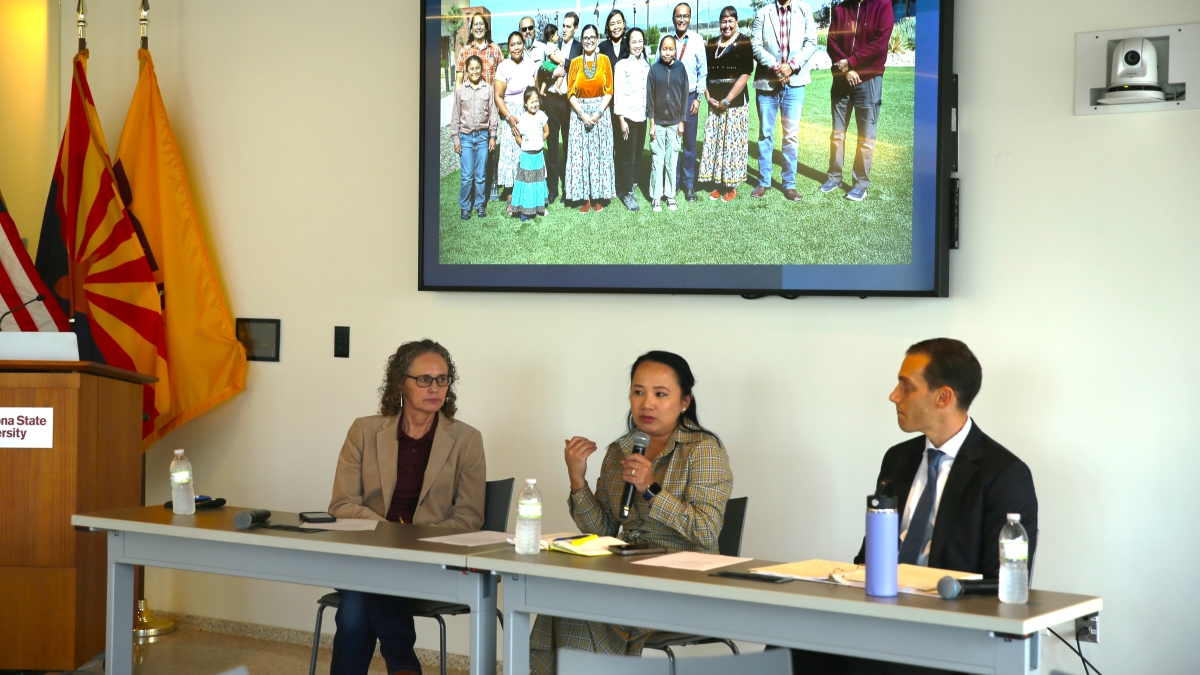
Ann Marie Bledsoe-Downes, Camille Touton and Gary Gold speak at a seminar hosted by the ASU Indian Legal Program in Washington, D.C., on Sept. 26. Photo courtesy Hager Sharp
Camille Touton, former Bureau of Reclamation commissioner in the U.S. Department of the Interior, never thought that she would help negotiate one of the largest Indian water settlements in history alongside colleagues Gary Gold and Ann Marie Bledsoe-Downes.
During her tenure at the Bureau of Reclamation, Touton led the agency’s efforts to address the country’s worsening drought crisis and helped manage funding for projects ranging from water efficiency programs to rural water projects and dam safety.
Touton saw firsthand the urgent need to guarantee water access in Indian Country. She once joined a Navajo family in Canyon Diablo and hauled water to their home miles away on a bumpy road. It was on that journey that Touton realized that these human challenges were what she needed to be solving for.
“We weren't sure the truck was going to make it, but we did. Once we got there, it took another 45 minutes to fill the 500-gallon tank we’d brought,” Touton recalled. “I thought to myself, ‘These are American children, and we're sitting here waiting to fill this tank with water.’”
Touton was instrumental in developing the Northeastern Arizona Indian Water Rights Settlement Act of 2025, which would go on to ratify and fund the largest Indian water rights settlement in the country, securing water rights for the Navajo Nation, Hopi Tribe and the San Juan Southern Paiute Tribe. The bill also includes a distribution pipeline and specific ground water rights and Indigenous protections.
Gary Gold, an attorney, engineer and former deputy assistant secretary for water and science at the U.S. Department of the Interior, outlined three key principles he believes were essential to negotiating this settlement:
- Maximizing benefits for tribal nations
- Establishing achievable commitments
- Ensuring feasible engineering
“We were able to carry forward some of the innovative ideas from the Navajo-Gallup Water Supply Project, like having a working cost estimate and doing feasibility studies rather than relying on value planning and appraisal studies, doing real engineering feasibility studies at the outset. We were very cognizant and just resolved to improve from our lessons learned in the past,” Gold added.
Touton’s negotiation team was joined by Ann Marie Bledsoe-Downes, professor of practice and director of the Indian Gaming and Tribal Self-Governance programs at the Sandra Day O’Connor College of Law at ASU. Touton’s relationship with Bledsoe-Downes was built on a foundation of trust.
“She's one of the best (water) lawyers that I know,” added Touton.
“Being a trustworthy broker doesn’t just mean being honest,” said Bledsoe-Downes. “It means delivering both the good news and the bad news. And so that is something else we did as lawyers. We carried those messages together. We were one family.”
This was the first brown bag lunch seminar hosted by the Indian Legal Program, part of the Sandra Day O’Connor College of Law at Arizona State University, at the Barrett & O’Connor Center in Washington, D.C.