From college dropout to ASU alum to Space Force general
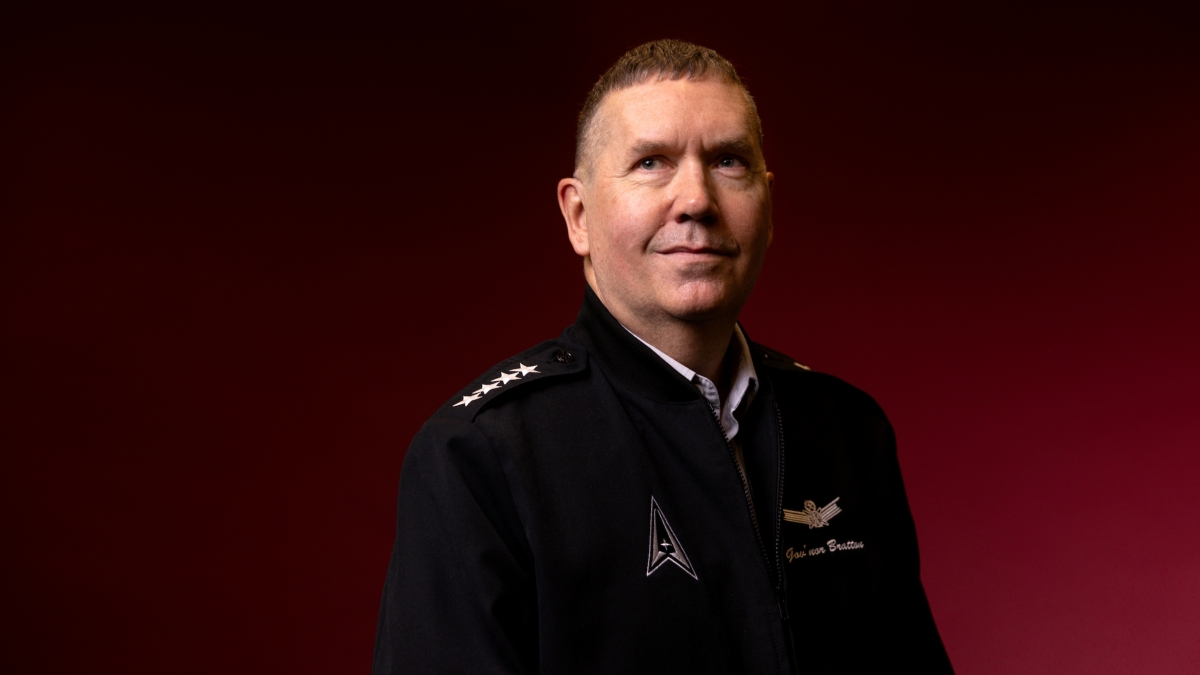
U.S. Space Force Gen. Shawn Bratton poses for a portrait in studio on Nov. 21. Photo by Samantha Chow/Arizona State University
Shawn Bratton stepped out of the Uber and onto the Arizona State University Tempe campus he called home in the early 1990s.
It was the first time Bratton had been back on campus since graduating in 1993 with a Bachelor of Arts in secondary education. Everything looked different. Bigger. Grander. More buildings.
But there was one familiar vibe.
“Even as I came in, in the Uber, it was like, ‘All right, this place is still great,’” Bratton said. “Mill Avenue and downtown Tempe still have that same great college town feel.”
Today, Bratton is a four-star general and the vice chief of space operations, the No. 2 role at the U.S. Space Force, the newest branch of the military.
The Space Force was created in 2019 and is focused on organizing, training and equipping personnel to protect U.S. interests in space.
It's been quite a rise for Bratton, who was once a college dropout — something he can smile about today — and at one time dreamed about making a living playing bass guitar with his band, Phineas Gage.
ASU News talked with Bratton about his work at the Space Force, his military career and his time at ASU.
Note: The following interview has been edited for length and/or clarity.
Question: Congratulations on your new role. What was that moment like when you got your four stars?
Answer: It was a seminal moment, especially because I started as a young, enlisted member. I went right into the service at 18. So it really made me reflect, like, “How did I end up here?” Luck and hard work, all those things come into play.
But, yeah, it was a pretty sobering moment. It’s not what I planned my life to be. I thought I was going to be a great bass player and maybe a high school teacher. That was the plan.
Q: So how did an erstwhile musician and teacher wind up a four-star general?
A: I came to ASU right out of high school (Bratton attended Brophy College Preparatory in Phoenix). I had a pretty rough first semester. The expectation in my family was you graduate high school and then you go to college. I followed that expectation, but I really stumbled coming out of the gate. It was a little bit too much freedom for my 18-year-old self.
So I dropped out after my first semester my freshman year. My dad had been in the military, and I knew my first report card was coming home and it wasn’t going to be good. I was like, “Man, I have to get ahead of this.” I snuck out, met with a recruiter and pretty much signed all the paperwork to join the military. So when the report card showed up, I could have a talk with my parents and say, “Hey, I don’t think college is for me. I’m going to go join the military.”
But I knew I wanted to come back to college, which is what led me to the National Guard.
Q: How did being in the National Guard sort of point your way back to school?
A: It helped me mature enough to take school seriously. ASU had a program at the time, I can’t remember what it was called, but they reset my GPA, and I didn’t have this cloud of failure hanging over me.
They gave me sort of a second chance to come back here and start with a clean slate. It really helped me get sort of on track again. And I did great. I had matured, I was working hard and serious about my studies. And then I was off to the races.
Q: But you still wanted to be a teacher, right?
A: Yeah, I was teaching at North High School, and my commander asked if I would be interested in this program called Project Challenge (a military program designed to help at-risk youth by providing a quasi-military environment to earn a high school diploma or equivalency). It was a pay raise, my wife and I were just starting a young family, so I moved over and worked full time with the (National) Guard.
My education degree and my military world came together, I eventually cross-trained into space and I’ve been full-time military ever since.
Q: Can you give an overview of what the Space Force does?
A: It’s the newest and, by far, the smallest branch of the service. The reason the Space Force came into being is that as competitors and potential adversaries gained capabilities in space and really started putting weapons in space, we knew we needed to be able to counter that. So we talk a lot about space superiority and fighting in space and thinking about how we do that.

Q: Sounds like Star Trek stuff.
A: The reality of it is pretty sobering. You remember Desert Storm, and how we were all watching TV and those bombs with the green camera light would go right down chimneys? People talk about that as the first space war, because of GPS. Satellite communications really enabled the United States to fight what way.
It turns out everybody was watching, and they realized, “Hey, if we have to fight the United States, we have to defeat those capabilities. We can’t let them have this precision-guided munition capability that GPS enables.”
That led to developmental weapons and capabilities, that, quite honestly, we weren’t thinking about. Maybe they got a little bit out in front of us, and we realized, “Holy smokes, we need to defend ourselves.” I think that realization culminated in the establishment of the Space Force.
Q: So, space is the next war zone?
A: We’re going to have to fight there. We’ve been fighting at sea for hundreds of years. We’ve been fighting in the air for decades. We’ve been fighting on land for thousands of years. But we’ve never fought in space. We don’t know how to do it. We have to think about it and develop the concepts.
Q: How would you describe your role?
A: I’m sort of the No. 2 guy. I deal with all the Pentagon aspects of it, like budget and force design, helping figure out what we need. I do a lot of budget stuff and then, just human capital. How many people do we need in space? I just keep all that moving forward and try to keep the boss (Gen. B. Chance Saltzman) informed. I might tell him, “Here’s where I think we need to go,” and then he makes the decisions.
Q: Last question: What memories came back when you were on campus?
A: A lot of time in downtown Tempe hanging out. I was in a band, and we used to play the Sun Club and The Library and the Mason Jar. Our band was called Exit, but like every college band we went through a bunch of names. The final name was Phineas Gage, who was the guy who gets a railroad spike through his brain and survives. Our psychology major drummer came up with that. For me, ultimately, school came down to, “I’m either going to graduate or be in a band. It can’t be both.” Fortunately, I chose graduation.
More Local, national and global affairs

ASU graduate uses communication, fundraising skills to aid nonprofits
Phoenix-native Madison Barton was inspired when she heard the founder of Love Never Fails speak about her vision for creating a world where every person can live free from exploitation.Last…

Emergency manager connects on-the-ground experiences with systemic change
Last year, when Hillsborough County, Florida, was hit with back-to-back-to-back hurricanes, Erik Challenger Sr. was there, helping his community.He worked with local, state and federal officials, as…

ASU expands global impact in Central Asia through new Kazakhstan partnerships
Arizona State University is deepening its engagement in Central Asia through two new university partnerships in Kazakhstan, announced at this year’s C5+1 Summit in Washington, D.C. The C5+1…