Elementary school teachers boast classroom benefits after participating in ASU program

Maricopa County elementary school teachers found that their students formed new friendships and stayed engaged in hands-on activities after implementing plans as part of ASU's Learning Together Challenge. Shutterstock photo
Laura Fitzpatrick believes failure is where learning begins.
“You have to fail a little bit in order to learn a lot,” says the kindergarten teacher at Kyrene de la Estrella Elementary School in Phoenix.
In fact, it can bring courage and confidence, especially to kindergarten-aged children. And that’s the sentiment she brings to her classroom, noting that sometimes it takes a few tears and feeling that moment of “I can’t do it” before children discover that they can.
She and other teachers recently participated in the Learning Together Challenge, a school-year-long program designed to foster cooperative, safe and supportive classrooms that promote positive student-caregiver relationships and overall well-being.
The challenge, an initiative of the T. Denny Sanford Harmony Institute at Arizona State University, highlights the institute's mission of supporting harmonious relationships among children and their peers, says Krista Oswalt, project manager at the institute.
Oswalt says the challenge encouraged educators to reflect on and build upon their own teaching strategies. The goal was to identify effective ideas and explore how they could be adapted to benefit other classrooms.
Participating teachers received funds to implement their projects, and additional funds to maintain the project for the following school year. They had the flexibility to use the funds in ways that best fit their approach, from classroom materials and project supplies to other creative resources that helped strengthen classroom learning and connection.
Along the way, the institute offered guidance to help educators shape their ideas, refine their plans and assess their classroom impact — ensuring every project had a positive, lasting impact in the classroom.
During the 2024–25 school year, three schools and four elementary teachers from Maricopa County participated in the program, including Fitzpatrick and Priscilla Arriaga from Kyrene de la Estrella Elementary School as a kindergarten team; Jennifer Adams, a fourth grade teacher at ASU Prep Downtown; and Sharyn Weinheimer, a K-5 instructional coach from Kyrene de los Niños.
Collectively, their efforts reached 75 educators and positively impacted more than 500 students across Arizona schools. The program’s reach expanded well beyond the participating teachers’ individual classrooms largely due to Weinheimer’s role as an instructional coach.
“This project serves as a testament to the profound impact that a nurturing educational environment can have on student growth,” Adams says. “It lays the foundation for ongoing improvement and success within our learning community.”
-

From left: Priscilla Arriaga, Krista Oswalt, Laura Fitzpatrick and Jessey Johnson, principal of Kyrene de la Estrella Elementary School. Arriaga and Fitzpatrick, teachers at Kyrene de la Estrella and participants in the Learning Together Challenge, received an Award of Excellence from the Sanford Harmony Institute.
Photo courtesy of Krista Oswalt
-

Krista Oswalt, project manager at the Sanford Harmony Institute, presented an Award of Excellence to Jennifer Adams of ASU Prep Downtown, a participating teacher in the Learning Together Challenge.
Photo courtesy of Krista Oswalt
-
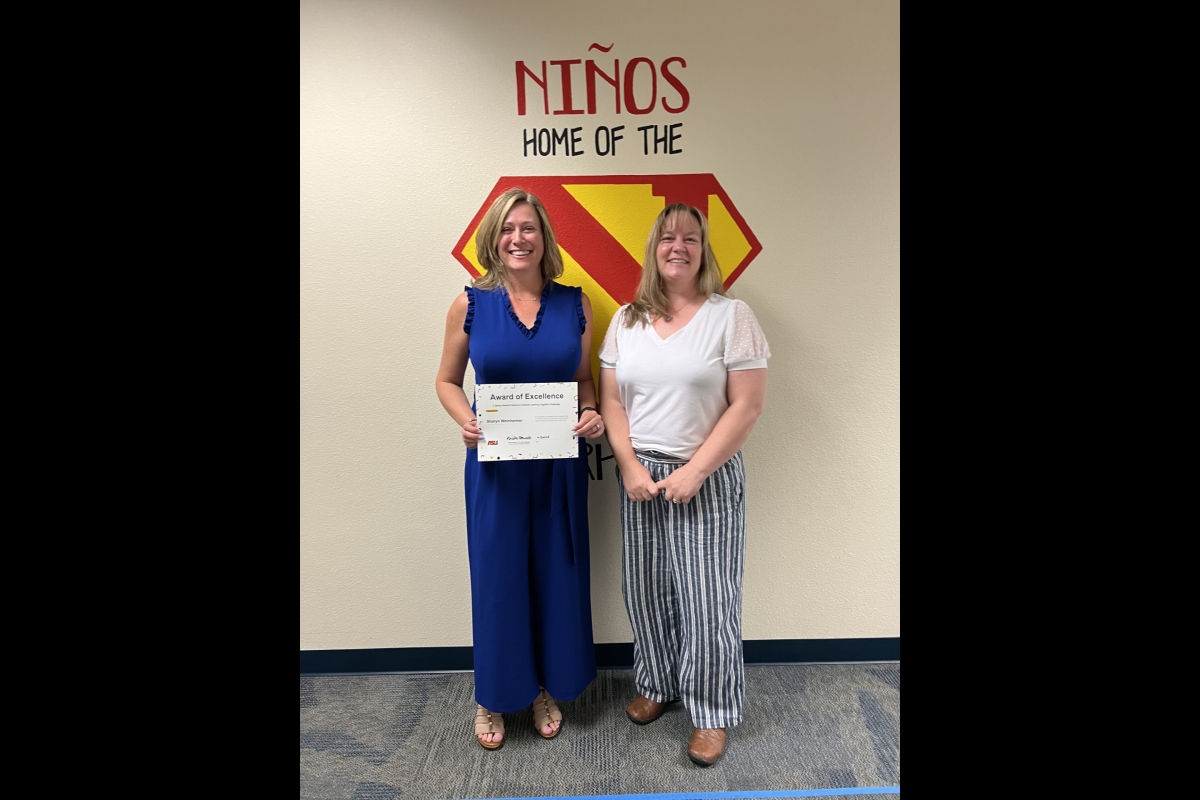
Krista Oswalt presented an Award of Excellence to Sharyn Weinheimer, a K-5 instructional coach at Kyrene de los Niños and participant in the Learning Together Challenge.
Photo courtesy of Krista Oswalt
Setting students up for success
Adams, Fitzpatrick and Arriaga all adapted the Learning Together Challenge to meet their classrooms’ unique needs, sharing a common goal: building a more connected, supportive learning environment where students had the confidence to reach their full potential.
For Fitzpatrick and Arriaga, creating a sense of belonging in their classrooms was essential. Since kindergarten was often their students’ first school experience, they wanted each child to feel welcomed and safe from day one. They saw relationship-building as central to this goal, giving students opportunities to strengthen their social skills through collaboration and feel accepted among one another.
Two of the three Kyrene de la Estrella project goals centered on helping students feel safe to be themselves and encouraging them to embrace challenges and see mistakes as part of the learning process.
“It takes work. … It takes a little struggle,” Fitzpatrick says.
But when students feel safe and supported in their environment, they grow more confident and willing to take risks in their learning without fear of failure, she says.
For Adams’ fourth grade class, she sought to create a collaborative environment using a class-family approach — a teaching method that fosters belonging, community and respect among students, much like the dynamics of a caring family.
In contrast, Weinheimer’s role at the school was to help teachers strengthen their classrooms and address common challenges. Many educators said they struggled to keep students engaged, manage behavior and adapt lessons to meet varied learning needs — challenges Weinheimer worked alongside them to improve through targeted support and coaching.
Her approach focused particularly on social emotional learning and the “Sequence of Engagement and Processing” — Regulate, Relate, Reason — from Dr. Bruce Perry’s Neurosequential Model in Education, a sequential understanding that supports educators in planning for and supporting themselves and their students through a brain-based lens.
She also hosted an optional book club on “What Happened to You?: Conversations on Trauma, Resilience, and Healing” by Perry and Oprah Winfrey. This strategy explores how children’s experiences shape their actions and how to move forward. Weinheimer believed that both an understanding of the “Regulate, Relate, Reason” sequence and the book club could guide teachers to overcome their classroom challenges.
“I believe in understanding how the brain functions,” Weinheimer says. “It's organized to act on incoming information before it feels and before it thinks about the incoming information, which helps teachers understand students’ and parents' reactions and behaviors.”
Meaningful improvements
Through surveys and progress check-ins, the educators tracked the development of the students’ social skills and peer relationships.
Based on results from Adams’ survey, student feedback consistently highlighted notable improvements during the school year, including stronger collaboration skills, higher engagement in projects and measurable personal growth in peer-related performance scores.
For example, friendship during recess significantly increased, particularly in the later months throughout the school year; and students reported consistently positive responses about feeling safe and like they belong at school and high confidence in talking to a teacher.
-

Laura Fitzpatrick’s Kindergarten Collaboration Survey showed growth in collaboration, with 78% of students saying they liked working with their classmates at the beginning of the year, rising to 100% by the end of the year, after the completing challenge.
Graphic by Sophia Franz
-

Jennifer Adams’ monthly check-in survey showed a significant increase in students’ sense of belonging at school, rising from 65.6% at the beginning of the year to 100% by the end of the year.
Graphic by Sophia Franz
-
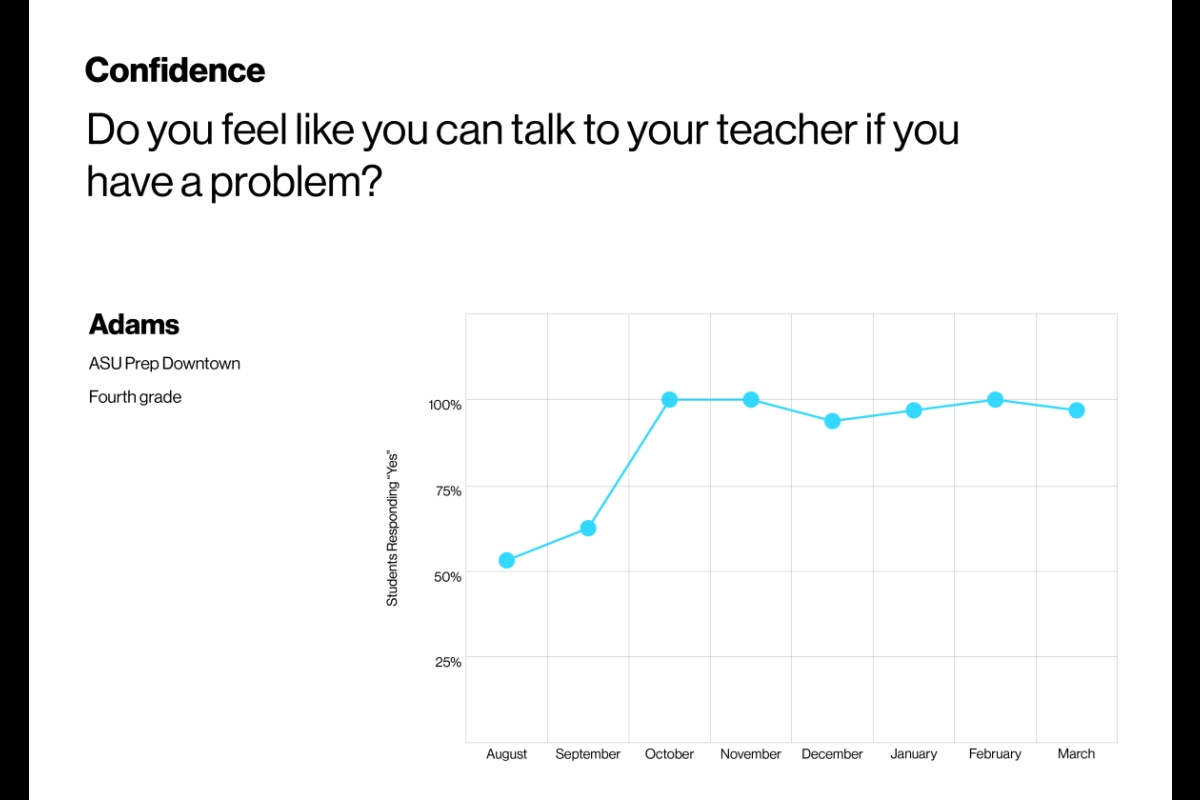
Jennifer Adams’ monthly check-in survey showed a notable increase in students’ confidence talking to a teacher, rising from 53.1% at the beginning of the year and peaking at 100% in October, November and February during classroom holiday parties and periods of more frequent teacher conferences.
Graphic by Sophia Franz
Fitzpatrick’s kindergarteners noted they appreciated being heard and collaborating with their classmates, even when the outcome is not favorable. The activities also helped students build a foundation of trust within their school community, supporting a feeling of connectedness.
By the end of the program, Fitzpatrick says her students were fully engaged and eager to learn more. And she’s seen numerous children who have worked on projects together from the challenge become friends.
“That's where I see the value,” she says. “They feel they're happy to come to school. They're happy to be in those friend groups.”
The educators say they plan to incorporate many of these approaches into their ongoing lessons year after year, extending far beyond the scope of the challenge.
“Teachers are overwhelmed and have a lot to do, but they want to do a good job,” Weinheimer says. “If they have the right tools and support, they can make magic happen and move mountains.”
More Arts, humanities and education

From Canada to Armenia: School of Art student pursues passion through global research
Fiona Gray, who will graduate this fall with a BA in art history and a minor in religious studies, said her time at ASU not only prepared her for pursuing a career in academia but also allowed her to…

Photography student explores cultural legacy through his lens
For Nicolas Morley, who graduates this fall with a BFA in photography from the School of Art, the path to photography began with a moment of clarity late in high school.“It took me a while to figure…

ASU professor offers tips for handling friction-filled family gatherings this season
Many people are grateful for the opportunity to gather with family for the holidays. Others are grateful when the gatherings are over.There are various reasons why these family get-togethers can be…