Professor creates 'a safe harbor' for Indigenous data

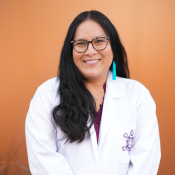
Karina Hernandez-Hernandez, PhD student in the Tsosie Lab, on set filming for the Data for Indigenous Implementations Interventions and Innovation, or D4I, Tribal Data Repository. Photo courtesy of the Tsosie Lab
Among Indigenous populations in the U.S., there is a history of personal data being used without consent. Now, a new digital repository hopes to change both who benefits from biomedical data and who gets to decide how it’s used.
The Data for Indigenous Implementations Interventions and Innovation, or D4I, Tribal Data Repository is led by Arizona State University Assistant Professor Krystal Tsosie. The project centers Indigenous data and digital sovereignty from the ground up, technically and ethically.
At its core, the repository is designed as a protected home for federally funded biomedical data originating with U.S. tribal nations and Indigenous peoples. Instead of a single gatekeeping key that unlocks everything, the system emphasizes federated and decentralized access models, and is built to incorporate modern tooling, including machine learning and AI.
Tsosie, who is also the co-founder of the Native BioData Consortium, calls it “a safe harbor” that adheres to tribal laws and policies.
Because infrastructure is easy to overlook, the team paired the repository with a set of short, high-production explainer videos that translate big concepts into approachable learning modules.
The series features artwork by Muscogee muralist and Oklahoma City Thunder artist-in-residence Maddie Sanders and narration by School of Life Sciences PhD student Karina Hernandez-Hernandez.
Early drafts using professional voice actors sounded like “a museum exhibit,” Tsosie said, so the team shifted to an Indigenous student voice to ground the project in lived experience. The videos cover consent models, data contracts and management basics, and are released under a Creative Commons noncommercial license so educators, tribal leaders and community members can “drag and drop” them into trainings and classrooms.
Tsosie’s motivation comes from what she observed as a genetics trainee: Data collected in one study can be reused indefinitely under broad or blanket consents, often far from the communities that enabled the research in the first place. Changing that pattern, she argues, requires changing the norms of the field.
“If you’re going to change the landscape of research, you really have to change how that data infrastructure looks and operates,” she said.
Put simply: Fix the platform, then practices can follow.
Governance is the project’s backbone. The repository follows the CARE Principles — collective benefit, authority to control, responsibility and ethics — to rebalance “open” data models that so often advantage already powerful institutions.
Practically, that meant months of work with tribal-nation attorneys to align repository operations with tribal and institutional law; collaboration with Indigenous ethicists on data provenance and intellectual property; and a shift from ownership language to stewardship. The architecture is explicitly federated, allowing tribal nations with their own repositories to interoperate while retaining control. The Native BioData Consortium, a tribal health research nonprofit organization, anchors community stewardship, and external advisory committees composed of tribal subject-matter experts, including voting panels, review and approve data-access requests.
The impacts of bridging health data back to tribal nations are tangible. Tsosie points to a small tribe in North Dakota that needed more ambulances but lacked localized statistics to demonstrate need on a grant application. A responsive, sovereignty-aligned repository can help communities build those datasets, she said, enabling them to “take control over their own data, data stories (and) their data narratives,” and compete for resources on their terms.
Adoption will be paced and deliberate. Tsosie likens the approach to finishing the house before welcoming guests: Get the walls up and the systems working, then invite broader use. For now, launching with standardized elements reduces risk while the governance and technical foundations harden.
A student voice at the center
Hernandez-Hernandez, who narrates the videos, joined the work in her first semester of doctoral study.

“The thought of being involved in something that’s so big and so impactful for our communities brought up some anxiety,” she said. But reflecting on her family, colleagues and the long history of research-related injustice pushed her to overcome her fears and to accept.
Her academic path maps neatly onto the project. Hernandez-Hernandez is pursuing a PhD in biology and society, and training as a genetic epidemiologist with an emphasis on social determinants of health, integrating bioethics, policy and law within an Indigenous data sovereignty framework.
The repository, she said, turns theory into practice, evidence that the principles she studies can be embedded in a working platform.
“This data repository is in actuality taking theory into practice.”
Identity informs her perspective. Hernandez-Hernandez is P’urhépecha from Pomácauro/Cantabria, Michoacán, born and raised on the traditional lands of the Yokuts and Mono people, now known as the San Joaquin Valley of California.
Sovereignty questions cross borders, she said, and a model that centers Indigenous authority has relevance far beyond a single campus. For her, the TDR is “research for us, by us; a place to rebuild trust between Indigenous communities and the scientific enterprise, with Indigenous scientists leading decisions about access and use.”
Because Indigenous data is highly valuable to outside entities, she said, having a meaningful say over who uses it and why is foundational to personal and national sovereignty. Early response says the videos are accessible, relatable and, as she put it, “hope-giving,” suggesting that the message is landing.
Cross-institution collaboration has doubled through mentorship. Many partners are longtime colleagues of Tsosie, and through efforts like the IndigiData workshop series, they’ve become Hernandez-Hernandez’s mentors too; models for operating as an empowered Indigenous scientist across disciplines and institutions.
Hernandez-Hernandez also sees the series as a push to reshape how science is communicated.
Too often, she said, Western scientific education hides behind jargon and claims of pure objectivity that ignores how lived experiences shape inquiry. Effective outreach should be grounded in people and purpose: honest about history and power, and focused on whether outcomes truly benefit communities and who ultimately owns the results.
Why ASU, and why now
Tsosie calls the repository a signal of ASU’s commitment to Indigenous innovation through durable partnerships with tribal leaders and communities. It’s also a starting line. She expects more Indigenous-directed data infrastructures to emerge as communities build capacity and tailor solutions to different data types and needs.
The innovation, she argues, isn’t just the build, it’s the alignment of technology, law and ethics so that biomedical data supports Indigenous priorities first.
“We’re really trying to operationalize Indigenous data and data sovereignty,” and a new way of doing things, Tsosie said.
With the house framed and the welcome mat ready, the next phase is about bringing people in on terms set by the communities whose data matters most.
More Science and technology

Programming to predict the unpredictable
As the natural world rapidly changes, humanity relies on having reliable, accurate predictions of its behavior to minimize harmful impacts on society and the ecosystems that sustain it.Ecosystems of…

Findings on adenoviruses in baby gelada monkeys provide a window into our own cold and flu season
If you have young kids or spend time around day care centers, you know the drill: Someone gets a cold, and soon the whole group is sniffling and sneezing. Now imagine that same pattern playing out in…

Student teams create AI tools to help neurodivergent learners
When Stevie Cervantes was a first-year student at Arizona State University, she shied away from using AI.“AI was everywhere and my friends were asking me, ‘Oh, do you use ChatGPT?’ And I hadn’t even…