ASU's STEAMtank course offers more than just child’s play

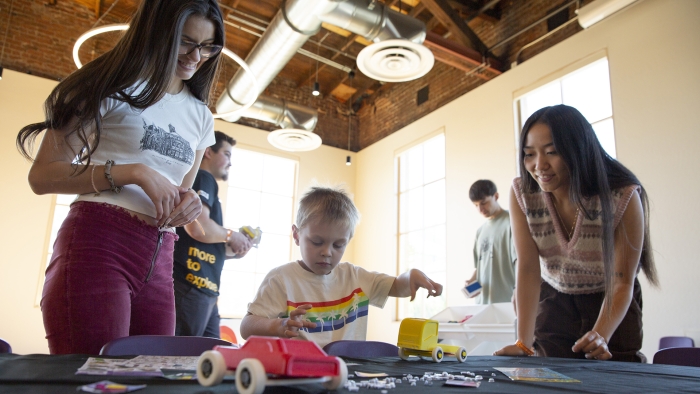
Robert Kittle, an industrial design student, assists a child at the "Go!" activity, one of several interactive, student-designed stations that were part of the STEAMtank exhibit at the Children’s Museum of Phoenix in May. The project, created to inspire elementary-age children to purse STEM studies, is an annual collaboration between ASU's School of Computing and Augmented Intelligence, part of the Ira A. Fulton Schools of Engineering, and The Design School, part of ASU’s Herberger Institute for Design and the Arts. Photo by Erika Gronek/ASU
“How do you create a real passion for engineering?” Daniel McCarville asks.
McCarville is a professor of practice in the School of Computing and Augmented Intelligence, part of the Ira A. Fulton Schools of Engineering at Arizona State University, who took up an academic role after a lengthy career as an industrial engineer in the microelectronics industry.
His journey began not on the bookshelf but on the toy shelf.
“For me, I really connected with engineering back in the second grade, when my dad bought me a rocket kit,” he says.
For McCarville, that early sense of play transformed into a lifelong thrill of figuring out how the world works.
With that thought in mind, McCarville was intrigued by work underway in the in The Design School, part of ASU’s Herberger Institute for Design and the Arts, where Craig Hedges, a clinical assistant professor of industrial design, had developed STEAMtank.
STEAMtank is a two-semester, interdisciplinary class open to all students that provides opportunities to design and build museum exhibits to teach young children about STEAM — science, technology, engineering, art and math — an updated acronym that reflects the need to incorporate the arts into technical education.
The program is part of The Design School’s InnovationSpace, a center that brings together students to tackle real-world challenges — not just as classroom exercises, but through hands-on engagement with industry, community groups and researchers.
A few years ago, Hedges and McCarville began to work together to ensure that both engineering and design students were participating in the program. Their efforts culminated in the STEAMtank exhibition held at the Children’s Museum of Phoenix in May.
Full STEAM ahead
Like McCarville, Hedges believes that hands-on experiences are essential for learners at all levels.
“STEAMtank began with a desire to get students into the shop and encourage them to build something with their hands,” Hedges says. “While a lot of industrial design uses digital tools, it’s still important for students to see how projects are actually fabricated.”
The Design School is the home of the Prototype Modeling Shop, a multimedia lab with comprehensive woodworking, metal fabrication and plastic fabrication capabilities. Over the course of a year, ASU industrial engineering and design students work cooperatively in the shop to develop, design and build museum exhibits.
While the students try hard to make the exhibits visually engaging and fun, they also make sure that STEAMtank isn’t just about play — it’s a sneaky-smart way to get kids thinking like engineers.
This May, more than 300 elementary-age children from the Phoenix area visited the STEAMtank exhibition. They got to design and race their own mini cars, learning how things like weight distribution and friction affect speed. They launched air rockets and explored how air pressure and aerodynamics influence flight. It was part science lab, part imagination playground. And 100% kid approved.
The exhibit was supported by the Richard F. Caris Foundation and W. L. Gore & Associates, the materials science company known for creating Gore-Tex, a breathable and waterproof fabric valued for its ability to keep people comfortable in varied weather conditions.

Encouraging little minds to dream big
The ASU students were excited to present their work and see kids interact with their creations. Jessica Marencic, a senior in the Herberger Institute’s industrial design program, says that she hopes the exhibit sparked the imagination of future designers, builders and engineers.
“We like to say that STEAMtank is about inspiring the future to inspire the future,” Marencic says.
Giovanny Buitron, a Fulton Schools engineering management student, agrees and hopes that the children left with an interest in scientific concepts.
“The exhibits are fun, and they can inspire kids to think more about physics or learn about the solar system,” Buitron says.
McCarville sees STEAMtank as providing opportunities for students to both learn and teach.
“The students were really jazzed to present their work,” he says. “And I think they learned a lot about interdisciplinary, cross-functional teamwork.”
More Science and technology

New research by ASU paleoanthropologists: 2 ancient human ancestors were neighbors
In 2009, scientists found eight bones from the foot of an ancient human ancestor within layers of million-year-old sediment in the Afar Rift in Ethiopia. The team, led by Arizona State University…

When facts aren’t enough
In the age of viral headlines and endless scrolling, misinformation travels faster than the truth. Even careful readers can be swayed by stories that sound factual but twist logic in subtle ways that…
Scientists discover new turtle that lived alongside 'Lucy' species
Shell pieces and a rare skull of a 3-million-year-old freshwater turtle are providing scientists at Arizona State University with new insight into what the environment was like when Australopithecus…