What do a spacecraft, a skeleton and an asteroid have in common? This ASU professor

A rendering of the Lucy spacecraft, which will perform a test run of its tools on an asteroid named after ASU Professor Donald Johanson on its way to explore Jupiter’s Trojan asteroids.
April 21 update: Check out images from the flyby on NASA's website.
NASA’s Lucy spacecraft will probe an asteroid as it flys by it on Sunday — one with a connection to the mission name.
The asteroid is named Donaldjohanson, after Donald Johanson, who founded Arizona State University’s Institute of Human Origins. In 1974, Johanson made the breakthrough discovery of the Lucy fossil skeleton, whose bones are more than 3 million years old and point to a key development in the evolution of humans.
The Lucy spacecraft is on its way to explore Jupiter’s Trojan asteroids, and this flyby will serve as a test run of its science tools.
NASA named the spacecraft and the mission Lucy because those asteroids may answer questions about the origins of the solar system and the elements that can produce life.
Asteroid Donaldjohanson is not one of the Trojan asteroids but is a lucky opportunity along the way.
One instrument that will fire up as the spacecraft zips by Donaldjohanson is the Lucy Thermal Emission Spectrometer, or L’TES.
It was designed and built at ASU’s School of Earth and Space Exploration by Regents Professor Phil Christensen.
“It's not a camera, but it takes spectra,” he says. “We jokingly say we make these wiggly lines. Each one of those wiggly lines tells us the composition of the surface, and it tells us the temperature. So that's our job. Cameras take beautiful pictures. We ask, what is the asteroid made out of, and how hot is it?”
Donald Johanson — the human, not the asteroid — will retire in May, but Christensen has one more assignment for him: Start thinking of another name, or even names. That’s because Christensen says after looking at long-range imaging, he feels there’s a good chance there could be two — or more — asteroids that we’ve been calling Donaldjohanson.
“I’ll starting thinking about that,” Johanson says.
Both men will be at the Southwest Research Institute in Colorado this weekend to watch the flyby and the downlinks of data and images as it happens.
Whether Donaldjohanson (the asteroid) turns out to be one, two or more objects, the flyby will add to what space scientists call planetary defense.
“Most of the asteroids we fly by, including Donaldjohansson, will never hit the Earth. They're out of the asteroid belt,” Christensen says. “But the ones that do hit us came from the asteroid belt. So the more we learn about the asteroids in the asteroid belt, the more it tells us about the ones that potentially — someday — might hit the Earth.”
More Science and technology

Student teams create AI tools to help neurodivergent learners
When Stevie Cervantes was a first-year student at Arizona State University, she shied away from using AI.“AI was everywhere and my friends were asking me, ‘Oh, do you use ChatGPT?’ And I hadn’t even…
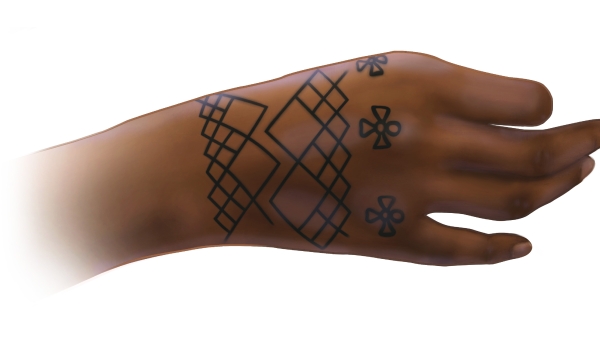
ASU researchers shed light on ancient tattoos in the Nile Valley
Long after an archaeological excavation, discoveries can still be made. One such example of this is newly discovered tattoos from ancient Nubia, nearly doubling the amount previously known from the…

ASU’s LEAPS lab marks a decade of energy impact
Nathan Johnson doesn't mince words when it comes to Earth's energy requirements.“The world needs every electron it can get to match the accelerated pace of economic development and electrification,”…