Top State Department official visits ASU to kick off international semiconductor supply chain initiative
Ramin Toloui, assistant secretary of the Bureau of Economic and Business Affairs, tours the university's MacroTechnology Works facility before meeting with ASU and local semiconductor industry leaders
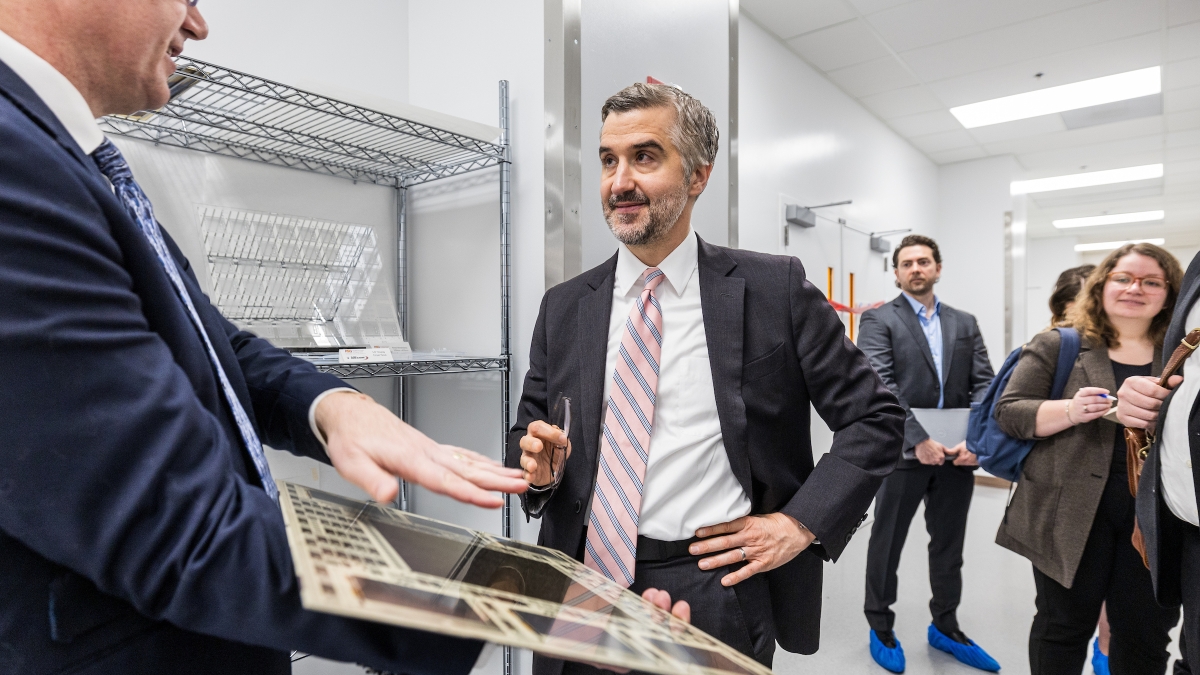
Kevin Reinhart (left), ASU Knowledge Enterprise’s executive director of research development, shows samples of microchip technology to Ramin Toloui, assistant secretary of the Bureau of Economic and Business Affairs in the U.S. Department of State on Thursday, March 7, at the ASU MacroTechnology Works facility in Tempe. Photo by Charlie Leight/ASU News
A top Biden administration official visited Arizona State University on Thursday to activate a new agreement in which ASU will help boost America’s semiconductor capacity overseas.
Ramin Toloui, assistant secretary of the Bureau of Economic and Business Affairs in the U.S. Department of State, toured ASU’s MacroTechnology Works and met with university leadership and local semiconductor industry leaders during his daylong visit.
In February, the State Department awarded a $13.8 million cooperative agreement to ASU as part of the International Technology Security and Innovation Fund, created by the CHIPS and Science Act of 2022. The new initiative will boost the assembly, testing and packaging capabilities in five partner countries to ensure a resilient supply chain for U.S. semiconductor manufacturers.
The goals are to bring more of semiconductor fabrication to the U.S., and also to make the global semiconductor supply chain more resilient to disruption like the shortages seen during the COVID-19 pandemic.
Toloui said the partnership is “drawing upon Arizona State’s extraordinary expertise and practical experience in this semiconductor technology ecosystem, which is manifest here in the Phoenix area.”
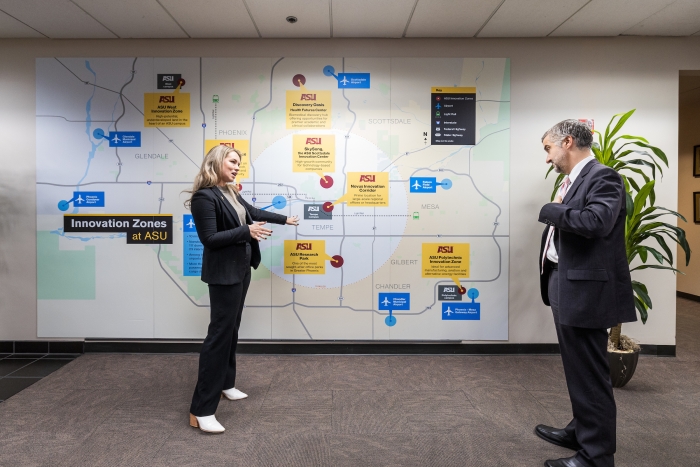
The countries are Costa Rica, Panama, Vietnam, Indonesia and the Philippines, and they were chosen for their potential in semiconductor development. Some of them already have U.S. and global companies that have established factories.
Each country will be evaluated for any issues that could constrain the semiconductor industry expansion, such as workforce shortages, physical infrastructure problems such as lack of electricity, or an inadequate regulatory environment, he said.
“We’re really tapping into the technical and technological expertise of ASU, but also the experience in working in other countries and with other partners,” Toloui said.
“Where ASU will come in is once we have that identification of the impediments, what are the things that we can do to address those? So if it's an issue of workforce development in a particular country, how can local educational institutions and industry partner to create a more skilled workforce?
“Because ASU has that experience here in the United States, and has experience working on this issue already with other international partners, they're going to be able to help us go from identifying a problem to designing effective interventions that can be made to address that problem.”
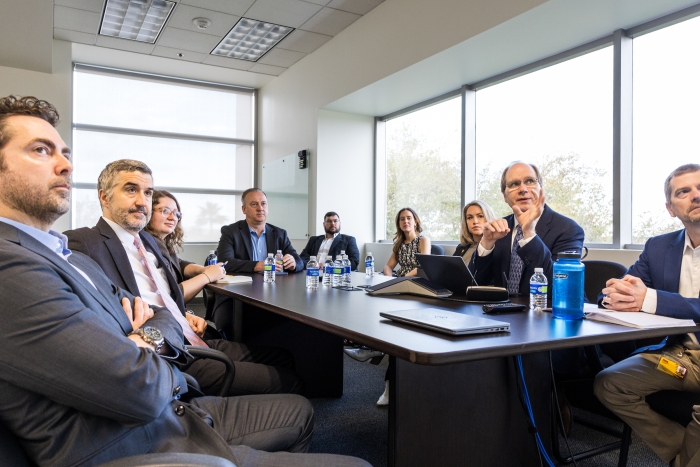
Toloui met with local semiconductor company leaders, including from Intel, ASM International and NXP Semiconductors, to find out their challenges to ramping up production. Shortage of workers, both in the U.S. and in overseas facilities, was discussed as a top issue. Not only do the companies need engineers, but also support workers such as technicians, truck drivers and construction workers.
“I've traveled all over the United States and around the world discussing with government, with academic institutions, with industry, the things that are most important to further developing the semiconductor industry. And something that I hear everywhere I go is the issue of having enough skilled workers for this industry,” he said.
“I have yet to visit with anyone who says, ‘We've got all the skilled workers we need.’
“So I think this issue of workforce development is going to feature very prominently in the programming that we are supporting through the International Technology Security and Innovation Fund.”
Toloui said that his tour of ASU’s MacroTechnology Works facility in Tempe, Arizona, showed him one way the university is addressing workforce development.
“It’s an extraordinary facility that brings together private industry and academia, providing a physical infrastructure to promote innovation and also introduce students to these exciting technologies, to educate them and to inspire them and motivate them to be some of the next generation of leaders.”
More Science and technology
ASU researchers develop special microphone to verify human speech
Deepfakes have become a large societal concern with the advent of video and audio content generated by artificial intelligence, or AI. A deepfake is a convincing imitation that blurs the lines…
Leading students toward a future of renewable energy
Nicholas Rolston, assistant professor in the School of Electrical, Computer and Energy Engineering, one of the Ira A. Fulton Schools of Engineering at Arizona State University, has found his passion…
SPARCS mission spacecraft bus delivered to ASU for final assembly
The Arizona State University team that is building the NASA-funded Star-Planet Activity Research CubeSat, or SPARCS, cleared a major milestone this week — receiving its spacecraft bus at the School…