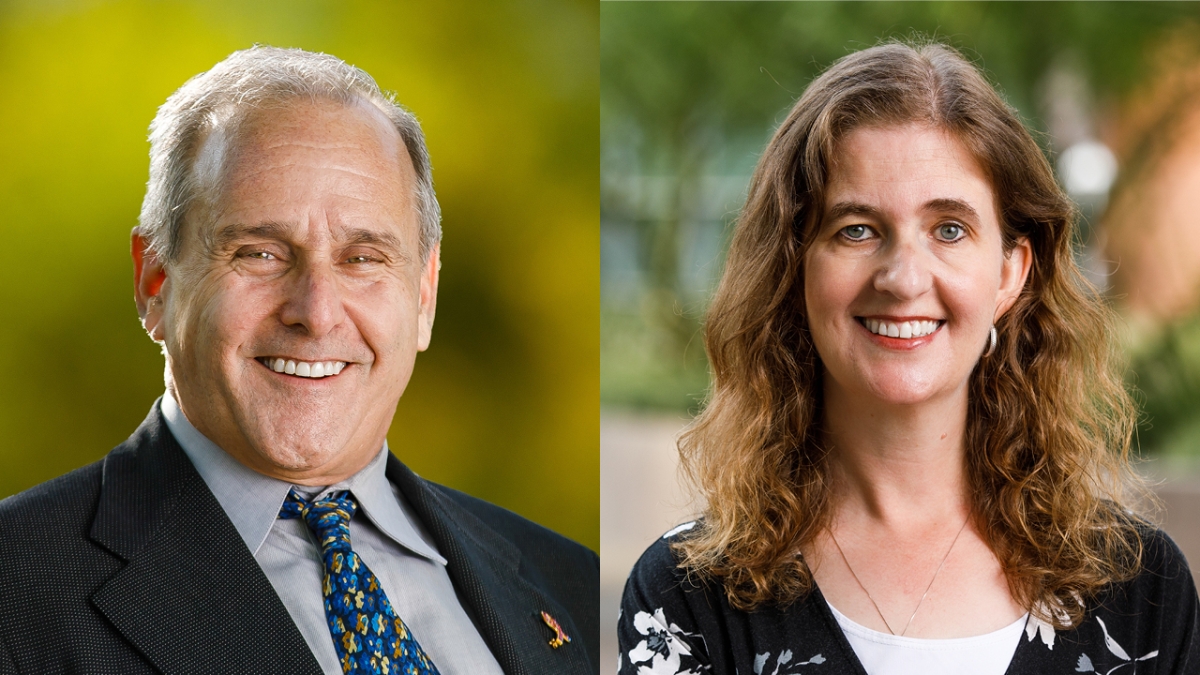
This month, AZBio announced that two of their annual awards will go to outstanding Arizona State University researchers — Joshua LaBaer and Rosa Krajmalnik-Brown.
AZBio is a statewide organization that is dedicated to “building the biosciences industry in Arizona by providing access to key resources, connections and information in our biosciences community.” As part of those efforts, each year AZBio recognizes scientists, educators, leaders and companies that are furthering biological solutions to improve the lives of our state’s residents.
The microbe whisperer
Krajmalnik-Brown is the recipient of the Arizona Bioscience Researcher of the Year award. She is the director of the Biodesign Center for Health Through Microbiomes and a professor in the School of Sustainable Engineering and the Built Environment. She studies how to use microbial systems to degrade environmental contaminants, produce renewable bioenergy and improve human health through the gut.
One of her most prominent research achievements came from a 2017 study, in which Krajmalnik-Brown investigated the impact of a treatment for children with autism that used fecal transplants to normalize their gut bacteria. They found that gastrointestinal symptoms decreased by 80% and autism-related symptoms improved 25%. Two years later, she and her collaborators found that most GI benefits remained and the improvements to autism behaviors were even greater.
“Rosa Krajmalnik-Brown defines what it means to be a pioneer at the frontier of research in environmental engineering and science,” said Joan Koerber-Walker, president and CEO of AZBio. “For her groundbreaking work and her deep commitment to finding answers to some of our most challenging scientific questions, she has been named the 2020 Arizona Bioscience Researcher of the Year.”
Video courtesy of ASU Research
Taking on the pandemic in Arizona
LaBaer is the recipient of the Jon W. McGarity Arizona Bioscience Leader of the Year award. He is the executive director of the Biodesign Institute and a professor in the School of Molecular Sciences. He specializes in personalized diagnostics, focusing on discovering biomarkers that can provide early evidence for risk of major illnesses.
Notably, he led a team that discovered a panel of 28 autoantibody biomarkers used to aid in the early diagnosis of breast cancer, as well as a team that developed a test for the amount of radiation absorbed by a person’s body after radiological exposure.
Most recently, LaBaer is leading a comprehensive response to the coronavirus pandemic, repurposing existing equipment and personnel to accelerate testing. He oversaw the creation of the ASU Biodesign Clinical Testing Laboratory, which quickly gained CLIA certification for testing nasopharyngeal swab samples and was the first in the western U.S. to offer saliva tests for COVID-19, as well as the first in the nation to offer those saliva tests to the public. He assembled a team of volunteers from across ASU and partner organizations that continues to expand testing. He concludes each daily team meeting with the rallying cry, “Let’s go save some lives!”
Video courtesy of ASU Research
“Joshua LaBaer is being honored with the Jon W. McGarity Arizona Bioscience Leader of the Year Award by AZBio for his ability to bring teams together to address some of our greatest health challenges,” Koerber-Walker said. “His call to action, ‘Let’s go save some lives,’ is more than just words. It exemplifies the mission he pursues each day and how he inspires others to embrace the mission and join him on the journey.”
The pandemic crisis makes us consider more than ever our health and our need for solutions to tough biological problems. Like never before, our future could crucially depend on successes in the biosciences. By continuing to celebrate the innovations of our state’s scientists, AZBio invites us to cultivate a hopeful attitude and displays the benefits of perseverance and creative thinking.
More University news

ASU’s Changemaker Campus designation renewed for third time
What does it mean to be a Changemaker Campus? According to Ashoka U, which awards just such a designation every six years, it means advancing social innovation and changemaking across higher…

Year in review: ASU's top stories for 2024
As the year draws to a close, ASU News is revisiting some of the university's biggest stories in 2024 — from big announcements to rare books to the Beatles. So pour a warm cuppa and peruse our…

ASU earns 'Gold' in inaugural Times Higher Education Online Learning Ranking
Arizona State University continues to set the standard in online learning, having earned a Gold rating in the inaugural Times Higher Education Online Learning Ranking 2024. This recognition…