
As economies begin to reopen, businesses are thinking about how to adapt and move forward. The private sector has already been collaborating with governments to respond to COVID-19 in unprecedented ways, from vaccine and ventilator production to enforcing social distancing protocols. At the same moment, businesses themselves are on life support as they try to survive the economic downturn. This is a crucial moment to consider the role of the private sector during a time of crisis, from coronavirus to climate change and beyond.
The future of business was the main topic of conversation during “Business in a Time of Crisis,” a webinar hosted by Future Tense — a partnership of Slate, New America, and Arizona State University — on Tuesday, May 12. This webinar was moderated by Jordan Weissman, Slate senior business and economics correspondent. Weissman hosted Sanjeev Khagram, dean of ASU’s Thunderbird School of Global Management, and Rebecca Henderson, dean of Harvard Business School.
The three discussed how the pandemic has impacted corporations and how capitalism may change in the aftermath of COVID-19.
The public’s trust in businesses has fallen since the pandemic began, while their trust in government has risen. Khagram said that corporations will have to spend a great deal of time rebuilding the trust they have lost, especially since they will have to adapt to whatever the post-pandemic landscape may look like.
“The whole focus on trust will require businesses to make really dramatic shifts in how they engage with customers, suppliers, and other stakeholders,” Khagram said. “The terrain has shifted, and corporations will have to adapt.”
Henderson predicted that businesses will start to focus more on their workers and benefitting society as a whole instead of mainly focusing on their shareholders.
“A lot of the problems we’re seeing and will continue to see will be easier to address if business comes together,” Henderson said. “I hope we’ll see the conversation change so that the big business peak associations talk much more about businesses’ role as a partner in the broader system than shareholder value.”
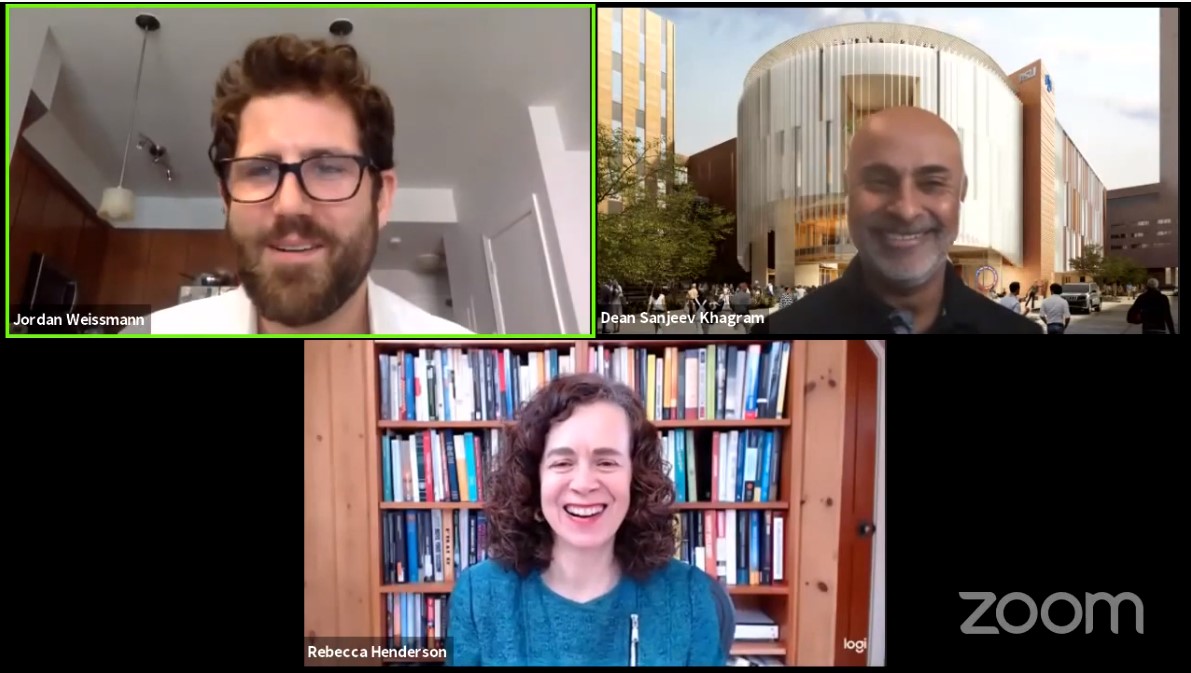
Left to right, top to bottom: Jordan Weissman, Slate senior business and economics correspondent, Sanjeev Khagram, dean of ASU’s Thunderbird School of Global Management, and Rebecca Henderson, dean of Harvard Business School.
Khagram agreed, and mentioned that this will be an opportunity for corporations to be a part of major changes, would be a wasted opportunity to fundamentally change many aspects of our society — including the role of business.
The pandemic is also likely to affect how business schools educate the next generation of executives-in-training. The Thunderbird School is ahead of the curve, as recent curriculum changes have focused on preparing students think from a global perspective and think differently and innovatively about how businesses interact with society.
“Thunderbird has already fundamentally changed its curriculum to equip students for an everchanging future,” he said. “I think this pandemic has only accelerated that goal and emphasized the need for the kind of education we’re providing.”
More Business and entrepreneurship

New rankings show impact of ASU W. P. Carey School of Business
Good rankings for Arizona State University's W. P. Carey School of Business reinforces the school's commitments to access, excellence and innovation.This week, the Financial Times Business Education…

Arizona Business and Health Summit asks attendees to innovate for value
Arizona State University's W. P. Carey School of Business hosted the third annual Arizona Business and Health Summit, sponsored by the Arizona Biomedical Research Centre, on Thursday, Nov. 14, in…

An economic forecast with lots of variables
The prospect of a new presidential administration is prompting some discussions among top economists.Tariffs, immigration, possible deportation, tax cuts and reduced renewable energy credits are top…