ASU psychology student works to destigmatize mental health for Arab Americans
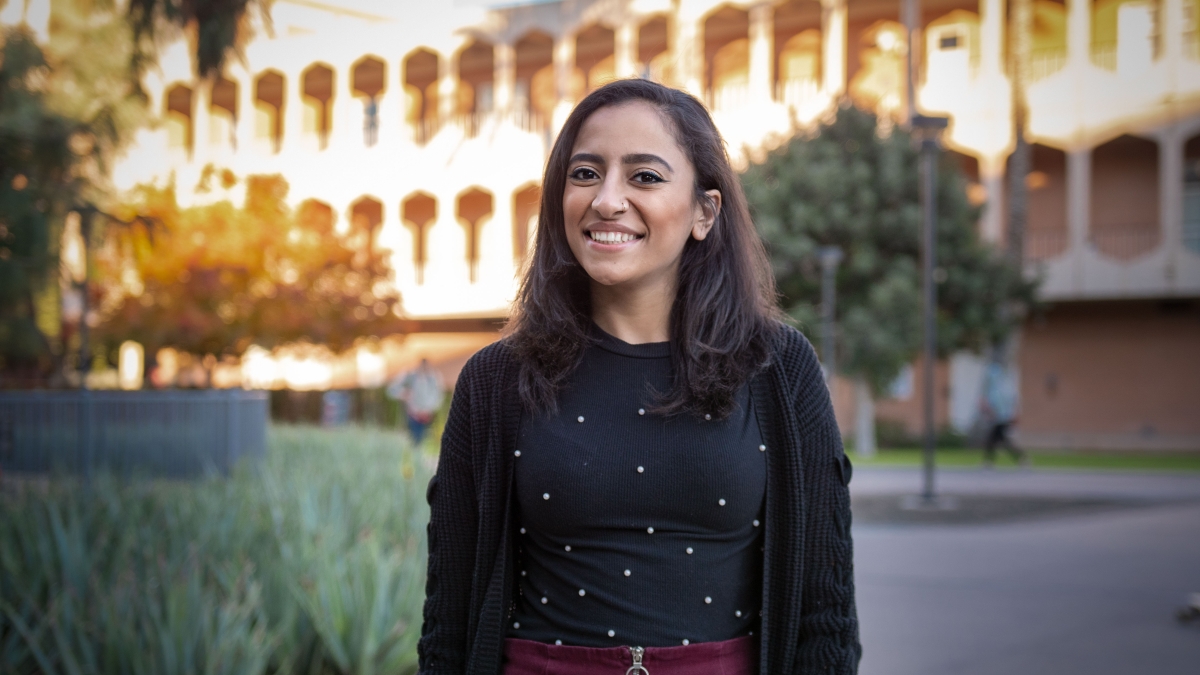
Myrna Abdel-Aziz, a recent graduate of the Arizona State University Department of Psychology.
The approximately 4 million Arab Americans living in the United States are rarely included in psychological research. This low inclusion rate can be explained in part because most participants in psychology studies are WEIRD (Western, educated and from industrialized, rich and democratic countries), but the stigma associated with mental health in Arab communities is also a major contributing factor.
Myrna Abdel-Aziz, a recent graduate of the Arizona State University Department of Psychology, knows firsthand how difficult talking about mental health can be.
“I grew up in an Egyptian-Muslim household, and we didn’t talk about mental health at all. It became really prominent when my mom thought she was having a heart attack, but it was really anxiety. It was at that point that I knew needed to help people recognize these symptoms and to provide coping resources,” Abdel-Aziz said.
When Abdel-Aziz first told her family she wanted to study psychology, they were skeptical. But after her mom suffered the anxiety attack, they began to understand.
“There really isn’t much mental health research on the Middle Eastern population, and culture is one of the main reasons why,” she said. “You don’t talk about mental health, you hide it away. Destigmatizing mental health would be extremely beneficial for so many kids.”
In addition to the stigma of mental health, Arab American youth are also figuring out how they fit in American culture. This process is challenging socially and psychologically, and many Arab American youth experience depression and generalized anxiety.
Abdel-Aziz works in the @Heart Lab with Thao Ha, assistant professor of psychology, and in the Couples Coping with Stress Lab with Ashley Randall, associate professor in the College of Integrative Sciences and Arts. In both labs, Abdel-Aziz helps with data analysis by watching videos of experiments and classifying how the participants interact with each other.
She also helps provide behavioral health, autism or developmental services to Arizona families at SEEK Arizona, which was named the 2019 Sun Devil 100 Honoree for leadership, innovation and growth.
In addition to her research with the @Heart Lab and the Couples Coping with Stress Lab, Abdel-Aziz served as a student mentor with the Psychology Advising Leader program. She also worked as a student facilitator and teaching assistant in the Psychology Pathways course. She said her passion is to help other students succeed, and she believes that helping others will help her establish a career in teaching.
Abdel-Aziz’s immediate goal is to help diverse minority groups. She plans to complete a master’s degree in mental health counseling and a doctorate in counseling.
More Science and technology
Indigenous geneticists build unprecedented research community at ASU
When Krystal Tsosie (Diné) was an undergraduate at Arizona State University, there were no Indigenous faculty she could look to…

Pioneering professor of cultural evolution pens essays for leading academic journals
When Robert Boyd wrote his 1985 book “Culture and the Evolutionary Process,” cultural evolution was not considered a true…

Lucy's lasting legacy: Donald Johanson reflects on the discovery of a lifetime
Fifty years ago, in the dusty hills of Hadar, Ethiopia, a young paleoanthropologist, Donald Johanson, discovered what would…