A moment that mattered: How an ASU alumna came to donate to psychology research

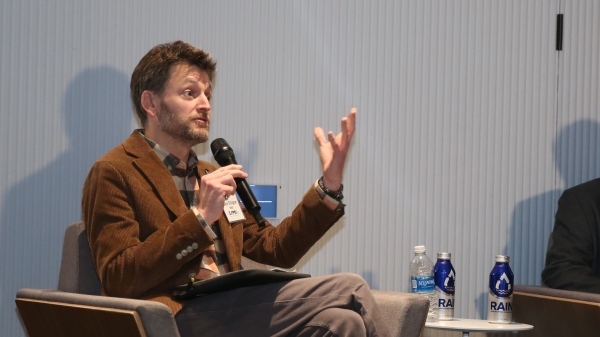
When Arizona State University alumna Lynn Robinson had the chance to give back to her alma mater, her first thought was William Fabricius and the ASU Department of Psychology. Photo by Charlie Leight/ASU News
When Arizona State University alumna Lynn Robinson had the chance to give back to her alma mater, her first thought was William Fabricius and the ASU Department of Psychology.
Robinson graduated from ASU over 20 years ago with a BA in psychology. She is now a senior manager at large consulting firm, where she specializes in digital human resources technology.
“It is not so much as I chose to donate to the Fabricius lab as it is about the impact he made on me during my undergraduate life,” Robinson said. “He first encouraged and supported me in getting past an academic struggle, and then he inspired me to conduct a research project. In my world, we call this a ‘moment that matters.’”
While at ASU, Robinson took a developmental psychology class with Fabricius, who is an associate professor of psychology. She recalled one time when she was struggling in the class, so she met with him to ask for help.
A meeting like this is routine for a professor but can have a lasting impact on a student. And the meeting with Fabricius stuck with Robinson. Because he supported her when she was a student in that class, she sought him out when she was a senior, and they worked together on a research project about how young children classify objects.
“I wanted to make sure my donation went to someone or something that mattered,” Robinson said. “It had to go back to Dr. Fabricius.”
Robinson has been donating to the Fabricius lab for seven years, and her employer matches her donation.
“One of the great joys of being a professor is having a positive effect on the lives of our students,” said Steven Neuberg, chair of the Department of Psychology. “To have a former student reach out so many years later, seeking a way to demonstrate her appreciation, is incredible. I commend Dr. Fabricius for his committed efforts, and Ms. Robinson for paying those efforts forward with her gifts.”
Since Robinson was a student at ASU, the focus of the Fabricius lab has expanded from studying how young children think and understand the world to also examining the effects of divorce and parenting on children.
“Much of my work is embedded research that involves the community, which is important because science needs to go beyond just publishing in a journal,” Fabricius said. “The donations from Lynn have enabled me to deliver the research to people who make decisions every day about divorce and the separation of families and kids. I am able to go to conferences and places where I can talk to judges, lawyers and policy makers.”
Fabricius recently used the funds to disseminate his research on the perceptions of Arizona’s child custody law. The law was revised in 2013 based on developmental psychology findings to prioritize equal parenting time when in the best interest of the child. Fabricius collaborated with a family court judge, conciliation court staff director, family law lawyer and a mental health professional who works with families during divorce. Together, they evaluated the perceptions of Arizona’s child custody law among family law professionals and citizens. The donated funds allowed Fabricius and his coauthors to present their work at the 2017 annual meeting for the Association of Family and Conciliation Courts.
Robinson said she plans to continue donating because of the impact Fabricius had on her in college and because she believes in the work he is doing.
“I know Dr. Fabricius was instrumental in changing the course of default custodial laws in Arizona, and this work is very important,” Robinson said. “Even today, we see in media and books an assumption or emphasis on the mother’s role in a child’s life, but the father’s role is equally important.”
More Science and technology

Cracking the code of online computer science clubs
Experts believe that involvement in college clubs and organizations increases student retention and helps learners build valuable…
Consortium for Science, Policy & Outcomes celebrates 25 years
For Arizona State University's Consortium for Science, Policy & Outcomes (CSPO), recognizing the past is just as important as…

Hacking satellites to fix our oceans and shoot for the stars
By Preesha KumarFrom memory foam mattresses to the camera and GPS navigation on our phones, technology that was developed for…