
Images of Mars taken by a visual and infrared camera designed at Arizona State University take a star turn in the new hit movie “The Martian.”
Last November, the film production company for "The Martian" approached ASU's School of Earth and Space Exploration about using THEMIS — Thermal Emission Imaging System — imagery in the movie.
“We gave it, of course, and ASU is duly credited in the crawl — way, way at the end, just before the copyright notice,” said Robert Burnham, manager of media relations for the school. “I'm really glad to see our imagery on screen. And while the movie does skate lightly over some brutal realities of Martian climate and conditions, it's a good story well-told.”
THEMIS passed 60,000 orbits of the Red Planet this past summer. It is carried on NASA's Mars Odyssey orbiter, the longest-operating spacecraft from any nation at Mars. Since arriving there, the ASU camera has taken nearly 400,000 images.
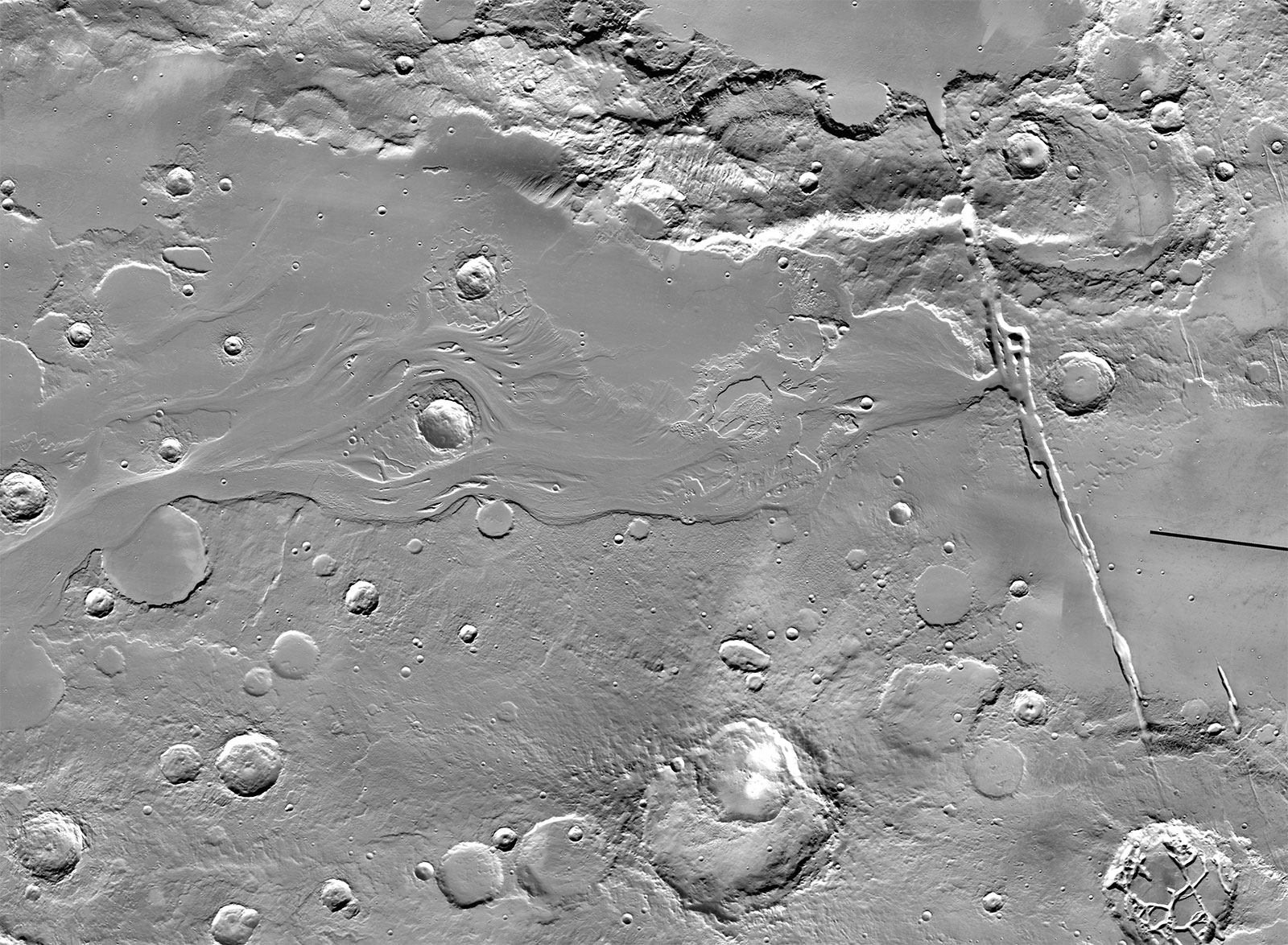
The new movie "The Martian" uses several images of Mars taken by a camera designed at Arizona State University. This one is used in the film by the director of Mars operations, when he draws on the image to measure with a ruler to figure out where stranded astronaut Mark Watney is going.
The camera — which operates in five visual and nine infrared (heat-sensitive) "colors" — was designed by ASU professor Philip Christensen, the instrument's principal investigator.
The movie production gave no hint of which images they would choose, Burnham said.
“We were a cheap ‘get’ for the film company because THEMIS images, like all NASA images, are public domain, being taxpayer-funded,” he said. “So it seemed likely to me they would use at least a couple. … I sent them the links to all of our ‘best of THEMIS’ collections and told them to take a look and to download whatever else might be usable.”
THEMIS images and mosaics appear briefly in a few scenes.
“I spotted one or two images framed and hung on the wall of the NASA director's office,” Burnham said. “One is a mosaic of either Tooting Crater or Bacolor Crater.”
Not in doubt, however, is a third THEMIS image that plays a role in the plot. It is shown when Vincent Kapoor (director of Mars operations) measures the photo with a ruler to figure out where stranded astronaut Mark Watney is going. (Answer: the old Mars Pathfinder landing site, to scavenge the spacecraft for parts.)
“The image he uses is actually the THEMIS mosaic of Mangala Fossae and Valles, a long way from the Ares Vallis outwash area that the real Pathfinder landed at,” Burnham said. “Oh well, this is Hollywood.”
The production crew did ask specifically about the Mangala Valles image, but said only that they were thinking of using it as set decoration for the NASA head official's office, Burnham said.
THEMIS has achieved a longer run of observations than any previous instrument at Mars, according to Christensen, Regents’ Professor of Geological Sciences.
NASA officials report Odyssey is in good shape and has enough propellant left on board to orbit the Red Planet for another decade.
More Science and technology

Innovation Showcase opens doors for students
This May, students, faculty members, industry professionals and community supporters gathered on Arizona State University’s Polytechnic campus for Innovation Showcase, a signature student event…

Nearly 50 years of AI at ASU
Story by Ellen ShengWhen Professor Subbarao Kambhampati started working in the field of artificial intelligence in 1983, his friends and colleagues felt sorry for him. People asked, “Why can’t…

Lunar launch
When Artemis II launched in April, sending astronauts around the moon for the first time in more than 50 years, the mission broke records — and will help scientists understand undiscovered secrets,…