ASU study finds weather extremes harmful to grasslands

Fluctuations in extreme weather events, such as heavy rains and droughts, are affecting ecosystems in unexpected ways — creating “winners and losers” among plant species that humans depend upon for food.
Arizona State University investigators conducted a six-year experiment on the effects of climatic variability on desert grassland. The study revealed that when unpredictable weather patterns create alternating wet and dry years, ecosystem productivity declines — mostly because grasses diminish, which allows shrubs to flourish.
“We found that not all species could respond effectively to extreme weather events including both dry and wet conditions,” said Osvaldo Sala, professor with ASU School of Life Sciences. “Grasses don’t fare as well as shrubs, which is really important to know because cattle ranchers depend on grasslands to graze their herds. Humans could see a reduction in the production of food — mostly cattle for meat — as the provision of ecosystem services like this one change.”
The findings were published today in the online early edition of the journal Proceedings of the National Academy of Sciences.
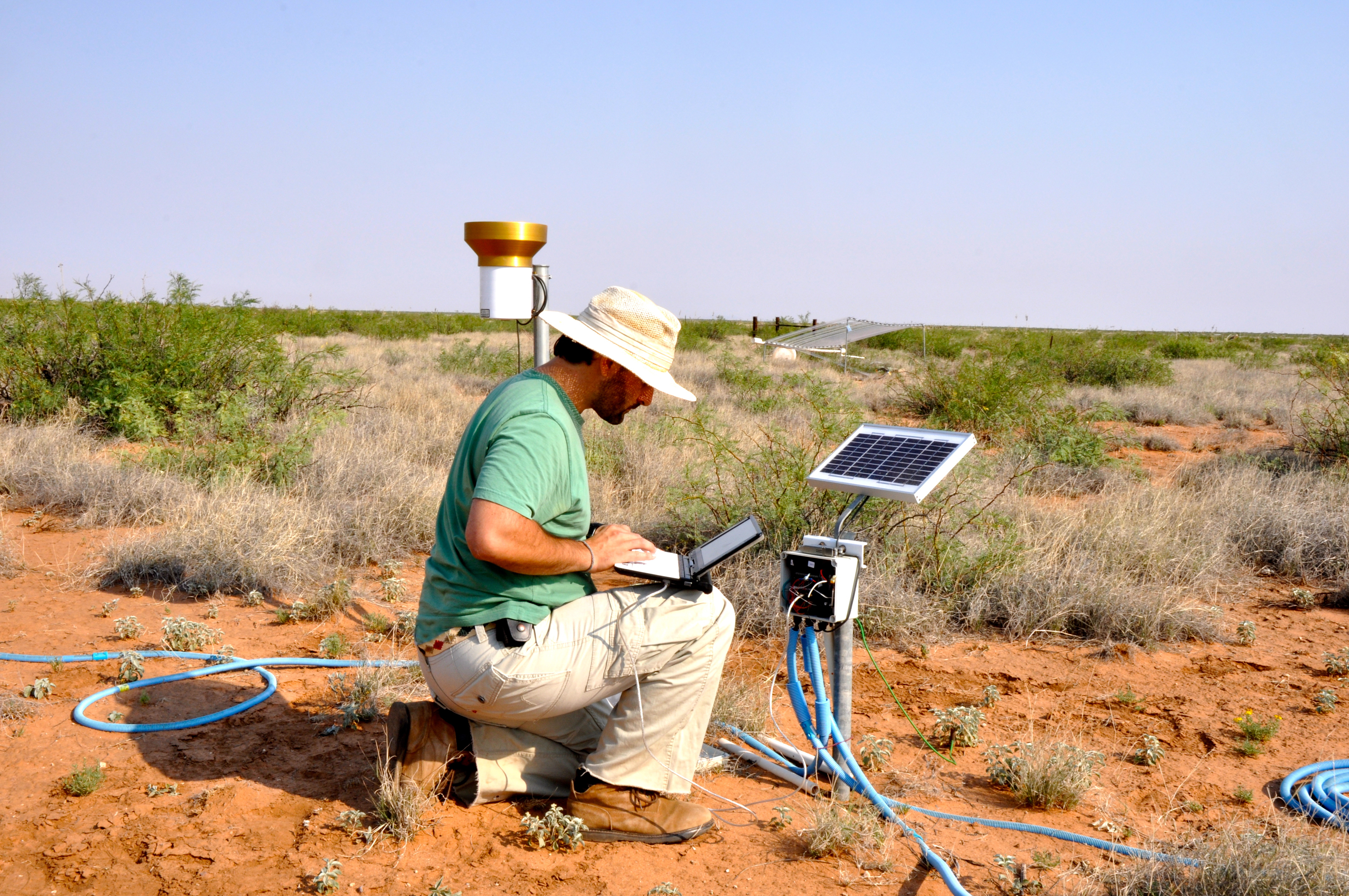
Laureano Gherardi, a School of Life Sciences postdoctoral research associate, takes measurements during a six-year study on grasslands and the effects of weather extremes.
“Interestingly, the effect of precipitation variability was amplified over the six years the experiment lasted, and we still don’t know its end point,” said Laureano Gherardi, a School of Life Sciences postdoctoral research associate and co-author of the paper. “Therefore, the effect of the expected climatic variance may be even larger and the ecosystem may shift into a different state,” he added.
The researchers created 50 study plots in the Chihuahuan desert in New Mexico, at the Jornada Long Term Ecological Research site. They increased precipitation variability on each plot to mimic the projected increase in the frequency of weather extremes such as drought and unusually wet conditions. Over a six-year period, the plots were alternately irrigated or subjected to dry conditions.
“Shrubs did rather well under these conditions because of their growing response to annual precipitation, but the grasses declined as a result of their limited response to wet years,” said Sala, also a distinguished sustainability scientist with the Julie Ann Wrigley Global Institute of Sustainability. “A desert grassland ecosystem could fairly quickly change into a different state, such as shrubland. This would have serious consequences for humans, considering that a large portion of land around the world is grassland.”
Sala added that some of the more dramatic changes to the grasslands did not occur until later in the study, proving how important long-term studies are, as well as the difficulty of making long-term predictions based on short-term experimentation.
This study was supported by National Science Foundation grants DEB-1235828 and DEB 09-17668.
The School of Life Sciences is an academic unit of the College of Liberal Arts and Sciences at ASU.